E-commerce order volume rarely grows in a straight line, and that unpredictability is exactly what makes fulfillment operations so hard to staff and plan around. Peak season spikes, flash sales, and shifting customer expectations around delivery speed all put pressure on a warehouse that was likely sized for a smaller, steadier business. E-commerce warehouse automation has become the most reliable way to absorb that volatility without adding headcount at the same rate as order volume grows.
MTLI Group works with e-commerce brands across the US and Canada on automation projects ranging from a single equipment upgrade to a full facility redesign, starting with conveyor installations and building out from there. This blog looks at the specific automation solutions that fit e-commerce fulfillment best, how to prioritize them, and what operations managers should evaluate before committing capital.
Why E-Commerce Warehouse Automation Looks Different Than General Warehousing
General warehousing and e-commerce fulfillment share some overlap, but the operational patterns differ enough that automation decisions need a different lens. E-commerce orders tend to be smaller, more numerous, and far less predictable in composition than the pallet-level orders typical of traditional distribution, which is why fulfillment automation systems built for one context often underperform in the other.
The scale of this shift is significant. U.S. retail e-commerce sales reached $326.7 billion in the first quarter of 2026, accounting for 16.9 percent of total retail sales and growing 9.8 percent year-over-year, more than twice the 3.9 percent growth rate for total retail overall. That gap between e-commerce growth and overall retail growth is exactly why e-commerce warehouse automation has become a priority rather than a nice-to-have brand trying to keep pace.
Core E-Commerce Warehouse Automation Solutions Worth Evaluating
Several categories of automation consistently deliver strong results for e-commerce fulfillment operations, though the right mix depends on order profile, SKU count, and facility size.
Automated storage and retrieval systems dramatically increase storage density while reducing the walking time pickers spend traveling to inventory locations. For e-commerce operations with a large SKU count and limited floor space, this is often the highest-impact category of e-commerce warehouse automation available, and reviewing typical ASRS costs early in the planning process helps set realistic budget expectations.
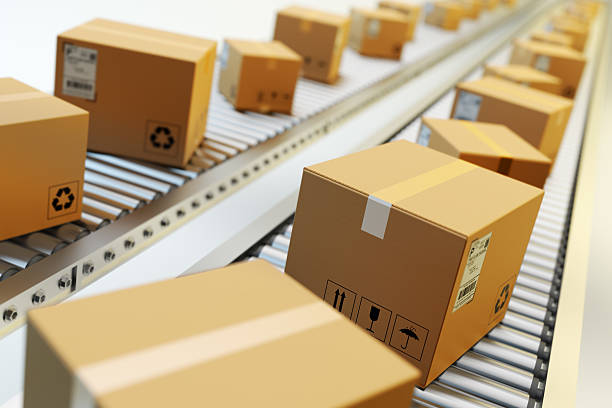
Conveyor and sortation systems move goods efficiently between zones and route packages to the correct outbound lane based on carrier, destination, or order type. E-commerce operations with high parcel volume see particularly strong returns here, since sortation errors are costly both in reshipment expense and customer trust.
Pick-to-light and put-to-light systems guide workers through multi-item orders with visual confirmation at each step, reducing errors in exactly the kind of complex, mixed-SKU orders common in e-commerce fulfillment.
The table below compares these core solutions across the factors that matter most to e-commerce operations managers.
| Automation Type | Best Fit | Typical Impact |
|---|---|---|
| Automated storage and retrieval | High SKU count, limited floor space | Increased storage density, reduced travel time |
| Goods-to-person picking | High order volume, small item sizes | Substantially higher picking rate per worker |
| Conveyor and sortation | High parcel volume, multiple carriers | Faster, more accurate outbound routing |
| Pick-to-light or put-to-light | Complex, multi-item orders | Reduced picking errors |
| Autonomous mobile robots | Seasonal or variable volume | Flexible capacity without fixed infrastructure |
Automated Picking: The Technology E-Commerce Operations Depend On Most
Picking accounts for a larger share of labor cost in e-commerce fulfillment than in almost any other warehouse function, which is why automated picking tends to deliver the fastest, most visible return within an e-commerce warehouse automation project.
Traditional walk-and-pick methods require workers to travel to each item’s storage location, a process that becomes less efficient as SKU count and order complexity increase. Goods-to-person picking systems, a common starting point for a warehouse robotics deployment, eliminate travel time entirely by bringing inventory to the worker rather than sending the worker to the shelf. Robotic picking arms, still maturing for irregular item shapes, handle a growing share of standardized SKUs in facilities that have adopted them. Voice and light-directed picking, while not fully automated, meaningfully reduce errors and search time even in facilities that are not ready for full automated picking adoption.
Facilities evaluating automated picking should weigh the order profile carefully. A facility fulfilling primarily single-item orders sees a different return than one handling complex, multi-item orders that require picking from several locations before a shipment is complete.
Fulfillment Automation Systems and Peak Season Planning
E-commerce brands face a unique challenge that many traditional warehouses do not: extreme seasonal volume swings that can multiply order volume several times over during a handful of weeks each year. Fulfillment automation systems need to accommodate this variability without sitting idle or underutilized during slower periods.
Labor markets add another layer of pressure to this plan. Warehousing and storage employment was 34.0 percent higher in June 2024 than it was in February 2020, a jump driven substantially by e-commerce order volume. Facilities competing for seasonal labor in that kind of tight market have a strong incentive to lean on fulfillment of automation systems rather than temporary hiring alone.
Modular and scalable automation approaches handle peak volume better than rigid, fixed-capacity systems. Reviewing the automation ROI case for a given technology, including how it performs during both peak and off-peak periods, clarifies whether a facility should invest in fixed infrastructure or a more flexible, incremental approach.
The table below outlines how different automation approaches handle peak season demand.
| Automation Approach | Peak Season Flexibility | Consideration |
|---|---|---|
| Fixed automated storage and retrieval | Limited, capacity set at installation | Best for stable, predictable growth |
| Autonomous mobile robot fleets | High, fleet size can expand temporarily | Requires available floor space for added units |
| Goods-to-person picking | Moderate, throughput scales with staffing | Reduces reliance on experienced pickers |
| Conveyor and sortation | Moderate, depends on original sizing | Should be sized with peak volume in mind from the start |
Evaluating E-Commerce Warehouse Automation Against Growth Projections
E-commerce brands often grow faster and less predictably than traditional retailers, which makes automation sizing decisions harder than they first appear. Underinvesting leaves a facility unable to keep pace with demand, while overinvesting ties capital in capacity that sits unused for years.
A useful starting point compares current order volume, and SKU count against realistic three-to-five-year growth projections, rather than sizing e-commerce warehouse automation purely around today’s operation. Brands exploring a full-scope approach often benefit from turnkey solutions that bundle design, installation, and commissioning into a single coordinated project, since piecing automation together vendor by vendor tends to slow down a fast-growing operation rather than support it.
Integration Considerations Specific to E-Commerce Operations
E-commerce warehouse automation depends heavily on integration with the order management and shipping software that drives daily operations. A pick-to-light system or automated storage system that cannot communicate in real time with the platform generating orders creates a bottleneck with no amount of mechanical automation can solve.
Carrier integration matters just as much. Sortation systems need to route packages correctly across multiple shipping carriers and service levels, a requirement that grows more complex as brands expand into new fulfillment channels or add same-day and next-day delivery options. Facilities planning a broader rollout benefit from reviewing how fulfillment automation projects account for software integration from the earliest planning stages rather than treating it as a separate project once the physical equipment is installed.
How MTLI Group Supports E-Commerce Warehouse Automation Projects
MTLI Group works with e-commerce brands across the US and Canada to design and install the automation solutions that fit fulfillment-specific operational patterns, including racking, conveyor and sortation infrastructure, and the electrical and controls work that ties automated equipment together.
With over 40 years of experience and more than 15,000 completed projects, MTLI Group helps operations managers evaluate which combination of automated racking and material handling technologies fits their specific order profile, SKU count, and growth trajectory, rather than defaulting to a generic automation package.
Choosing the Right E-Commerce Warehouse Automation Mix
E-commerce warehouse automation is not a single technology decision. The strongest fulfillment operations combine storage, picking, and sortation automation matched to their specific order profile, SKU count, and seasonal volume pattern, rather than adopting whichever solution is most heavily marketed. Automated picking tends to deliver the fastest, most visible return given how much labor cost concentrates in that function, while fulfillment automation systems built around storage and sortation pay off over a longer horizon as SKU count and parcel volume grow. Reviewing high throughput warehouse systems alongside your picking and storage plans rounds out a complete e-commerce warehouse automation strategy.
MTLI Group helps e-commerce operations teams evaluate and implement the right automation mix for their facility. Contact MTLI Group to discuss automation options tailored to your fulfillment operation.