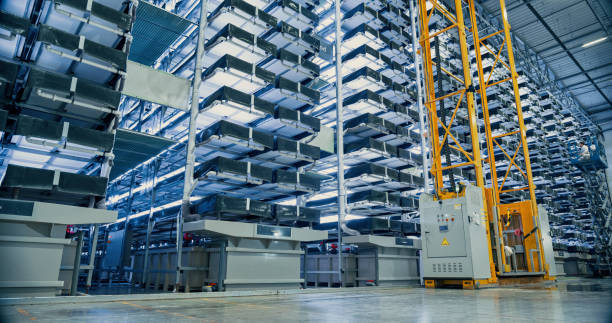
Manufacturing companies are under constant pressure to produce more from the same footprint, with fewer workers and tighter accuracy requirements. That pressure is exactly what makes ASRS systems one of the most practical investments a manufacturing operation can make today.
An automated storage and retrieval system (ASRS) combines hardware and software to automatically store and retrieve inventory, raw materials, components, or finished goods; without requiring workers to walk aisles, manually locate items, or physically retrieve loads. The result is faster throughput, denser storage, fewer errors, and lower labor cost per unit handled.
MTLI Group has helped manufacturing companies across North America evaluate, install, and commission ASRS systems for over 40 years. This guide explains what ASRS systems are, how the different types work, what they cost, and how to build a realistic return on investment (ROI) case before committing capital.
What Is an ASRS System?
An ASRS system, or automated storage and retrieval system, is a computer-controlled combination of equipment and software that stores and retrieves loads from defined locations within a facility. According to MHI, the nation's largest material handling, logistics, and supply chain industry association, AS/RS systems handle, store, and retrieve materials with precision, accuracy, and speed under a defined level of automation.
Systems range from smaller units serving individual workstations to large computer-controlled installations fully integrated into a manufacturing process. All ASRS systems share three core features: computer-managed inventory, machine-based storage and retrieval, and the removal of the need for workers to physically travel to and from storage locations.
In a manufacturing context, ASRS systems store raw materials and parts in buffer zones near production lines and restock them automatically as they are used. They hold work-in-process inventory between production stages, manage finished goods before distribution, and keep tooling and specialized equipment accessible on demand without using dedicated floor space.
Types of ASRS Systems Used in Manufacturing
ASRS is not one product; it is a category covering several system types, each suited to different load sizes, throughput needs, and facility layouts.
Unit Load AS/RS
Large-scale systems that use automated cranes inside narrow-aisle rack structures to store and retrieve full pallets or large containers. These are common in manufacturing operations that handle heavy raw material staging and finished goods storage, and they work well in high-bay buildings.
Mini Load AS/RS
These systems handle smaller containers, totes, and cartons using automated cranes inside enclosed rack structures. They are widely used in manufacturing operations that need frequent, accurate access to parts, small assemblies, or kitting materials.
Vertical Lift Modules (VLMs)
A VLM is a self-contained unit with a vertical column of storage trays and an internal extractor that brings the correct tray to a fixed access point at a comfortable working height. They are well suited to operations where workers need quick access to a large number of small parts. VLMs use far less floor space than standard shelving and remove the time workers spend searching for items.
Horizontal Carousels
A series of bins or shelves that rotate horizontally on a track, bringing the required position to the operator. These work well in kitting and assembly support applications where fast picks and operator efficiency are the main priorities.
Shuttle Systems
Autonomous shuttle vehicles that move horizontally and vertically inside deep rack structures to store and retrieve loads. Shuttle systems process items faster than crane-based systems, offer more layout flexibility, and support multi-depth storage that increases density further.
The Core Benefits of ASRS for Manufacturing Companies
Manufacturing operations that evaluate ASRS systems carefully find that the benefits show up across several areas at once.
Space Reduction Without Losing Capacity
ASRS systems store loads vertically inside engineered rack structures, using building height that standard shelving cannot effectively reach. They can reduce the floor area needed for the same number of storage positions by up to 40% compared to conventional racking. In manufacturing plants where production floor space is limited, recovering that footprint creates room for equipment, staging areas, or quality control functions.
Lower Labor Costs
Manual storage and retrieval requires workers to walk aisles, find items, confirm picks, and move loads, steps that use labor hours without adding direct value to the product. ASRS systems automate the full cycle, allowing manufacturers to move workers to higher-value tasks. ASRS systems can reduce picking labor requirements by up to 66%, according to leading system provider data.
Accurate Inventory at the Part Level
ASRS systems record every storage and retrieval transaction automatically, keeping inventory counts current at the bin or tray level. Production planners get reliable data for scheduling, physical counts that disrupt operations are no longer necessary, and just-in-time (JIT) replenishment models that lower carrying costs become practical.
Safer Working Conditions
Retrieving items from high racks manually involves climbing, bending, and lifting; all common sources of injury. ASRS systems bring loads to a fixed, ergonomic access point, removing those physical risks entirely. According to the U.S. Bureau of Labor Statistics, the manufacturing sector recorded a total recordable case (TRC) injury rate of 4.0 per 100 full-time equivalent (FTE) workers in 2024, compared to 2.6 across all private industries. Removing manual storage tasks directly reduces exposure to several of the most common injury causes in that figure.
ASRS System Costs: What to Expect
ASRS systems are capital-intensive investments. Manufacturing companies need clear expectations across all cost categories before committing.
Equipment Costs
Costs vary widely by system type, size, and throughput requirements. Smaller VLM or horizontal carousel installations can start between $150,000 and $500,000 per unit. Mid-scale mini load or shuttle systems typically range from $1 million to $5 million. Large unit load AS/RS installations with high-bay crane systems can run from $5 million to $20 million or more, depending on height, aisle count, and throughput needs.
Installation and Integration Costs
Installation covers structural preparation, electrical work, software integration with the existing manufacturing execution system (MES) or ERP platform, and commissioning. These costs typically add 20 to 30% to the equipment cost, depending on the facility and integration complexity.
Ongoing Maintenance
Annual maintenance typically runs 1 to 3% of the original equipment cost, covering scheduled preventive maintenance, software updates, spare parts, and technical support. Including maintenance in the total cost of ownership model is essential for an accurate ROI projection.
How to Build the ROI Case
The return on investment for ASRS systems in manufacturing comes from measurable savings in three main areas.
Labor Savings
Calculate the full cost of workers who currently handle storage and retrieval including wages, benefits, supervision, training, and turnover. Then model the headcount reduction or redeployment that the ASRS makes possible. This is typically the largest single contributor to ROI.
Space Value
Determine what the floor space freed by higher-density ASRS storage is worth. In manufacturing environments where adding production capacity would otherwise mean building expansion, the cost avoided by freeing that space through ASRS can be substantial.
Inventory and Accuracy Savings
Estimate the current cost of inventory inaccuracies like scrap, expediting, production line downtime, and excess safety stock. ASRS-driven accuracy improvements reduce all of these consistently.
The global ASRS market was valued at $9.86 billion in 2025 and is projected to reach $14.80 billion by 2030, according to MarketsandMarkets, a compound annual growth rate (CAGR) of 8.5% that reflects consistent industry confidence in the returns these systems generate. Most manufacturing ASRS projects reach full payback within three to five years, with labor savings driving most of the return in the early years and space and accuracy benefits adding to it over time.
How MTLI Group Supports ASRS Projects for Manufacturers
Selecting, installing, and commissioning an ASRS system that performs as planned requires expertise across equipment selection, facility design, structural preparation, software integration, and project management. That is the full scope MTLI Group covers on every project.
With over 40 years of experience and more than 15,000 completed projects across the US and Canada, MTLI Group delivers ASRS installations as part of fully coordinated warehouse automation solutions that bring together equipment, construction, and systems integration under one project team. Their manufacturing experience means they understand how ASRS systems must connect with production scheduling, MES platforms, and material flow requirements specific to each facility.
Review MTLI Group's completed projects to see ASRS and automation installations across manufacturing and distribution environments. Then contact the team to discuss your storage challenges, throughput goals, and budget.
Final Thoughts
ASRS systems deliver returns across multiple areas at once like less floor space needed, lower labor costs, more accurate inventory, and safer working conditions. That combination makes them one of the most practical infrastructure investments a manufacturing company can make.
The sustained growth of the global ASRS market reflects consistent industry confidence that these systems deliver on their promise in real manufacturing environments. Companies that move forward now build the capacity to handle more production volume, manage rising labor costs, and work within tighter space constraints.
MTLI Group delivers the engineering expertise, project management, and manufacturing industry knowledge to help your ASRS investment perform as planned. Reach out today to start the conversation.