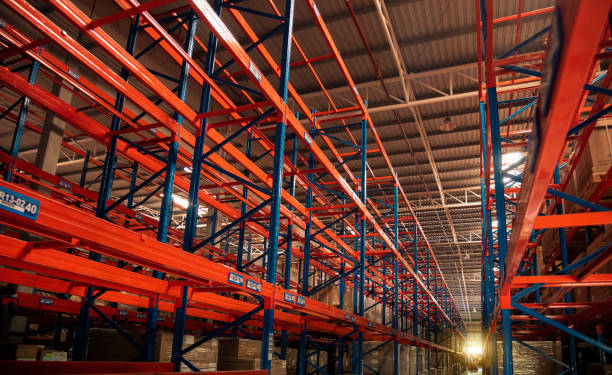
Two operations managers can face the exact same storage problem and land on completely opposite solutions. One invests in an automated retrieval system. The other buys used warehouse racking at a fraction of the cost and put the savings toward payroll. Neither is wrong on its face. The right call depends on what "long-term" actually means for that specific operation, and how much that meaning might shift over the next three to five years.
This guide breaks down what each approach actually involves, what it costs over time, and how to figure out which one fits a given facility rather than which one sounds more impressive on paper. MTLI Group helps operations work through this decision by supplying and installing warehouse racking systems built around real throughput numbers, not guesswork.
Setting the Stage: Two Very Different Storage Strategies
Automated storage systems use robotics, software, and mechanical retrieval to move pallets without a forklift operator involved in every cycle. Used racking is the opposite end of the spectrum: standard steel structure, previously owned, purchased at a discount and installed the same way new racking would be.
These aren't really competing in versions of the same product. One is a capital-intensive technology investment that changes how a facility operates day to day. The other is a lower-cost way to add conventional storage capacity fast, without changing anything about how staff actually pick and move product. Comparing them only makes sense once you know what problem you're actually solving, whether that's throughput, labor cost, or simply getting more pallets under one roof without breaking the budget.
It's also worth noting that these two paths aren't always mutually exclusive. Some of the most cost-effective layouts use automation only in the highest-turnover zones, while relying on used warehouse racking for slower-moving overflow storage elsewhere in the same building.
What Goes into an Automated Storage Setup
An automated system typically pairs high-density racking with a retrieval mechanism, whether that's a shuttle, crane, or robotic unit, all coordinated through warehouse management software. The racking itself often needs to be engineered specifically for the equipment running through it, which is why most automated projects start with high-density storage design rather than a standard layout.
The appeal is speed and consistency. Automated retrieval doesn't slow down at the end of a shift, doesn't take a lunch break, and doesn't make picking errors from fatigue. Order accuracy tends to climb once a facility removes manual picking from the equation entirely, since the system pulls exactly what the software tells it to pull, every time.
That consistency comes at a price, though, both in upfront capital and in the specialized maintenance the equipment requires once it's running. Automated systems need trained technicians on staff or on call, software licensing, and a maintenance schedule that a standard racking system simply doesn't require. Facilities considering this route usually pair it with our warehouse automation division early in the design process, since racking and retrieval equipment have to be engineered together, not bolted together after the fact.
What You're Actually Buying with Used Warehouse Racking
Used warehouse racking is, at its core, standard pallet racking that already had a life somewhere else. Frames, beams, and decking get pulled from a closed facility or a company upgrading its layout, inspected, and resold. There's no software, no motors, no retrieval logic. Just steel doing what steel does, the same job it did for its previous owner.
The savings show up immediately. Used pallet racking systems commonly sell for 30 to 50 percent less than the same components new, and availability is often faster since there's no manufacturing lead time involved. For an operation that needs storage capacity in weeks rather than months, that lead time difference alone can be the deciding factor.
The tradeoff is that used warehouse racking still relies entirely on manual or semi-automated material handling to move product, which means labor costs stay in the picture long-term in a way they don't with an automated system. As order volume grows, that labor cost grows roughly in proportion, whereas an automated system of labor cost stays comparatively flat. Getting used racking installed correctly still matters just as much as with new equipment, which is why racking installation should always include a structural inspection before anything goes live, regardless of how good a deal the racking seemed at the time of purchase.
Matching the Right Approach to Different Operations
Neither option is universally "better." The right fit depends on SKU count, labor availability, and how much capital is available for the project right now versus what might be available later.
| Operation Profile | Better Fit | Why |
|---|---|---|
| High SKU count, tight labor market | Automated | Reduces dependence on manual picking labor |
| Bulk storage, few SKUs, tight budget | Used Racking | Lower cost, faster to deploy |
| Rapid growth, uncertain future layout | Used Racking | Easier and cheaper to reconfigure or expand |
| Stable, high-volume distribution | Automated | Consistent throughput justifies the investment |
Operations still working out which racking configuration fits their SKU mix often start with a broader overview, like our guide to pallet racking types, before deciding whether automation makes sense at all. Jumping straight to an automation vendor without that groundwork tends to produce a system sized for the wrong problem.
This decision shows constantly in manufacturing facilities, where production zones and finished goods storage frequently need entirely different racking strategies within the same building. A production line feeding directly into packaging may benefit from automated buffer storage, while raw material storage nearby runs fine on standard used warehouse racking.
The Numbers Behind This Decision
The case for either path depends partly on where the broader market sits right now. Online sales in the United States reached $1,233.7 billion for 2025, up 5.4 percent from 2024, and now make up 16.4 percent of total retail sales. That kind of sustained volume growth is exactly what pushes fulfillment-heavy operations toward automation, since manual picking struggles to scale linearly with order volume the way automated retrieval can, particularly during peak shopping periods when order counts spike well above the yearly average.
At the same time, broader industrial capacity tells a different story. Manufacturing capacity utilization sat at 75.7 percent in June 2026, a rate of 2.5 percentage points below its long-run historical average, suggesting a fair amount of underused capacity still exists across the US industry. For operations running below full output, a large automation investment may be harder to justify than simply adding used warehouse racking to expand storage while demand catches up to available capacity.
This split shows clearly across warehousing and distribution facilities, where growth trajectory matters just as much as current volume when choosing a storage strategy. A facility growing steadily quarter for quarters tells a very different story than one riding a temporary spike in demand that may not hold.
Running the Long-Term Math
Automated systems cost significantly more upfront, often several times what a comparable used warehouse racking installation runs, but they reduce ongoing labor costs and typically increase pick accuracy. Used racking costs less to install but keeps labor as a fixed, ongoing expense that scales with order volume rather than shrinking over time as volume grows.
| Factor | Automated Storage | Used Racking |
|---|---|---|
| Upfront Cost | High | Low |
| Ongoing Labor Dependency | Low | High |
| Installation Timeline | Longer, custom engineering | Shorter, often available quickly |
| Scalability | Requires planned capacity | Can add sections incrementally |
| Best Payback Scenario | High, consistent order volume | Variable or seasonal demand |
Facilities that combine structural racking with automation infrastructure often find structural racking offers a middle path, since it supports both mezzanine-level storage and future automation retrofits without needing to rebuild the frame later. That approach lets an operation start with a lower-cost used or standard racking setup now, while leaving the door open to add automated retrieval once volume justifies it.
Companies serving 3PL and logistics clients frequently choose this flexible route, since client contracts can shift volume unpredictably, and a rigid, fully automated system doesn't always flex with that kind of demand swing. Losing or gaining a major client can change required capacity by a significant margin almost overnight; something used racking can absorb far more easily than a fixed automated installation.
Where Operations Get This Decision Wrong
The most common mistake is choosing automation based on future ambitions rather than current order volume. Automated systems justify their cost through consistent, high-frequency use, and an underutilized system sits there generating depreciation without generating the labor savings it was bought to deliver. Sizing an automation project for the volume a business hopes to reach in three years, rather than the volume it's actually processed today, is one of the most expensive planning errors in this space.
The opposite mistake happens with used warehouse racking too. Operations sometimes buy used components without confirming permit and code compliance for their specific building, only to discover the layout doesn't pass inspection once installation is underway. Every racking project, automated or not, needs proper engineering and permits work completed before installation begins, not after. Skipping that step or hiring a contractor unfamiliar with local code requirements during a broader construction project, is one of the most expensive and avoidable errors in this entire decision, often costing more to fix after the fact than it would have cost to do correctly the first time.
MTLI Group's Role in Either Direction
MTLI Group doesn't push clients toward the more expensive option by default. Our team evaluates order volume, SKU count, labor market conditions, and budget before recommending a direction, and we're equally set up to deliver either one, or a combination of both within the same facility. For operations adding a second level of usable space alongside their racking decision, our mezzanines and platforms team designs that expansion to work with whichever racking strategy makes sense for the space below it.
For businesses relocating or consolidating facilities, we also handle relocation services, moving and reinstalling racking, whether new, used, or automated, as part of the same project rather than a separate contract handled by a different vendor entirely.
Choose the Right Path with MTLI's Used Racking Experts
There's no universal answer to automated versus used racking. The right choice comes down to order volume, labor availability, and how much capital an operation can commit today versus over the next several years. Getting an honest assessment before signing a contract saves real money either way and often reveals that the right answer isn't purely one option or the other.
MTLI Group works with operations across the country to evaluate both paths and deliver whichever fits, including used racking sourced and inspected to the same standard as new. Contact our team to talk through your facility's storage strategy.