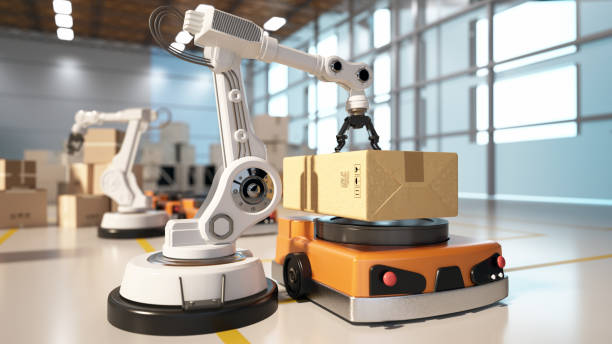
Manufacturing facilities carry a different set of automation demands than a typical distribution warehouse. Raw materials, work-in-process inventory, and finished goods all move through the same building on different schedules, often feeding directly into a production line that cannot afford to wait on a late delivery. Manufacturing warehouse automation has to account for that complexity, not just replicating what works in a retail fulfillment center.
MTLI Group works with manufacturers across the US to design and install automation that fits factory floor realities, and a Robotics installation company with that kind of manufacturing-specific experience makes a measurable difference in how smoothly a project integrates with existing production. This blog looks at the automation solutions manufacturing facilities rely on most, how they differ from general warehouse automation, and what operations managers should evaluate before committing to a project.
Why Manufacturing Warehouse Automation Requires a Different Approach
General warehousing optimizes order fulfillment speed and storage density. Manufacturing warehouse automation has to balance those same goals against production schedules, quality control requirements, and the physical realities of moving raw materials and components to exactly the right point on a line at exactly the right time.
The labor context behind this shift is significant. Manufacturing employed over 12.8 million workers in 2024, and the Bureau of Labor Statistics projects nearly 1 million openings in production occupations each year through 2034, even as overall manufacturing employment stays largely flat. Notably, industrial machinery mechanics are projected to add more jobs than any other manufacturing occupation over that decade, a trend BLS attributes directly to the continued adoption of automated manufacturing machinery that needs skilled workers to keep it running.
Capital investment trends confirm manufacturers are leading this shift. The manufacturing sector was the largest investor in robotic equipment in 2022, spending $7.289 billion and accounting for 56.2 percent of all robotic equipment expenditures nationwide that year, according to the U.S. Census Bureau. No other sector comes close to that share, which underscores how central automation has become modern manufacturing operations specifically.
Core Material Handling Systems for Manufacturing Facilities
Material handling systems in a manufacturing environment need to support continuous, often just-in-time delivery of components and materials rather than the batch-oriented picking common in general distribution.
Conveyor systems remain the backbone of most manufacturing material flow, moving components between production stages, staging areas, and finished goods storage. Unlike distribution-focused conveyors optimized purely for parcel sortation, manufacturing conveyor systems often integrate directly with production equipment, requiring tighter synchronization between line speed and material delivery timing.
Automated guided vehicles handle repetitive, point-to-point material transport between fixed locations, such as moving raw materials from receiving to a specific production cell on a consistent, predictable route. Facilities with stable production layouts see strong results here, since the fixed guidance infrastructure works well when the route rarely changes.
Automated storage and retrieval systems support high-mix manufacturing environments where a large number of component SKUs need to be stored densely and retrieved quickly to feed production without creating a bottleneck at the line.
Overhead and gantry systems move heavier materials or finished products that would be impractical to handle floor-level conveyors or vehicles, a common requirement in heavy manufacturing environments.
The table below compares these material handling systems across the factors most relevant to manufacturing operations.
| Material Handling System | Best Fit | Key Consideration |
|---|---|---|
| Conveyor systems | Continuous flow between production stages | Requires synchronization with line speed |
| Automated guided vehicles | Fixed, repetitive point-to-point routes | Best for stable, unchanging layouts |
| Automated storage and retrieval | High-mix component storage | Reduces search and retrieval time for production feeds |
| Overhead and gantry systems | Heavy or oversized materials | Requires structural assessment of building capacity |
Factory Automation Logistics: Connecting the Warehouse to the Production Line
Factory automation logistics covers the handoff between storage and production, an area that general warehouse automation planning often overlooks since it does not exist in the same form outside manufacturing.
Kitting and sequencing systems prepare components in the exact order and grouping a production line in need, reducing the manual sorting work that otherwise happens at the point of use. This becomes increasingly valuable as product customization increases, and lines need to switch between configurations more frequently.
Just-in-time delivery systems synchronize material replenishment with actual production consumption rather than maintaining large buffer stock at each workstation, freeing up floor space while reducing the risk of excess inventory tying up capital.
Integration between the warehouse management system and the manufacturing execution system ties this all together, ensuring that inventory data, production schedules, and material movement stay synchronized in real time rather than relying on separate, disconnected systems that require manual reconciliation.
Facilities planning this kind of integrated factory automation logistics approach benefit from involving an industrial electrical contractor early in the design process, since the controls and connectivity requirements for a fully synchronized system are considerably more complex than a standalone conveyor or storage installation.
Evaluating Manufacturing Warehouse Automation Against Production Constraints
Manufacturing facilities face constraints that general warehouses do not, and these need to be factored into any manufacturing warehouse automation plan from the start.
Production schedules rarely pause for installation to work the way a distribution center might shut down between shifts. Automation projects in an active manufacturing environment need careful sequencing to avoid disrupting output, often requiring phased implementation during scheduled maintenance windows or planned production downtime rather than a single continuous installation period.
Building structure and floor load capacity matter more in manufacturing than in many general warehouses, since heavy machinery, overhead systems, and dense material storage all place significant demands on the structure. An Industrial and Commercial Construction services assessment before committing an automation layout confirms whether the existing building can support the planned equipment without costly structural reinforcement discovered mid-project.
Quality and traceability requirements, particularly in regulated manufacturing sectors, add data and documentation demands that general warehouse automation systems may not be built to handle without additional customization.
The table below outlines key evaluation points specific to manufacturing warehouse automation projects.
| Evaluation Area | Manufacturing-Specific Consideration |
|---|---|
| Production continuity | Automation installation must work around active production schedules |
| Structural capacity | Heavy equipment and dense storage require floor load assessment |
| System integration | Warehouse management and manufacturing execution systems must sync |
| Traceability | Regulated industries need documentation beyond standard inventory tracking |
Choosing the Right Storage Approach for a Manufacturing Facility
Storage decisions in manufacturing warehouse automation differ from general distribution because inventory often includes raw materials, work-in-process components, and finished goods, each with different handling and access requirements.
Facilities storing a large volume of raw materials benefit from evaluating industrial racking systems designed for the specific load types involved, since bulk raw material storage often requires different rack configurations than the palletized finished goods typical of a distribution operation.
Work-in-process storage needs to balance accessibility against space efficiency, since components waiting for the next production step need to move quickly without creating congestion near active work cells. Finished goods storage, by contrast, can often prioritize density since retrieval timing is less time-critical than feeding an active production line.
Automation Maintenance in a Manufacturing Context
Automation reliability matters even more in manufacturing than in general warehousing, since a material handling failure can halt an entire production line rather than just delaying a shipment. A structured automated system maintenance program built around production-critical equipment reduces the risk of a maintenance issue cascading into a costly line stoppage.
Facilities should prioritize maintenance attention based on production impact rather than treating all automated equipment in the same way. A conveyor feeding a single, low-volume workstation carries far less risk than one feeding the primary production line, and maintenance schedules should reflect that difference in criticality.
Planning a Manufacturing Warehouse Automation Project
Manufacturers considering a larger automation investment should understand how much do ASRS systems cost relative to their specific component storage needs, since automated storage and retrieval investments in manufacturing settings often carry different cost drivers than a general distribution deployment given the higher SKU diversity and tighter integration requirements typical of production environments.
Facilities weighing a full facility change alongside automation planning sometimes need to consider plant relocation services if the current building cannot reasonably support the automation layout the operation requires, rather than forcing a compromised design into a structure that was never built for it.
How MTLI Group Supports Manufacturing Warehouse Automation Projects
MTLI Group works with manufacturers across the US to design and install automation systems that account for production continuity, structural requirements, and integration with existing manufacturing execution systems. Services span material handling installation, structural and electrical work, and ongoing maintenance support built around production-critical equipment.
With over 40 years of experience and more than 15,000 completed projects, an industrial construction company like MTLI Group brings the manufacturing-specific experience needed to plan an automation project that works with an active production environment rather than against it.
Building a Manufacturing Warehouse Automation Strategy That Fits Your Facility
Manufacturing warehouse automation is not a smaller version of general distribution automation. It requires accounting for production schedules, structural demands, and the tight integration between material storage and the production line itself. Facilities that plan around these manufacturing-specific realities, rather than adapting a generic warehouse automation template, see stronger, more reliable results once the system goes live.
MTLI Group helps manufacturing operations teams plan and execute manufacturing warehouse automation projects built around real production constraints. Contact MTLI Group to discuss automation options for your facility.