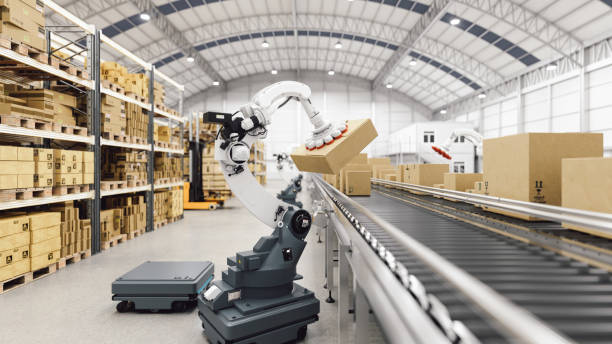
Distribution managers across North America are facing the same squeeze at once: fewer available workers, shrinking delivery windows, and customers who expect order status updates in real time. A smart warehouse addresses this by linking sensors, software, and equipment, so managers can see inventory levels, equipment health, and throughput as they happen instead of waiting for an end-of-shift report.
This article covers what a smart warehouse includes in practice, the numbers behind its growth across the region, and what to plan for before starting a project. MTLI Group builds and upgrades distribution facilities across the United States and Canada, including full automation retrofits, so the guidance here comes from projects our teams have actually delivered rather than a vendor pitch deck.
Defining the Connected Facility
A smart warehouse is not one piece of equipment bolted onto an existing operation. It is a set of connected systems, sensors, and software platforms that share data continuously, giving managers visibility without a physical walkthrough of every aisle. The term sits close to connected warehouse and IoT warehousing, since the Internet of Things (IoT) is the underlying technology letting shelves, vehicles, and machines report their own status back to a central platform. This level of connectivity also supports automated e-commerce fulfillment by keeping inventory, order processing, and warehouse operations synchronized in real time.
Three layers make this work. Sensing devices gather raw data on temperature, location, inventory counts, and equipment condition. A connectivity layer carries that data from the floor to the software. Then a warehouse management system (WMS) or similar platform converts the incoming data into decisions, such as flagging low stock or catching a motor drawing more power than usual before it fails.
Facilities running high-density racking or automated storage already generate much of the data a connected platform needs. The missing piece for most operators is not the equipment itself, but the layer that ties everything together into one usable view, enabling more accurate inventory management and automated e-commerce fulfillment as order volumes grow.
Smart Warehouse Technology Layers
| Layer | Function | Example Technology |
|---|---|---|
| Sensing | Collects raw data from the floor | RFID tags, temperature sensors, barcode scanners |
| Connectivity | Moves data to a central platform | Wi-Fi, private 5G, industrial Ethernet |
| Software | Turns data into decisions | Warehouse management system, digital twin platform |
| Action | Executes decisions in real time | Robotics, automated conveyor diverters, alerts |
The Numbers Driving the Shift
Interest in smart warehouse technology is not just a passing trend. It lines up with hard data on where labor and operating costs are headed for the industry. The U.S. Bureau of Labor Statistics projects warehousing and storage employment to grow 13.1 percent between 2022 and 2032, well ahead of the 2.8 percent growth expected across the broader economy. E-commerce expansion drives nearly all of that increase, which means more facilities competing for a labor pool that is not growing at the same pace.
Energy costs tell a similar story. The U.S. Energy Information Administration found that space heating makes up 39 percent of energy use in warehouse and storage buildings, with lighting adding another 15 percent, according to its most recent building energy survey. Together those two categories account for more than half of a typical facility's energy bill, and both respond well to automated sensors and controls without requiring any change in staffing.
Taken together, these figures explain why operations managers are moving on smart warehouse investments now instead of waiting for labor markets to loosen or energy prices to fall.
The Technology Stack Inside a Modern Facility
IoT warehousing runs on a handful of core technologies working in tandem rather than any single system. Knowing what each one does helps operations managers cut through vendor marketing and evaluate proposals on their merits.
Radio Frequency Identification (RFID) tags attach to pallets or individual units and transmit location data as they pass reader points. Unlike barcodes, RFID does not need a direct line of sight, which speeds up inventory counts and reduces miscounts.
Environmental sensors track temperature, humidity, and air quality throughout a facility. Cold storage and food grade operations depend on these most, but even standard ambient warehouses use them to catch HVAC problems early.
Digital twins build a virtual model of the physical facility that updates continuously as sensor data comes in. Teams use this model to test a layout change or spot a coming bottleneck before touching the actual floor.
Warehouse robotics, including automated guided vehicles (AGVs) and autonomous mobile robots (AMRs), move product between zones while reporting battery status, location, and task progress back to the central system. A separate resource on how robotics is reshaping floor work covers this equipment in more depth for teams researching a purchase.
Edge computing processes sensor data close to where it is generated instead of routing everything to a distant server first. This matters most for time sensitive tasks, like a conveyor diverter that has to react within milliseconds of a scan.
Technology and Operational Benefit
| Technology | What It Solves | Typical ROI Driver |
|---|---|---|
| RFID Tracking | Manual inventory counting errors | Faster cycle counts, fewer stockouts |
| Environmental Sensors | Undetected temperature or humidity drift | Reduced product loss, lower HVAC costs |
| Digital Twin Modeling | Costly trial and error layout changes | Faster, lower risk facility redesigns |
| Warehouse Robotics | Labor shortages in repetitive tasks | Higher throughput per labor hour |
| Edge Computing | Latency in automated equipment response | Fewer jams, faster diverter response |
Infrastructure Considerations Before You Connect Anything
None of the technology above functions well without a physical infrastructure layer that many operators overlook until problems show up. A connected warehouse needs reliable wireless coverage across the entire floor, including sections with tall steel racking that can block or weaken signals. Retrofitting an older building often means adding access points or installing private cellular coverage to reach every aisle consistently.
Power distribution is the next item team's underestimate. Sensors, charging stations for robotics, and edge computing hardware all draw power in spots that older buildings were never wired to support. Coordinating electrical work alongside the technology rollout, instead of adding it after equipment shows up, prevents the rework that drives project costs later.
Physical layout plays a role too. Storage density and mezzanine placement change where sensors and access points can go, and racking height affects signal strength more than most IT teams expect going in. Lining up racking and structural planning with network design from the outset keeps both systems working with each other rather than against each other.
How the Shift Looks Across the Region
A few patterns stand out across the United States and Canada right now. Nearshoring has pushed manufacturers to expand distribution capacity closer to the border, and many of these newer builds go smart from the first day of operation rather than getting retrofitted years later. Labor availability differs sharply by market, and facilities in the tightest labor regions are adopting robotics and sensor monitoring faster than those with a deeper local workforce to draw from.
Cold storage and food distribution operators are moving quickest on IoT warehousing, since compliance already demands dense sensor coverage, making a fully connected platform a smaller leap than it would be for a dry goods facility. Third-party logistics providers managing multiple client accounts face similar pressure, since clients now expect the kind of visibility a connected distribution operation provides as a standard feature rather than a paid upgrade.
MTLI Group's Role in Building Connected Facilities
MTLI Group helps operations teams plan smart warehouse projects that treat the building and the technology as one system, not two separate purchases. Our engineering group coordinates racking, power, and network infrastructure together instead of handling each in isolation, which avoids the gaps that show up when sensors get added to a building that was never wired to support them. We also provide preventive maintenance support once a connected facility goes live, since sensor networks and automated equipment need the same ongoing attention as any other building system. Whether your project is a retrofit or a ground-up build, our team can walk your operations group through what a connected facility actually requires on the floor before you commit to a vendor.
Final Thoughts on the Smart Warehouse Shift
The move toward a smart warehouse is not driven by hype. It comes from real labor pressure, climbing energy costs, and customer expectations that keep rising each year. Facilities that connect sensors, robotics, and software into a single system gain a level of visibility that manual processes cannot match, and the labor and energy data covered above both point toward that pressure building further over the next decade rather than easing.
MTLI Group has supported distribution and manufacturing facilities across North America through connected warehouse upgrades built around their existing operations rather than a full rebuild. If your team is weighing a smart warehouse project, contact MTLI Group to talk through what a connected facility could look like on your floor.