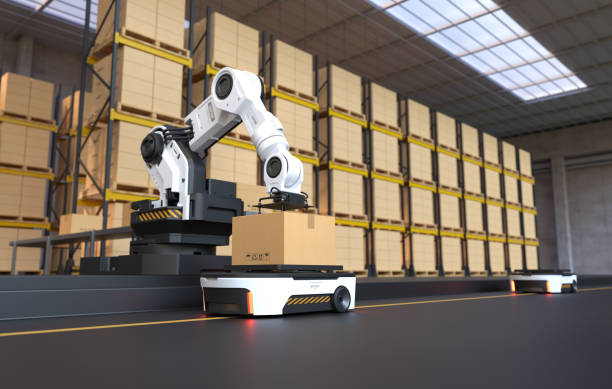
Order volumes keep rising every year, but warehouse floor space and available labor do not grow at the same rate. Operations managers feel this gap most during peak season, when the same crew has to move more product through the same aisles. This gap is a big reason warehouse robotics has moved from a pilot project into a standard line item on facility budgets.
MTLI Group works with operations teams across North America to plan and install warehouse automation systems built around real order profiles, not vendor demos. This guide covers how robotics in warehousing works day to day, where it adds the most value, and what to weigh before bringing it into your facility.
According to the Association for Advancing Automation (A3), North American companies ordered 36,766 robots in 2025, a 6.6 percent increase over the year before, with collaborative robots making up nearly 20 percent of that total. Growth like this shows robotics has moved well past large automotive plants and into general warehousing, food and consumer goods, and life sciences.
What Falls Under Warehouse Robotics Today
The term covers a wide mix of equipment, from fixed robotic arms on a packing line to mobile units that carry totes across the floor. Two categories come up most often in planning conversations.
Automated Guided Vehicles (AGVs) follow a set path, usually a magnetic strip, wire, or painted line built into the floor. They run reliably, but changing their route means physically changing the guide path.
Autonomous Mobile Robots (AMRs) navigate using onboard sensors and a stored digital map instead of a fixed guide. This lets AMR robots reroute around obstacles and adjust to layout changes without new floor infrastructure.
Robotics in warehousing also covers robotic picking arms, automated palletizers, and sortation units, but AGVs and AMRs are usually the first equipment operations managers evaluate, since they handle the core task of moving product from point to point.
How AMR Robots Navigate a Facility
AMR robots build a live map of the warehouse using cameras, lidar, or a combination of both. This process, often called simultaneous localization and mapping (SLAM), lets the robot compare what it senses against its stored map and adjust course in real time. A forklift crossing an aisle or a pallet left in the wrong spot does not stop the robot; it simply plots a new path.
| Factor | AGV | AMR |
|---|---|---|
| Navigation | Fixed path (wire, magnetic strip, floor markers) | Onboard sensors plus a digital map |
| Flexibility | Low; layout changes require new floor infrastructure | High; reroutes without physical changes |
| Setup time | Longer, due to floor installation work | Shorter, since no floor guides are needed |
| Best fit | Repetitive, unchanging routes | Facilities with shifting layouts or SKU mix |
| Typical cost | Lower per unit, higher install cost | Higher per unit, lower install cost |
Neither option wins in every case. A facility running one stable production line may do fine with AGVs. A fulfillment center that reorganizes its layout every season usually gets more out of AMR robots.
Where Robotics Shows Up in Daily Operations
Robotics in warehousing tends to concentrate around a handful of recurring tasks:
- Goods-to-person picking. Robots bring shelving units or totes to a stationary picker instead of sending the picker to walk the aisles.
- Replenishment. Robots restock forward pick locations from bulk storage on a set schedule.
- Sortation. Small mobile units sort parcels by destination zone before they reach a shipping dock.
- Palletizing. Robotic arms stack cases onto pallets at a consistent height and pattern, cutting down on manual lifting.
- Cycle counting. Robots equipped with barcode or RFID scanners can move through racking overnight to verify stock levels.
Adding any of these usually means changes to racking layout, power drops, and wireless coverage. Our team handles MHE installation work alongside the racking and construction changes a robotics rollout typically requires, so the equipment goes live on the schedule the operations team committed to.
Robotics vs. Manual Material Handling
Operations managers often ask how much difference robotics actually makes compared to a manual process. The answer depends on the task, but a few patterns hold across most facilities.
| Factor | Manual Handling | Robotics-Assisted Handling |
|---|---|---|
| Labor need | Scales directly with volume | Lower per unit moved, though staff still oversee the system |
| Throughput consistency | Varies with fatigue and shift changes | Stays steady across shifts |
| Error rate | Higher on repetitive picking tasks | Lower, since routing and counts are system-tracked |
| Scalability | Requires hiring more staff for peak volume | Can add units without adding floor space |
| Upfront cost | Lower | Higher, with a longer payback period |
The U.S. International Trade Commission notes that Amazon alone produced more than 50,000 robots annually during 2017 through 2019 for its own fulfillment network, and that the United States remains the leading global producer of these systems for warehouse automation. That scale of investment shows how much large operations depend on robotics to keep pace with order volume without proportionally growing headcount.
What to Weigh Before Adding Robots
A robotics rollout affects more of the building than the robots themselves. A few factors tend to decide whether a project goes smoothly:
Facility layout
Aisle widths, floor flatness, and rack spacing need to match the equipment specs before installation, not after.
Wireless coverage
AMR robots depend on steady coverage across the whole floor, including corners and mezzanine areas.
Staff training
Employees need to know how to work safely near robots and how to flag issues before they turn into downtime.
System integration
Robotics needs to connect with the warehouse management system (WMS) so tasks, inventory counts, and order data stay in sync.
Maintenance planning
Robots need scheduled servicing like any other equipment. Our storage and racking team often adjusts rack spacing and aisle configurations during this stage, since racking and robotics decisions affect each other directly.
Facilities that skip this planning stage tend to run into avoidable delays once the robots arrive. A facility maintenance program built around the new equipment helps catch small issues before they become unplanned downtime.
Industries Seeing the Fastest Adoption
Robotics adoption is not even across every sector. A few industries are moving faster than others.
| Industry | Common Robotics Use |
|---|---|
| E-commerce fulfillment | Goods-to-person picking for high SKU counts |
| 3PL and logistics | Flexible routing to serve multiple clients from one site |
| Manufacturing | Parts delivery to production lines and finished-goods movement |
| Cold storage | Reducing time staff spend in conditioned space |
| Food and beverage | Sortation and palletizing for high-volume, fast-turnover product |
This pattern shows up often in e-commerce fulfillment centers, where SKU counts grow every year while floor space does not. The same logic applies to 3PL and logistics providers, who need equipment flexible enough to serve different clients without a full redesign each time a contract changes. Manufacturing plants tend to focus robotics on internal parts movement rather than customer-facing picking, since the goal there is keeping the production line fed on schedule.
How MTLI Group Supports Warehouse Robotics Projects
MTLI Group manages warehouse robotics projects from the first site assessment through final commissioning. Our team combines construction and general contracting work, racking adjustments, electrical upgrades, and installation services under one contract, so a project does not stall while separate vendors coordinate schedules on their own.
For facilities planning a larger footprint change alongside a robotics rollout, our warehouse relocation team can move inventory and equipment with minimal downtime, so the new system goes live in a facility already set up to support it. With more than 40 years in the industry and over 15,000 completed projects across North America, our team has coordinated the structural, electrical, and mechanical pieces of these rollouts enough times to catch conflicts before they show up on the floor.
Ready to Bring Warehouse Robotics Into Your Facility?
Robotics is not the right fit for every operation, but for facilities facing rising order volume, tight labor availability, or a layout that needs to flex more often, warehouse robotics is worth serious evaluation. The right partner reviews your current layout, order profile, and growth plans before recommending specific equipment.
MTLI Group is ready to help you assess your facility and plan a rollout that fits your operation. Get a free quote and talk through your goals with our team.