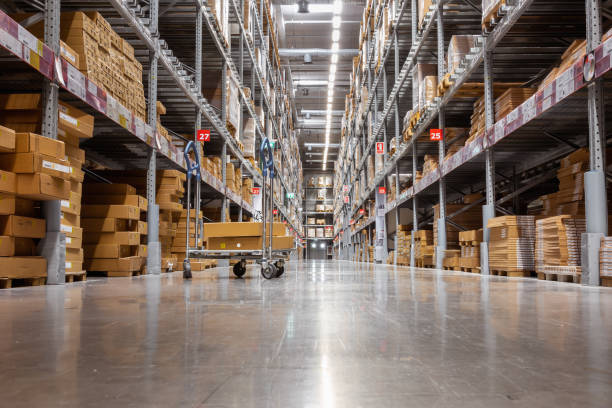
Growth should feel like a good problem to have, but for most operations managers it arrives with an uncomfortable question attached: how do we handle more volume without simply hiring our way through it? Warehouse scalability that depends entirely on headcount runs into a hard ceiling, since labor costs rise in near-direct proportion to volume and never really loosens their grip once added. The facilities that scale most successfully break that relationship deliberately, building capacity that grows without payroll growing at the same rate.
MTLI Group works with operations teams across the US on the automation and facility projects that make this kind of decoupling possible, drawing on experience with a warehouse robotics company background that spans conveyor, storage, and robotics integration. This blog looks at what actually drives warehouse scalability without ballooning labor costs, and how operations managers should sequence that investment.
Why Labor Costs Make Traditional Scaling Unsustainable
Scaling a warehouse by adding headcount proportional to volume growth works in the short term, but it stops working the moment labor costs climb faster than revenue can absorb. Compensation costs for private industry workers increased 3.4 percent for the twelve months ending March 2026, with wages and salaries rising at the same rate and benefit costs climbing even faster at 3.6 percent, according to the U.S. Bureau of Labor Statistics. A facility that scales headcount linearly with volume absorbs that rising cost baseline on every single new hire, compounding the burden year after year.
The productivity data behind this trend is even more telling. Warehousing and storage recorded the largest annual productivity decline of any of the 31 service-providing industries tracked by BLS between 2019 and 2024, even as hours worked in the sector rose 8.0 percent between 2007 and 2019. More hours worked with declining output per hour is precisely the pattern that makes labor-only scaling financially unsustainable, since it means each additional worker is producing less relative value than the workers who came before.
What Warehouse Scalability Actually Requires
True warehouse scalability separates capacity growth from headcount growth, allowing volume to increase without payroll rising at the same pace. This requires deliberate investment across several areas rather than a single fix.
Automation that handles volume increases without proportional staffing
Systems like conveyor sortation, automated storage and retrieval, and robotics absorb additional throughput demand without requiring a matching increase in workers, which is the core mechanism behind decoupling growth from labor cost.
Flexible infrastructure that expands incrementally
Facilities designed with modular racking, expandable conveyor sections, or scalable robot fleets can add capacity in phases as volume actually materializes, rather than requiring a full capital commitment sized for peak projected demand from day one.
Cross-trained staff who can flex across functions
A smaller, more versatile team that can shift between picking, packing, and shipping based on daily demand handles volume swings more efficiently than a larger, narrowly specialized workforce that sits idle in some areas while others fall behind.
Data visibility that identifies bottlenecks before they require additional labor
Facilities with strong warehouse management system data can often solve a capacity constraint through process improvement or better slotting rather than defaulting to adding staff as the first response.
The table below compares labor-driven scaling against automation-supported scaling across the factors that matter most to operations managers.
| Scaling Factor | Labor-Driven Scaling | Automation-Supported Scaling |
|---|---|---|
| Cost trajectory as volume grows | Rises roughly proportional to volume | Grows more slowly than volume after initial investment |
| Speed to add capacity | Fast, but limited by hiring market | Slower initial setup, faster ongoing scaling |
| Vulnerability to labor market conditions | High, tied directly to hiring and wage trends | Lower, once systems are operational |
| Long-term cost per unit processed | Tends to stay flat or rise | Tends to decline as volume increases |
Automation Scaling Strategies That Match Real Growth Patterns
Automation scaling works best when it matches a facility's actual growth pattern rather than assuming every operation needs the same approach.
Facilities with steady, predictable growth benefit from automation investments sized for a three-to-five-year horizon, since the demand curve is stable enough to justify committing to a larger system upfront. Conveyor and sortation infrastructure fit this pattern well, since it typically requires more significant upfront installation but delivers consistent throughput gains as volume climbs steadily.
Facilities with unpredictable or seasonal growth benefit more from modular, incrementally scalable systems. Robot fleets that expand and contract with demand, or automated storage systems designed with expansion bays built in from the start, let operations managers add capacity only when volume actually justifies it rather than committing capital against an uncertain projection.
Facilities pursuing aggressive, rapid growth sometimes need a combination of both approaches, layering flexible automation on top of a foundational system designed for higher baseline capacity than current volume requires, anticipating growth that would otherwise force a disruptive mid-year expansion project.
Robotics adoption trends suggest more facilities are choosing the flexible path. Industrial robot installations in the United States rose 11 percent year-over-year to reach 38,000 units in 2025, according to the International Federation of Robotics, reflecting how accessible incremental automation scaling has become compared to a decade ago when large, fixed installations were often the only viable option.
Warehouse Growth Strategies That Reduce Dependence on New Hiring
Warehouse growth strategies built around automation still need a labor plan, since even highly automated facilities require skilled staff to operate, maintain, and oversee the systems doing the heavy lifting.
Investing in training for existing staff to manage and troubleshoot automated systems reduces reliance on external hiring for these specialized roles, and it also improves retention, since employees moving into higher-skill oversight positions have a clearer career path than those doing purely repetitive manual work.
Facilities pursuing this kind of warehouse growth strategy often coordinate a phased rollout, starting with the automation category showing the clearest return, then reinvesting the labor savings from that first phase into the next expansion. This approach avoids the common mistake of committing a large, all-at-once automation project before the operational team has built the internal expertise to run it effectively.
The table below outlines a general framework for sequencing automation scaling investments based on growth patterns.
| Growth Pattern | Recommended Automation Approach | Typical Investment Horizon |
|---|---|---|
| Steady, predictable growth | Fixed conveyor and sortation infrastructure | 3 to 5 year sizing |
| Seasonal or variable growth | Modular, scalable robot fleets | Incremental, added as needed |
| Rapid, aggressive growth | Combined fixed and flexible systems | Higher baseline capacity with expansion built in |
| Uncertain, early-stage growth | Phased rollout starting with highest-ROI area | Reinvest savings into next phase |
Facility Infrastructure Decisions That Support Long-Term Scalability
Warehouse scalability depends on more than equipment choices. Physical infrastructure decisions made early in a facility's life either support or constrain how easily automation and headcount decoupling can happen later.
Electrical capacity sized for future automation, not just current equipment, avoids the costly rework of upgrading power distribution mid-expansion. Facilities planning ahead often involve electrical automation services during the initial construction or renovation phase, specifically building in headroom for systems that have not been selected yet.
Structural considerations matter just as much. A building with adequate floor load capacity and clear height accommodates automated storage and robotics far more easily than one designed purely around manual operation, and retrofitting these structural elements later carries a much higher cost than planning for them from the start. Facilities that anticipate this sometimes work with a steel erection company during initial construction to build mezzanine and structural capacity ahead of the automation need actually materializing.
When Scaling Requires a Facility Change Rather Than Just Automation
Some growth trajectories outpace what automation alone can solve within an existing footprint. Facilities approaching this threshold should evaluate whether a full facility change makes more sense than continuing to layer automation into a building that has reached its physical limits.
This decision sometimes involves winding down or right-sizing an outgrown facility as part of a broader transition, and operations managers navigating this kind of change often need asset liquidation services to responsibly exit equipment and infrastructure that will not transfer to a new, better-suited location.
Building a Warehouse Scalability Plan with Facility Management in Mind
Scalability planning does not end once new automation goes live. Ongoing strategic facility management services keep growing operations running reliably as volume and equipment complexity both increases, since a facility management program built for a smaller, simpler operation often cannot keep pace with the maintenance demands of a scaled, automation-heavy one without deliberate adjustment.
Facilities evaluating a major automation investment as part of their scalability plan should also review asrs systems cost against projected labor savings over a multi-year horizon, since storage automation in particular often shows its strongest return only after volume has grown enough to fully utilize the added capacity.
How MTLI Group Supports Warehouse Scalability Projects
MTLI Group works with operations teams across the US to plan and execute automation, electrical, and structural projects that support warehouse scalability without a proportional increase in labor costs. Facilities seeking a fully coordinated approach often review turnkey warehouse management solutions us operations rely on to bundle design, installation, and commissioning into a single accountable scope.
With over 40 years of experience and more than 15,000 completed projects, MTLI Group helps operations managers build a scalability roadmap that sequences investment around actual growth patterns rather than a one-size-fits-all automation package.
Scaling Your Warehouse Without Scaling Labor Costs
Warehouse scalability that depends entirely on adding staff eventually runs into the same wall every growing operation encounter: rising compensation costs outpacing the productivity gains new hires can realistically deliver. Automation scaling, flexible infrastructure, and cross-trained staff together break that dependence, allowing volume to grow without payroll climbing at the same rate. Facilities that plan this transition deliberately, sequencing investment around their actual growth pattern rather than reacting to capacity constraints after they appear, build a foundation that scales sustainably for years rather than requiring a disruptive overhaul every time volume jumps.
MTLI Group helps operations teams build a warehouse scalability plan that grows capacity without growing labor costs at the same pace. Contact MTLI Group discuss a scalability assessment for your facility.