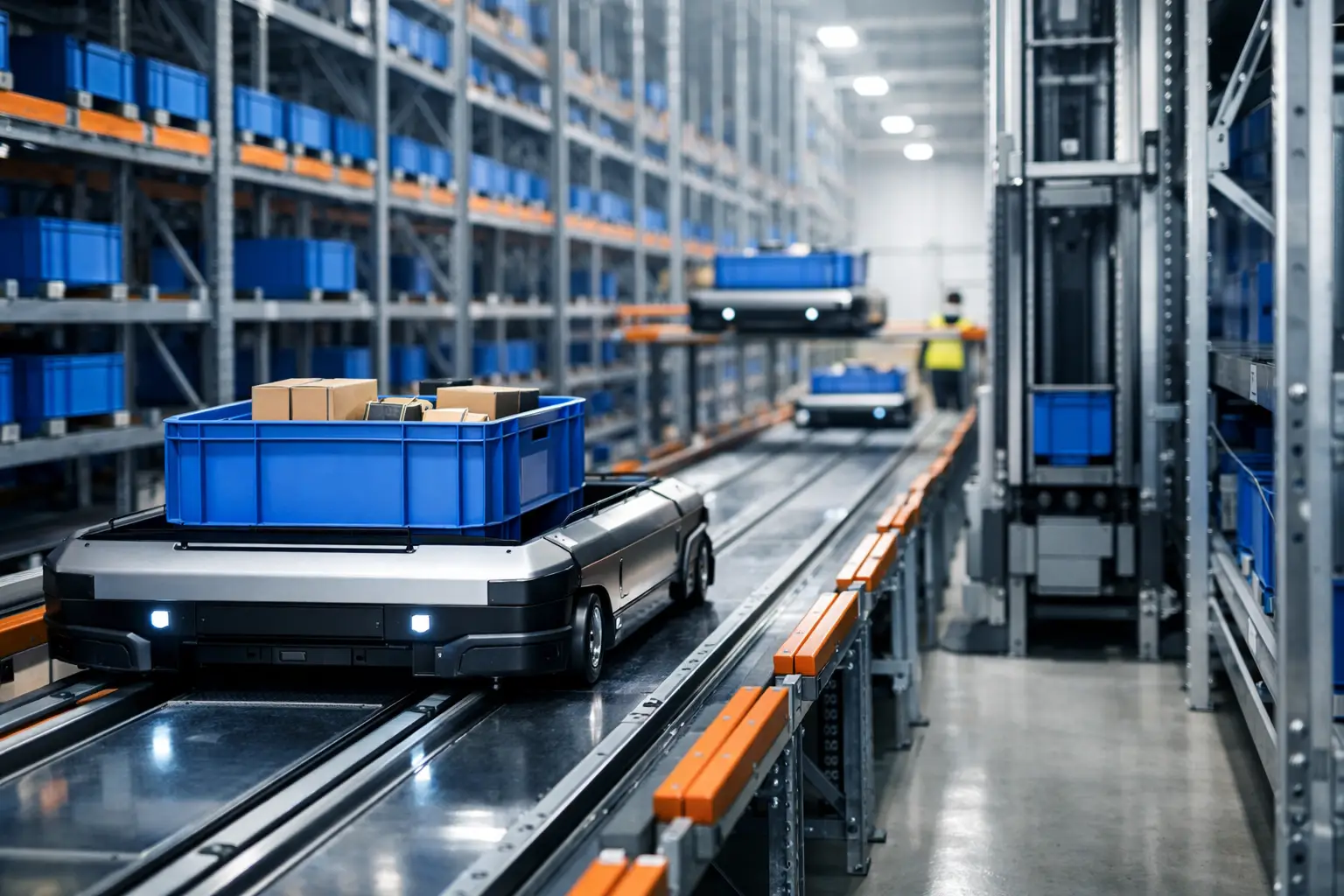
A warehouse can run out of usable capacity long before it runs out of floor space. When pallet positions are constrained by aisle requirements, slow lift-truck travel, or inconsistent inventory flow, adding conventional racking may not solve the operating problem. Shuttle system warehouse solutions address this gap by moving pallets within deep storage lanes with powered carrier vehicles, reducing travel time and increasing storage density without sacrificing controlled access to inventory.
The technology is a strong fit for operations managing large quantities of similar SKUs, predictable pallet dimensions, and high-volume inbound or outbound movement. It is not a universal replacement for selective racking. The right design depends on inventory profile, throughput targets, building conditions, material handling equipment, and the organization’s ability to maintain an automated operating environment.
What a Pallet Shuttle System Does
A pallet shuttle system combines high-density racking with a battery-powered shuttle cart that moves pallets through storage lanes. A lift truck places the shuttle and pallet at the lane entrance. The shuttle then carries the load to the required position, returns to the lane face, and repeats the process based on operator commands or controls integrated with the warehouse system.
This configuration removes the need for lift trucks to drive into every storage lane. The result is deeper storage, fewer travel aisles, and more consistent pallet movement. Depending on the system design, operations can support first-in, first-out inventory rotation, first-in, last-out storage, or a combination of flow paths.
The practical benefit is not simply more pallet positions. It is a storage and handling model built around repeatable movement. In facilities where operators spend significant time driving into deep lanes, waiting for access, or repositioning loads, the shuttle can reduce nonproductive travel and create a more controlled process.
Where Shuttle System Warehouse Solutions Fit Best
Shuttle systems perform best when storage depth and product velocity are both meaningful design factors. Cold storage, food and beverage distribution, manufacturing supply, automotive parts, consumer packaged goods, pharmaceutical operations, and high-volume 3PL environments are common applications.
Temperature-controlled facilities are especially strong candidates. Every aisle consumes valuable conditioned space, and dense storage can reduce the total refrigerated volume required for a given pallet count. The calculation must account for rack structure, fire protection, airflow, insulation, battery performance, and equipment service access, but the potential value of cubic-space utilization can be substantial.
Operations with many pallets of the same SKU also benefit. A deep lane can hold a product family, production batch, or customer allocation without consuming a separate aisle for each pallet position. This is often more efficient than selective racking when SKU counts are manageable and replenishment patterns are disciplined.
A shuttle system may be a weaker fit for facilities with a very broad SKU base, frequent partial-pallet picks, irregular pallet sizes, or constant changes to slotting strategy. Selective racking may provide better direct access in those circumstances. Some operations use a hybrid design, reserving shuttle storage for reserve inventory and using selective or pick modules for faster-access stock.
Start With the Operating Profile, Not the Equipment
The most costly warehouse automation mistake is selecting equipment before defining the work it must perform. A shuttle system should be engineered around verified operating data, not a general assumption that denser storage will improve performance.
Project teams should establish the actual pallet count by SKU, pallet dimensions and weights, required storage depth, daily moves, peak-hour activity, rotation requirements, and the percentage of inventory requiring direct access. They should also identify exceptions: damaged pallets, mixed loads, overhang, unstable cases, special handling requirements, and seasonal volume changes.
Four questions often determine whether the concept moves forward:
- Can inventory be grouped into deep lanes without creating access issues?
- Does reduced lift-truck travel improve throughput at the required peak volume?
- Will the building support the rack loads, clear heights, fire protection approach, and charging requirements?
- Can operations maintain consistent pallet quality and follow defined loading procedures?
These questions connect system design to daily execution. A shuttle system can operate quickly, but it cannot correct poor pallet construction or an inventory strategy that demands random access to every load.
Throughput Is More Than Shuttle Speed
A system specification may highlight shuttle travel speed, but total throughput is determined by the complete movement cycle. Lift-truck availability, operator travel to the correct lane, battery exchanges or charging, pallet staging, WMS transaction timing, and dock flow all influence the number of pallets moved per hour.
For example, a high-speed shuttle will not resolve congestion if inbound pallets are staged across the facility or if forklifts must travel long distances between receiving and storage. Conversely, a well-located shuttle zone with properly sized staging can improve receiving capacity even when the facility retains conventional equipment elsewhere.
Design should include peak conditions rather than relying on average daily movement. Seasonal surges, production changeovers, late-arriving inbound trailers, and outbound cutoffs are where capacity constraints become visible. Modeling these periods helps determine the number of shuttles, lift trucks, charging stations, lanes, and operators needed to protect service levels.
Engineering Requirements That Cannot Be Treated as Add-Ons
High-density storage changes the demands placed on the building and the operating team. Rack layout, slab capacity, seismic requirements, sprinkler design, lighting, ventilation, egress, and equipment clearances must be coordinated early. Treating these elements as separate scopes after the rack design is selected can create expensive rework or delay commissioning.
The rack itself must be designed for the actual loads and operating method. That includes pallet weight distribution, rail alignment, impact protection, lane depth, and tolerances that allow shuttle movement without interruption. If pallets vary materially in condition or footprint, the system needs defined acceptance standards before equipment arrives.
Fire protection deserves particular attention. Deep storage configurations can affect sprinkler criteria, flue spaces, commodity classification, and local code requirements. Early coordination among the rack designer, fire protection contractor, building team, and authority having jurisdiction reduces the chance that a late design review changes storage capacity or project cost.
Battery management is another operational requirement. Shuttle availability depends on a charging plan that matches demand. The right approach may involve spare batteries, automatic charging locations, manual battery exchange, or a planned charging schedule. The decision should consider labor, battery life, temperature conditions, safety procedures, and the consequences of a shuttle being unavailable during a peak shift.
Plan Implementation Around Continuity of Operations
For an active distribution center or manufacturing site, the installation approach can matter as much as the equipment selection. A complete shutdown is rarely acceptable. The project plan should define phased work areas, material delivery routes, temporary storage, safety separation, cutover milestones, and contingency procedures before construction begins.
Commissioning should verify more than mechanical movement. Teams need to test load handling, controls, charging, fault recovery, WMS or warehouse control system transactions where applicable, emergency procedures, and operator workflows. Training should include routine use, inspection requirements, exception handling, and escalation paths for maintenance issues.
A turnover package should provide equipment documentation, preventive maintenance schedules, spare-parts recommendations, system settings, inspection records, and clear ownership for support. Automated storage is a long-term operating asset, not a one-time installation. Reliable performance depends on disciplined handoff and ongoing service planning.
Evaluate the Business Case Beyond Pallet Positions
The financial case for a shuttle system usually begins with storage density, but the strongest evaluations include labor, building expansion avoidance, energy use, lift-truck utilization, product rotation, and service-level impact. In a cold environment, reducing conditioned space may carry significant value. In a high-throughput distribution operation, fewer truck travel miles and better lane access may be the larger benefit.
There are trade-offs. Shuttle systems require capital investment, controls, battery management, maintenance capability, and operational discipline. They may also create concentration risk if a small number of shuttles serve a critical area without adequate redundancy. Those risks can be managed through proper sizing, spare equipment, preventive maintenance, and a layout that preserves alternate operating paths.
The best project teams evaluate total cost of ownership against a realistic planning horizon. A lower-cost rack layout may appear favorable at installation, then create recurring labor, space, and throughput costs that limit the operation for years. A higher-density automated solution may be justified when it protects growth capacity and reduces the need for a facility expansion.
A well-executed shuttle project begins with a clear view of the work on the floor: which pallets move, when they move, where delays occur, and what the building can support. From there, the system can be designed as part of a coordinated facility plan - with racking, automation, construction, installation, and commissioning aligned to keep the operation moving.