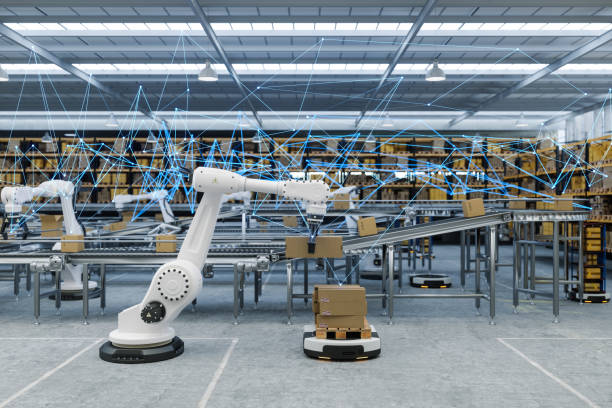
Twenty years ago, a robotic arm on a factory floor meant one thing: a heavy, caged machine bolted to the floor doing one repetitive task, welding the same joint or stamping the same part thousands of times a shift. Today, that same floor might have mobile robots navigating around workers, vision-guided arms adjusting their grip in real time, and palletizing systems coordinating directly with inventory software. The technology didn’t just get faster. It got fundamentally more flexible, and that shift is changing what manufacturing operations actually look like day to day.
MTLI Group works with manufacturers to find practical applications for robotic automation for manufacturing based on their workflows and operational goals. This guide covers the evolution of industrial robotics, emerging developments, and the key factors to weigh before bringing automation into your plant.
From Isolated Machines to Connected Production Lines
Early factory robots typically worked independently, performing one task without communicating with other machines or sharing production data. While this improved consistency, it limited flexibility. Changing a robot's task could require downtime, reprogramming, and help from a specialized technician.
Today, robotic automation for manufacturing connects machines, conveyors, and control systems across the production line. Equipment can share data, coordinate tasks, and respond to changing conditions, helping teams improve workflow and reduce interruptions.
At MTLI Group, our robotic automation for manufacturing team designs connected systems that work together from the start. This approach helps manufacturers get more value from their equipment and build production lines that can adapt to changing operational needs.
The Shift Toward Collaborative and Mobile Robotics
Manufacturing robots are becoming more flexible, allowing businesses to automate tasks without relying only on large, fixed systems. Two developments are shaping this shift:
- Collaborative Robots (Cobots): Designed to work near people, cobots use sensors and built-in safety features to support tasks such as assembly, inspection, and material handling. Depending on the application and risk assessment, they may require less physical guarding than traditional industrial robots.
- Autonomous Mobile Robots (AMRs): These robots use cameras, sensors, and mapping software to navigate factory floors without fixed tracks. They can transport materials and adjust routes around obstacles, helping improve movement between work areas.
Both technologies need to connect with the facility's electrical systems and production controls. Expert integrated electrical solutions team helps integrate these systems so equipment can communicate reliably with the wider production environment.
Automotive Manufacturing Automation: Where It All Started
Robotic automation for manufacturing has driven more robotics innovation than any other industry, and it still sets the pace for how robots get used elsewhere. Welding, painting, and body assembly were among the first processes automated at scale. This is largely because precision and repeatability mattered more in those steps than almost anywhere else in production.
| Industry | Primary Robotic Application | Adoption Pace |
|---|---|---|
| Automotive | Welding, painting, body assembly | Earliest, most mature |
| Electronics | High-speed, precise component placement | Fast-growing |
| Food and Beverage | Packaging, palletizing | Accelerating |
| Metal Fabrication | Material handling, cutting | Steady, growing |
Automation first became popular in automotive plants but has since spread across many manufacturing industries. Smaller, more affordable, and easier-to-program robots now help manufacturers adapt technology to different products and production needs.
Robotic Palletizing Systems and the End of Manual Lifting
Few applications illustrate the shift as clearly as robotic palletizing systems. For decades, stacking finished product onto pallets for shipping was almost entirely manual work, repetitive, physically demanding, and a leading source of workplace injury across manufacturing and warehousing alike.
Robotic palletizing systems now handle this task with a consistency manual labor can’t match, stacking product at a steady pace without fatigue-related errors or the injury risk that comes with repeated heavy lifting. These systems typically work hand in hand with the rest of a facility’s material flow. This is why they’re often installed alongside conveyor systems that feed product to the palletizer at a matched pace rather than in disconnected batches.
Industrial Robotics Beyond the Assembly Line
Industrial robotics has expanded well past the production line itself, reaching into areas of a facility that didn’t traditionally involve automation at all.
A few applications worth noting:
- Quality inspection robots using machine vision to catch defects invisible to the human eye
- Robotic dispensing systems applying adhesives, sealants, or coatings with precise, repeatable accuracy
- Automated machine tending, where a robot loads and unloads parts from CNC machines or presses
- Robotic sorting systems separating products or materials by size, weight, or type
Many of these applications involve heavier equipment than a standard assembly station, requiring specialized rigging and structural planning during installation. Our heavy industrial installation crews handle this kind of work directly, positioning large automated systems correctly the first time rather than requiring costly adjustments after the fact.
The Safety Case for Robotic Automation for Manufacturing
Safety has become one of the strongest arguments for robotic automation for manufacturing, and the national injury data backs that up clearly. According to the US Bureau of Labor Statistics, manufacturing recorded 306,500 nonfatal workplace injuries and illnesses in 2024, a rate of 2.5 cases per 100 full-time workers. That’s a meaningful share of the overall private industry total, and manual material handling remains one of the largest contributors.
Robots don’t get tired, and they don’t develop the cumulative strain injuries that come from repeating the same lift hundreds of times a shift. Getting the electrical and controls side of these systems right matters just as much as the mechanical installation. This is why facilities often lean on specialized guidance, like our industrial electrical contracting resource, before finalizing a robotics project involving complex power or control requirements.
What the Injury Data Reveals About Timing
Workplace injury data highlights why automating repetitive tasks can be valuable for manufacturers. According to the Bureau of Labor Statistics (BLS), overexertion, repetitive motion, and other bodily conditions accounted for 946,290 days-away-from-work or job-transfer cases across private industry during 2023–2024. These injuries often involve physical strain from repeated movements and demanding manual tasks.
Robotic palletizing systems and material handling robots can help reduce this strain by taking over repetitive lifting, carrying, and stacking tasks. Facilities that also need to move and store large volumes of products can extend robotic automation for manufacturing into their operations with an automated storage and retrieval system. This helps reduce manual handling across production, storage, and shipping while supporting a safer, more efficient workflow.
Productivity and Quality: The Other Side of the Ledger
Safety gains get a lot of attention, but the productivity and quality case for industrial robotics is just as strong, and it shows up in different ways depending on the application.
| Outcome | How Robotics Delivers It |
|---|---|
| Consistency | Eliminates fatigue-driven variation in repetitive tasks |
| Throughput | Maintains steady pace across full shifts without breaks |
| Defect Reduction | Machine vision catches errors earlier and more reliably |
| Data Capture | Every cycle generates data for process improvement |
Data collection is especially valuable because it gives plant managers a clearer view of production performance. Instead of relying mainly on manual records, teams can use system data to spot recurring issues and make better-informed decisions.
Getting these insights depends on proper system setup and data integration from your electrical installation company. When these elements are planned from the start, manufacturers can gain more than functional equipment. They can also get useful performance data to support ongoing improvements.
Planning a Transition Without Disrupting Production
Adding robotic automation for manufacturing to an active production line is different from building automation into a brand-new facility. Most manufacturers can’t afford extended downtime, which means transitions typically happen in phases rather than all at once.
A phased approach for robotic automation for manufacturing generally looks like this:
- Start with the single highest-injury or highest-bottleneck task
- Pilot the new system on one line before expanding plant-wide
- Train staff on oversight and troubleshooting before full handoff
- Document performance data to justify the next phase of investment
Facilities planning a future move or expansion should factor robotic equipment into that planning early as well, since relocating sensitive automated systems takes considerably more care than standard machinery. Our facility relocation guide covers what that process typically involves when automated equipment is part of the move.
Choosing a Partner for the Shift
Not every automation provider understands the operational realities of a working production floor. Some focus narrowly on the robots themselves without accounting for the electrical capacity, controls integration, or structural planning the rest of the system needs to actually function.
A few things worth confirming before committing to a provider:
- Experience with your specific industry’s applications, not just general robotics work
- In-house electrical and installation capability, not fully subcontracted work
- A clear plan for phased rollout that doesn’t require shutting down production
- Ongoing support once the system goes live, not just a one-time installation
MTLI approaches robotic automation for manufacturing as a full scope of work. Our team covers electrical infrastructure, equipment installation, and integration under a single accountable team.
The Road Ahead for Manufacturing Robotics
Robotic automation for manufacturing has moved from an isolated, single-task tool to a connected, flexible part of how modern operations run day to day. That shift shows no sign of slowing, and plants that treat it as a strategic, phased investment tend to see better results than those that bolt on equipment without a broader plan.
MTLI Group helps manufacturers plan that transition around their actual production needs rather than a generic automation package. Reach out to our team to talk through where robotics could make the biggest difference on your floor.