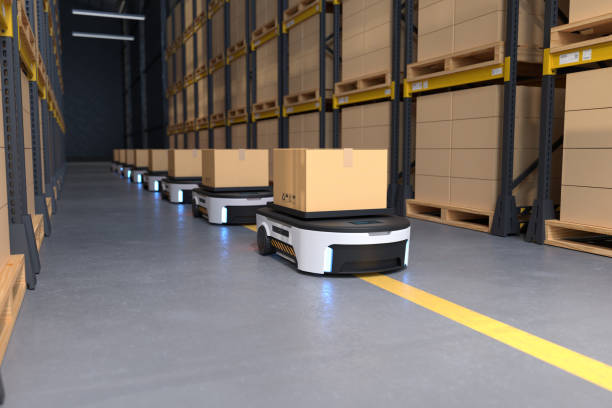
Manual material handling still causes a lot of warehouse injuries each year. In fact, OSHA points to Bureau of Labor Statistics data showing that powered industrial trucks injure about 20,000 workers each year across the United States. That risk, plus rising labor costs and tighter delivery windows, is why more operations managers now look at automated guided vehicles. They move materials without adding headcount, and without putting staff in harm's way.
Automated guided vehicles, or AGVs, are not new. But the technology behind them has come a long way. Mid-size and large warehouses can now deploy AGV systems with a real payback period. MTLI Group builds and installs automation infrastructure, including AGVs, for warehouses and distribution centers nationwide as a warehouse system integrator. This guide covers what these systems do, where they fit best, and what a facility needs before it brings them onto the floor.
What Automated Guided Vehicles Actually Do on the Warehouse Floor
An automated guided vehicle is a self-driving cart. It moves materials along a set path with no human driver. Older AGVs followed magnetic tape or wires in the floor. Newer ones use lasers, cameras, and onboard maps to find their way. That gives them more room to reroute around obstacles.
The core job of an AGV stays simple. Pick up a load at one point. Carry it to another point. Repeat that cycle for hours at a time. While each trip may seem simple, material transport is one of the most repetitive activities on the warehouse floor. According to the U.S. Bureau of Labor Statistics, transportation and material moving occupations recorded more than 265,700 nonfatal workplace injuries and illnesses in 2023.
Automating repetitive transport tasks with AGVs helps reduce manual movement while keeping materials flowing on a consistent schedule. Common tasks handled by AGVs include:
- Moving pallets from receiving docks to storage spots
- Carrying work-in-progress parts between production stages
- Delivering picked orders from pick areas to packing stations
- Restocking pick faces from bulk storage
- Hauling empty totes and pallets back to staging areas
A fixed conveyor only runs one path. An AGV can serve many routes and shifts as layouts change. That makes it a flexible piece of a bigger automation plan, not just a single-purpose machine.
Types of AGV Systems and Where Each One Fits
Not every warehouse needs the same kind of vehicle. AGVs come in a few standard types. The right pick depends on load size, floor layout, and how often routes change.
| AGV Type | How It Moves Materials | Typical Best Fit |
|---|---|---|
| Tugger AGVs | Pull a train of carts along a route | Many small loads on a fixed loop |
| Unit load AGVs | Carry a single pallet on a flat deck | Pallet moves between dock, storage, and staging |
| Forklift AGVs | Lift and place loads onto racking | Automated put-away and retrieval |
| Tow AGVs | Slide beneath a cart and tow it | Light loads already on wheeled carts |
Tugger and unit load AGVs tend to be the easiest starting point for a warehouse new to automation. They handle simple point-to-point moves. Forklift AGVs cost more and take longer to set up. But they remove one of the riskiest manual tasks in a warehouse: lifting loaded pallets up into tall racking.
Facilities that pair AGVs with automated storage racking solutions tend to see the biggest gains. A rack layout built around vehicle paths lets AGVs move in straight, clear lines instead of working around obstacles meant for foot traffic.
How AGVs Change Daily Operations
The clearest change shows up in travel time. A worker pushing a pallet jack across a big facility spends a lot of a shift just walking. An AGV covers that same ground at a steady pace. It does not take breaks. It does not slow down near the end of a shift. It does not take a wrong turn because its mind wandered.
That freed-up time does not vanish. It shifts. Staff who once spent hours moving material between zones can move into picking, quality checks, or other work that still needs a human eye. In fact, this shift is often where the real payback shows up, since labor opens up for higher-value tasks instead of repeat hauling.
AGVs also bring a level of steady output that manual transport cannot match. A vehicle running the same route hundreds of times a day delivers materials at a set interval. That helps production lines and pick stations plan around a steady supply instead of guessing when the next load will land. This kind of steady timing matters most at facilities running high throughput warehouse systems, where even small gaps between stations can slow the whole line down.
The Safety Case for Automated Guided Vehicles
Warehouse safety data makes a strong case for cutting back on manual vehicle traffic. The Bureau of Labor Statistics reported a nonfatal injury rate of 4.3 cases per 100 full-time workers in transportation and warehousing in 2023. That compares with 2.2 cases per 100 workers across private industry as a whole. Powered industrial trucks, the forklifts and pallet jacks AGVs often replace or support, are a top cause of those incidents.
Automated guided vehicles cut that risk in a few clear ways. They use onboard sensors, often laser-based Light Detection and Ranging (LiDAR), to spot people and objects and stop or slow before contact. They stick to set paths and speed limits. They do not get tired, distracted, or make a bad call near the end of a long shift. And since they run on fixed routes, teams can plan walkways and safety zones around known paths instead of guessing where a forklift might turn up.
None of this replaces a full safety program. AGVs still need floor markings, staff training, and clear rules for manual override. But moving routine, repeat transport off human-driven trucks removes one of the most common sources of warehouse injury.
Manual Material Handling vs. AGV-Based Handling
| Factor | Manual Material Handling | AGV-Based Handling |
|---|---|---|
| Route consistency | Varies by driver and shift | Fixed or planned, repeats the same way |
| Injury exposure | Higher, tied to forklift and jack use | Lower, sensors avoid collisions |
| Labor use | Staff tied up in transport tasks | Staff freed for picking and quality work |
| Peak season scaling | Needs added temp drivers | Existing fleet covers more cycles |
| Delivery timing | Uneven | Steady, set intervals |
The gap tends to widen during peak periods. A facility that relies on manual transport usually adds temp drivers to keep pace. This adds training time and cost during the exact weeks a mistake costs the most. A fleet of AGVs can often absorb more cycles by running close to nonstop.
What a Facility Needs Before Deploying Warehouse AGV Solutions
Bringing this kind of fleet into an existing building takes more than an order form. A few things need to be in place first.
- Floor conditions matter more than most teams expect. AGVs need smooth, flat surfaces to run well. Cracks, uneven joints, or heavy debris can throw off sensors or stall a vehicle outright. Older buildings may need floor repair before any automation runs right.
- Network coverage is another common gap. Vision and laser-guided AGVs rely on live position data. That means a facility needs solid wireless coverage across the full floor, not just near the office or dock.
- Charging setup and power capacity also need an early look. A growing AGV fleet draws real power. Panels or charging stations sized for a smaller operation may need an upgrade. This is where an industrial electrical contractor who knows automation loads speeds up planning and avoids surprises during commissioning.
Finally, a link to the warehouse management system decides how much value the fleet delivers. AGVs that run without a tie to inventory and order data can still move loads. But they cannot rank tasks by priority or send performance data back to the team running the floor.
Common Mistakes When Planning an AGV Deployment
A few mistakes show up again and again on AGV projects, no matter the facility size.
- Choosing the Wrong Vehicle Type: Picking a vehicle type before mapping real routes is a common one. Teams sometimes choose AGVs off a vendor demo, not the actual pallet sizes, aisle widths, and traffic in their own building. That leads to a fleet that runs, but never quite performs.
- Overlooking Facility Preparation: Skipping floor and facility prep is another. Vendors often quote AGV hardware costs without flagging the building work needed to support it. Budgets run short once floor repairs or electrical upgrades show up mid-project.
- Skipping the Pilot Phase: Deploying a full AGV fleet without testing a single route first increases project risk. Rolling out a full fleet before testing on one route makes it hard to catch routing or charging issues before they hit the whole floor.
Treating warehouse AGV solutions as a one-time buy, not a system that grows, is the last common gap. Order patterns, SKU counts, and floor layouts shift over time. A fleet sized for last year's volume can fall behind current demand without a regular review.
How MTLI Group Supports Automated Guided Vehicle Projects
MTLI Group works as a single, accountable partner for facilities planning an AGV rollout. That means we handle the pieces that often get split across separate vendors:
- facility checks
- floor and electrical readiness
- conveyor and material handling installations
- full installation and commissioning support
With more than 40 years in the field and 15,000-plus completed projects, MTLI has backed warehouse automation ROI for distribution centers, manufacturers, and e-commerce warehouse automation operations across the country. As a warehouse automation company, MTLI also runs ongoing machinery inspections once a fleet is live, so performance does not slip after launch. Facilities weighing new construction alongside automation can lean on MTLI as an industrial construction company to get a building ready for AGV traffic from day one.
Ready to Bring Automated Guided Vehicles Into Your Warehouse?
AGVs are no longer a large enterprise-only investment. With the right facility prep, and a partner who can handle floor readiness, power capacity, and install under one roof, mid-size operations can run a fleet that pays for itself in lower labor strain and fewer safety incidents. MTLI Group brings automation design, construction, and installation together. So, your AGV project moves from plan to production without the gaps that slow most facilities down. Reach out to start a facility check and see where AGVs fit into your operation.