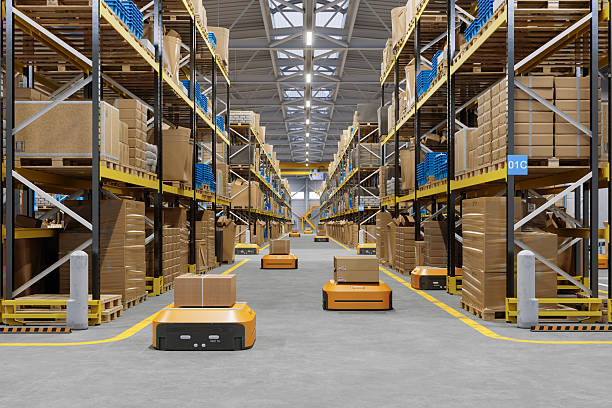
Third-party logistics providers operate under pressure that most single-facility warehouses never face managing inventory, throughput, and service levels for multiple clients simultaneously, each with different volume patterns and expectations. 3PL automation solutions have become the difference between providers who can take on new clients confidently and those who hit a capacity wall every time volume grows past what manual processes can handle.
MTLI Group works with 3PL operators across the US on the equipment and infrastructure behind automated fulfillment, including autostore provider relationships built specifically around multi-client storage density needs. This blog looks at why 3PL automation solutions matter more than ever, which technologies deliver the strongest results, and how operations managers should think about scaling automation as their client base grows.
Why 3PL Automation Solutions Have Become Essential
The scale of freight moving through the logistics system continues to expand at a pace that manual processes alone cannot keep up with indefinitely. Between 2020 and 2050, U.S. freight activity is projected to grow 50 percent in tonnage, reaching 28.7 billion tons, and double in value to $36.2 trillion, according to the Bureau of Transportation Statistics and Federal Highway Administration. For 3PL providers, that growth translates directly into pressure to handle more volume across more clients without a proportional increase in facility footprint or headcount.
Capital investment trends confirm that automation adoption tied to retail and fulfillment activity is accelerating quickly. The retail trade sector was the second-largest investor in robotic equipment in 2022, spending $3.552 billion, an increase of 170 percent from 2021, according to the Census Bureau's Annual Capital Expenditures Survey. That kind of jump reflects how quickly fulfillment-adjacent operations, many of them run through 3PL partners, are turning to automation to keep pace with client demand.
Core 3PL Automation Solutions Worth Evaluating
Several categories of automation address the specific operational challenges 3PL providers face that single-client warehouses typically do not.
Multi-client inventory segmentation systems keep each client's inventory tracked, reported, and billed separately even when stored within the same automated system. This capability matters enormously for 3PL providers, since a system that cannot cleanly separate client data creates both operational confusion and billing disputes.
Flexible automated storage and retrieval systems support the SKU diversity typical of a multi-client 3PL operation, where storage needs to shift constantly as clients onboard, offboard, or change their product mix. Facilities considering automated storage racking solutions built for this kind of flexibility avoid the rigidity of systems designed around a single, stable product catalog.
Scalable conveyor and sortation systems need to route orders correctly not just by destination but by client, ensuring one client's shipments never get mixed with another's during the sortation process. This client-level accuracy requirement adds complexity that general warehouse conveyor systems were not originally designed to handle.
Client-facing reporting integration ties automation data back into dashboards clients can access directly, giving them visibility into their own inventory and order status without requiring the 3PL's staff to manually compile reports for each account.
The table below compares these 3PL automation solutions across the specific challenges multi-client 3PL operations face.
| 3PL Automation Solution | Core Challenge Addressed | Why It Matters for 3PL Operations |
|---|---|---|
| Multi-client inventory segmentation | Keeping client data cleanly separated | Prevents billing errors and inventory confusion |
| Flexible automated storage and retrieval | Frequently changing SKU mix across clients | Adapts as clients onboard and offboard |
| Client-aware sortation systems | Accurate routing across multiple accounts | Avoids cross-client shipping errors |
| Client-facing reporting integration | Real-time visibility for client accounts | Reduces manual reporting overhead |
Logistics Growth Strategies Built Around Automation
Logistics growth strategies for 3PL providers increasingly treat automation as a prerequisite for expansion rather than an optional upgrade pursued after growth has already strained current operations. Adding a new client account without adequate automated capacity often means either turning away volume or accepting service level declines across the existing client base, neither of which supports sustainable growth.
Labor market pressure reinforces this shift. The freight transportation arrangement industry is projected to grow 10.0 percent from 2024 to 2034, the fastest of any industry within the broader transportation and warehousing sector, which is expected to add 198,800 jobs over that decade. 3PL providers competing for labor in that fast-growing, competitive segment benefit from logistics growth strategies that reduce dependence on headcount scaling at the same rate as client volume.
Phased automation adoption tends to work better for 3PL providers than a single, large-scale deployment, since it allows the operation to validate performance and refine multi-client processes on a smaller scale before committing to full-facility automation. This approach also spreads capital investment across a growth trajectory rather than requiring a large upfront commitment before new client revenue has materialized.
Automated Fulfillment for Multi-Client Operations
Automated fulfillment in a 3PL context needs to accommodate a much wider range of order profiles than a single-brand warehouse, since each client may have entirely different packaging requirements, shipping preferences, and service level agreements.
Goods-to-person picking systems adapt well to this variability, since the system can be configured to apply different picking and packing rules by client account without requiring separate physical zones for each one. Automated packaging systems that adjust box or mailer size based on order contents help 3PL providers manage shipping costs across clients with different product dimensions, an efficiency that becomes harder to achieve manually as the client roster grows.
Order sequencing software that accounts for each client's specific shipping cutoff times ensures automated fulfillment prioritizes correctly across accounts, rather than processing orders in a single queue that might delay a client with an earlier cutoff behind one with a later deadline.
The table below outlines how automated fulfillment priorities shift as a 3PL provider's client base grows.
| Client Base Size | Automation Priority | Key Consideration |
|---|---|---|
| Small (1-5 clients) | Basic inventory segmentation, shared conveyor infrastructure | Lower upfront investment, manageable manual oversight |
| Mid-size (5-15 clients) | Flexible storage, client-aware sortation | Growing need for automated accuracy checks |
| Large (15+ clients) | Full automated fulfillment integration, real-time client reporting | Manual processes become a significant bottleneck |
Evaluating Automation Investment Against Client Onboarding Speed
3PL providers face a unique tension when evaluating automation: the speed at which they can onboard new clients often depends directly on available automated capacity, yet automation investment requires committing capital before that new client revenue is guaranteed.
A useful approach evaluates automation investment against a realistic pipeline of prospective clients rather than only current committed volume, recognizing that a 3PL provider with automated capacity already in place can close new business faster than a competitor needing to build out capacity after signing a contract. Facilities weighing this tradeoff should also account for the conveyor automation ROI for 3PL operations specifically, since payback calculations for multi-client operations differ from single-brand warehouses given the added revenue potential from faster onboarding.
Providers outgrowing their current facility entirely sometimes need to weigh a full space change alongside automation planning. Reviewing warehouse liquidation services as part of a broader facility transition helps 3PL operators manage the wind-down of an outgrown space while automation and expansion plans move forward in a new location.
Installation Considerations Specific to 3PL Facilities
3PL facilities often need automation installed while the operation continues running for existing clients, since a full shutdown is rarely acceptable when multiple client accounts depend on continuous service. Working with a conveyor installation company experienced in phased, live-facility installation reduces the risk of disrupting current client commitments during the automation rollout.
Facilities planning a broader renovation alongside automation should also account for warehouse renovation cost considerations early, since structural changes needed to support new automation, such as reinforced flooring or expanded electrical capacity, often cost less when planned and executed alongside the automation project rather than as a separate, later phase.
How MTLI Group Supports 3PL Automation Projects
MTLI Group works with 3PL providers across the US to design and install Electrical integration and commissioning alongside conveyor, storage, and controls systems built around multi-client operational requirements. With over 40 years of experience and more than 15,000 completed projects, MTLI Group understands the specific coordination challenges 3PL facilities face when automation needs to support several client accounts simultaneously without disrupting existing service commitments.
Building 3PL Automation Solutions That Support Real Growth
3PL automation solutions have moved from a competitive advantage to a baseline requirement for providers looking to grow their client base without a proportional increase in labor and facility footprint. Multi-client inventory segmentation, flexible storage, and client-aware sortation address the specific operational complexity that sets 3PL operations apart from single-brand warehouses, and providers that build automation capacity ahead of client demand consistently win and onboard new business faster than those scrambling to add capacity after a contract is already signed.
MTLI Group helps 3PL providers plan and execute 3PL automation solutions built around real client growth patterns. Contact MTLI Group to discuss automation options for your operation.