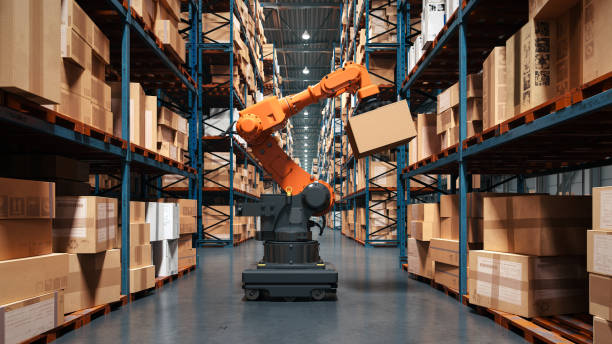
The warehouse industry is changing fast. Rising labor costs, growing e-commerce demand, and ongoing workforce shortages are pushing companies to rethink how they manage distribution and fulfillment operations. Warehouse automation sits at the center of that shift; a technology-driven approach that changes how goods are stored, moved, picked, and shipped.
For warehouse operators and third-party logistics (3PL) companies across North America, understanding warehouse automation is no longer optional. It is a business necessity. MTLI Group has spent over 40 years helping businesses design, build, and implement automation and warehousing solutions across the US and Canada, giving operators the tools they need to stay competitive.
What Is Warehouse Automation?
Warehouse automation refers to the use of technology, software, and mechanical systems to perform tasks inside a warehouse or distribution center that workers previously did by hand. These tasks include receiving, sorting, storing, picking, packing, and shipping goods.
Automation does not always mean a fully robotic facility. It exists on a spectrum. On one end, you have basic tools like barcode scanners and conveyor belts. On the other, fully automated warehouses use autonomous mobile robots (AMRs), artificial intelligence, and warehouse management systems (WMS) to handle nearly every step of the fulfillment process with minimal human involvement. Machines handle repetitive, physically demanding tasks while workers shift into supervisory, technical, and exception-handling roles.
The Core Components of Warehouse Automation Systems
Warehouse automation systems are rarely a single product. They are groups of connected technologies that work together. Here are the most widely used components:
Conveyor and Sortation Systems: Conveyors move products through the facility automatically, while sortation systems direct items to specific shipping lanes or pack stations based on real-time data. These form the backbone of most large-scale distribution centers.
Automated Storage and Retrieval Systems (AS/RS): AS/RS technology uses cranes, shuttles, or robotic carousels to store and retrieve inventory from high-density racking. These systems make better use of vertical space and reduce the time workers spend walking aisles.
Autonomous Mobile Robots (AMRs): AMRs navigate warehouse floors on their own using sensors and mapping technology. Unlike older automated guided vehicles (AGVs) that follow fixed floor paths, AMRs adjust their routes in real time, making them more flexible in fast-changing environments.
Warehouse Management Systems (WMS): A WMS is the software that runs an automated warehouse. It directs inventory placement, order routing, and labor allocation, and connects with enterprise resource planning (ERP) systems for full supply chain visibility.
Pick Modules and Goods-to-Person Systems: These bring inventory directly to the picker instead of requiring workers to walk the floor. That change alone increases pick rates and reduces errors in high-volume operations.
Why Businesses Are Investing in Warehouse Automation Now
The Labor Shortage Is Not Going Away
The warehousing labor market has been under pressure for years, and the data backs that up. According to the U.S. Bureau of Labor Statistics, warehousing firms are increasingly adopting automation solutions, including WMS platforms, AGVs, robots, and AI-based systems, because the productivity gains from these tools are expected to reduce dependence on manual labor in the years ahead.
Turnover makes the problem worse. Separation rates in warehousing and transportation sit at 5.3%, with quit rates around 2.3%, according to BLS-sourced industry data. This keeps operators in a cycle of hiring and training that drives up costs. A Supply Chain Quarterly survey found that only 2.9% of Generation Z respondents expressed interest in careers in transportation, distribution, and logistics. The workforce pipeline for manual warehouse work cannot keep up with demand.
The Cost Pressure Is Real
Labor costs in warehousing have risen steadily. According to BLS wage data, the national average hourly wage for order fillers and stockers has increased roughly 35% over the past decade. When you add benefits, overtime, and turnover costs, the total cost of manual labor is pushing more operators to look at automation.
The results speak for themselves. Automated picking systems can improve order fulfillment speeds by up to 300%. Warehouses using automation report a 25% drop in workplace injuries and a 35% increase in productivity. Warehouse automation has the potential to cut total labor costs by 30 to 40% over the next five years.
E-Commerce Is Raising the Bar
Customer expectations for same-day and next-day delivery have put more pressure on throughput. For warehousing and distribution operations and 3PL companies managing multiple clients with strict service agreements, automated warehouse solutions provide the capacity and consistency that manual operations cannot sustain at scale.
The market reflects this shift. The mobile robot market is projected to grow from just under $5 billion in 2024 to $14 billion in 2030, a 19% annual growth rate. Robot orders in North America grew 6.6% in a recent period, with food and consumer goods sectors seeing 51% growth in 2025, according to the Association for Advancing Automation (A3). By 2027, roughly 26% of warehouse sites globally are expected to be automated.
How MTLI Group Supports Warehouse Automation Projects
Implementing warehouse automation takes more than picking the right equipment. It requires expertise in facility design, structural construction, equipment installation, system integration, and ongoing facility management. That is where MTLI Group adds value.
With over 40 years of experience and more than 15,000 completed projects across North America, MTLI Group delivers end-to-end solutions covering conveyor systems, AS/RS, shuttle systems, pick modules, and automation retrofits, all backed by in-house construction and general contracting. This means the physical building and the automated systems are planned together from day one, so nothing falls through the gaps when multiple systems need to work together.
MTLI Group works with warehouse operators, 3PL companies, e-commerce fulfillment centers, food and beverage facilities, cold storage operations, and more across all 50 US states and Canadian provinces. Whether building a new facility or updating an existing one, MTLI Group manages the full project. Contact the team to find out which automated warehouse solutions fit your operation, order volumes, and budget.
Key Considerations Before Investing
Automation is not the same for every operation. Operators and 3PL companies should review several factors before committing to a specific approach.
Throughput and Order Profiles: The right solution depends on daily order volumes, SKU count, order complexity, and seasonal variation. A facility processing 500 orders per day has very different needs than one processing 50,000.
Facility Infrastructure: Building height, floor load capacity, column spacing, power supply, and fire suppression systems all affect which automation systems will work. A structural review early in the process avoids problems during installation.
Total Cost of Ownership: Capital costs, maintenance, training, and downtime during setup all factor into the real project cost. A realistic return on investment (ROI) model should include all of these over a set time period.
Phased Implementation: Not every operation needs to automate everything at once. Starting with the highest-return applications such as automated sortation or goods-to-person picking and expanding once results are proven is a workable approach for operators with budget limits or complex existing setups.
Final Thoughts
Warehouse automation is already a reality for companies that want to stay competitive. Labor market pressures, e-commerce growth, and advances in technology have made automation the most practical path forward for warehouse operators and 3PL companies that want to grow without adding costs at the same rate.
The businesses investing in warehouse automation systems today are building a foundation that will pay off for years. MTLI Group has the expertise and project delivery experience to help your operation make that shift successfully. Contact the team to start the conversation.