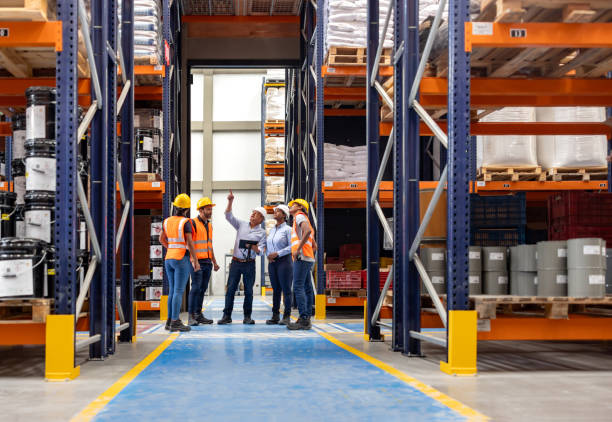
Most warehouse safety incidents trace back to a small, predictable list of issues. The same hazards show up year after year on OSHA's citation reports, and the same fixes prevent nearly all of them. For safety officers, the work is rarely about chasing exotic risks. It is about staying consistent on the basics: guarding, training, housekeeping, and equipment inspection.
MTLI builds and maintains facilities with warehouse safety designed into the structure, not bolted on afterward. This guide covers the most common safety violations cited in warehouses, what triggers them, and the practical steps safety officers can take to avoid them.
Why Warehouse Safety Violations Carry Real Financial Risk
Citations are not just paperwork. As of 2026, OSHA's maximum penalty for a serious violation stands at $16,550, while willful or repeated violations can reach $165,514 per violation (Occupational Safety and Health Administration, OSHA Penalties, 2026). Warehousing and storage operations consistently rank among the industries with the heaviest concentration of citations, alongside manufacturing and repair and maintenance (Occupational Safety and Health Administration, Top 10 Most Frequently Cited Standards, FY2025).
Good warehouse safety practice is not about eliminating every conceivable risk overnight. It is about identifying the violations that show up most often in federal inspection data and addressing them with consistent, documented controls rather than one-time fixes.
Fall Protection Gaps
Fall protection has been the single most cited OSHA standard for more than a decade, with thousands of citations issued annually across all industries, and warehouses are not exempt (Occupational Safety and Health Administration, 29 CFR 1926.501). In a warehouse setting, this usually shows up around mezzanine edges, loading dock openings, and elevated work platforms that lack proper guardrails.
General industry rules require fall protection at four feet or more above a lower level, lower than the six-foot threshold used in construction. Safety officers should treat any open mezzanine edge, dock leveler pit, or platform without a permanent guardrail as an immediate priority, since these gaps are among the easiest for an inspector to spot during a walkthrough.
Hazard Communication Failures
Hazard Communication, governed by 29 CFR 1910.1200, consistently ranks among the top cited standards across all industries (Occupational Safety and Health Administration, 29 CFR 1910.1200). In warehouses, this typically means missing or outdated Safety Data Sheets, unlabeled chemical containers, or a written hazard communication program that exists on paper but does not match what is actually happening on the floor.
Common Warehouse Safety Violations and Primary Fixes
| Violation Area | Common Trigger | Primary Fix |
|---|---|---|
| Fall protection | Open mezzanine or dock edges | Permanent guardrails, edge marking |
| Hazard communication | Missing or outdated safety data sheets | Updated SDS binder, container labeling |
| Machine guarding | Missing or bypassed guards | Guard checks, lockout procedures |
| Powered industrial trucks | Untrained or unrefreshed operators | Documented training, refresher schedule |
| Respiratory protection | Improper fit testing or selection | Annual fit testing, written program |
Machine Guarding Gaps
Conveyors, palletizers, and other powered equipment introduce crush, entanglement, and pinch point hazards if guards are missing, damaged, or bypassed. OSHA's general industry standard requires guarding wherever moving machine parts create a hazard to workers, and inadequate guarding remains a frequent finding during inspections (Occupational Safety and Health Administration, 29 CFR 1910.212).
Safety officers should treat guard removal as a controlled event, never something a worker does informally to clear a jam faster. Lockout and tagout procedures should apply any time a guard is removed for maintenance, and guards should be inspected as part of routine equipment checks rather than only after an incident occurs.
Powered Industrial Truck and Forklift Hazards
Forklifts are involved in a large share of warehouse incidents, ranging from collisions with pedestrians to tip-overs caused by overloading or uneven surfaces. Common contributing factors include poor visibility at blind corners, inadequate or expired operator certification, and mixing pedestrian traffic with vehicle traffic in the same aisles.
Practical prevention steps include marking clear pedestrian walkways separate from forklift travel paths, installing mirrors or warning systems at blind intersections, requiring documented refresher training at set intervals rather than just at hiring, and conducting daily pre-shift equipment checks before any forklift goes into operation.
Building OSHA Warehouse Safety Compliance Into Daily Operations
Strong OSHA warehouse safety compliance does not come from a once-a-year inspection push. It comes from daily habits built into supervisor walk-throughs and shift handoffs. A practical approach includes:
- Daily visual checks. Supervisors scan for blocked exits, damaged racking, and missing guards as part of their normal floor walk.
- Documented training records. Every operator and employee handling hazardous tasks should have a signed, dated training record on file.
- Scheduled internal audits. Quarterly self-inspections against OSHA standards catch issues before a federal inspector does.
- Written programs for required standards. Lockout and tagout, hazard communication, and personal protective equipment programs need to exist in writing, not just in practice.
- Clear incident reporting. Near-misses should be logged and reviewed, not dismissed as minor events that did not result in injury.
Building a Warehouse Compliance Program
| Program Element | What It Involves | Frequency |
|---|---|---|
| Hazard identification | Walk-throughs, incident review | Weekly or daily |
| Equipment inspection | Forklifts, racking, machine guards | Daily to monthly |
| Staff training | Initial and refresher safety training | At hiring, then annually |
| Documentation | Inspection logs, training records | Ongoing |
| Internal audits | Self-inspection against OSHA standards | Quarterly to annually |
Personal Protective Equipment Gaps
Personal protective equipment violations often stem from an incomplete hazard assessment rather than a complete absence of PPE. OSHA requires employers to assess workplace hazards, document that assessment, provide the correct PPE for the identified hazards, and train employees on proper use. A facility that issues generic safety glasses and gloves without first documenting which specific tasks require which specific equipment is exposed to citation even if workers are technically wearing some form of protection.
Warehouse Compliance Across Recordkeeping Requirements
Warehouse compliance extends beyond physical hazards into recordkeeping. OSHA requires covered employers to maintain accurate injury and illness logs and to verify abatement of any cited hazard within the timeframe set by an inspector. Falling behind on these administrative requirements, even when the physical workplace is reasonably safe, still results in citations during an inspection.
Safety officers should assign clear ownership for recordkeeping tasks, just as they would for physical hazard checks. A facility with excellent guarding and training but incomplete injury logs can still face a citation that a well-organized facility would have avoided entirely.
How Facility Design Reduces Violation Risk From the Start
Many common violations trace back to decisions made during the original facility design, such as aisle widths too narrow for safe forklift operation, mezzanines built without guardrails included in the original plan, or racking installed without a proper structural assessment. Addressing these issues after the fact is far more disruptive than building compliance into the layout from the beginning.
MTLI incorporates safety planning into our construction and general contracting projects, including aisle layout, guardrail placement, and fire code compliance for racking height. Our storage and racking solutions team also ensures every rack installation meets load capacity and anchoring requirements from day one, rather than leaving safety officers to catch design issues after the building is already in operation.
Common Mistakes Safety Officers Should Avoid
Even well-staffed safety programs run into recurring problems:
- Treating training as a one-time event. Skills and awareness fade over time without periodic refreshers.
- Relying on informal reporting. Hazards that are not documented are easy to forget or deprioritize.
- Underestimating slow-building risks. Equipment wear and minor guard damage develop gradually and are easy to miss without regular review.
- Inconsistent enforcement. Safety rules that are enforced selectively lose credibility with staff over time.
- Delaying repairs. Damaged racking, guards, or equipment left unfixed "for now" often leads to the most serious incidents and the most serious citations.
Working with MTLI to Build Compliant Facilities
Reducing warehouse safety violations works best when it starts at the construction and equipment installation stage rather than being added after problems appear. MTLI works with safety officers and facility managers across the U.S. to design layouts, install racking, and set up automated systems that reduce risk by design. Our installations teams follow the same safety standards we expect our clients to maintain, and our facility management services support ongoing inspection and repair work that keeps compliance programs on track.
Building a Safer, More Compliant Warehouse
Most warehouse safety violations come from a small set of recurring issues: fall protection gaps, hazard communication failures, machine guarding lapses, forklift hazards, and incomplete PPE assessments. Addressing each one with consistent controls, clear documentation, and regular review reduces both incidents and citations far more effectively than reacting to problems after an inspector finds them.
If your facility operates in manufacturing, 3PL and logistics, or general warehousing, building compliance into your design and daily operations protects both your workers and your bottom line. MTLI works with safety officers across the U.S. to design and build facilities that meet this standard. Contact MTLI to discuss how we can support your warehouse safety program.