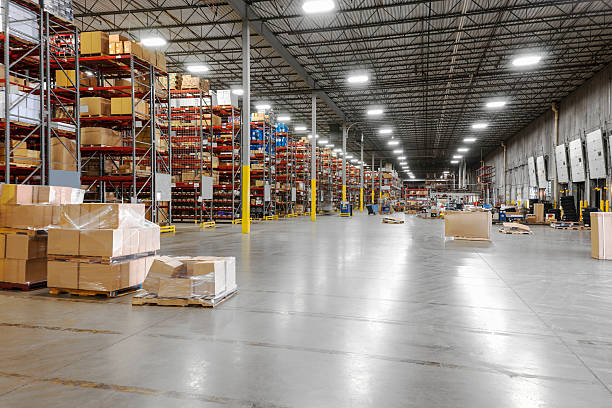
E-commerce now drives how distribution centers are built, operated, and scaled. According to the U.S. Census Bureau, US retail e-commerce sales reached $326.7 billion in Q1 2026, growing 9.8% year over year while total retail sales grew just 3.9% in the same period. That gap in growth rates translates into growing demand for distribution center space and for warehouse design that can handle high-volume, high-SKU fulfillment with speed and accuracy.
For e-commerce fulfillment companies, the decisions made during the warehouse design phase determine whether a facility scales with growing order volumes or becomes the bottleneck that limits growth. Getting the design right from the start or reviewing and updating an existing layout before adding automation, is one of the most useful investments a fulfillment operation can make.
MTLI Group has designed, built, and retrofitted distribution centers across North America for over 40 years. This guide covers the most practical warehouse design principles for growing e-commerce fulfillment operations.
Why Warehouse Design Shapes Fulfillment Performance
Warehouse design is not just about where the racks go. It is a set of connected decisions about product flow, labor movement, storage density, automation readiness, and future capacity, decisions that either support or limit every process running inside the building.
A poorly designed distribution center sends workers on inefficient routes, creates traffic conflicts between incoming and outgoing product, makes automation harder to add later, and leads to throughput failures during peak seasons. A well-designed facility moves product in a logical sequence, supports workers at every station, and can grow without needing a complete rebuild.
For e-commerce fulfillment companies, warehouse design has added complexity. The average e-commerce order has one to two line items, volumes swing sharply across seasons and promotions, return rates are high, and the number of active product types (SKUs) is large and changes often. Each of these factors shapes how the warehouse should be laid out and managed.
1: Let Product Flow Drive the Layout
The most important principle in distribution center design is this: map how product moves through the building before placing a single rack. Trace the complete path from receiving dock to storage location to pick face to pack station to outbound staging to shipping dock.
That flow map becomes the organizing principle for the entire layout. Inbound and outbound docks should be positioned to avoid product crossing paths. Receiving should connect efficiently to putaway routes. Pick paths should end at pack stations, which feed into outbound sortation. When product moves in one continuous direction, travel time drops, congestion clears, and throughput improves without adding labor.
E-commerce operations that find crossflow problems after racking is already installed face costly changes. Planning for flow from the start prevents that.
2: Slot Inventory Based on How Fast It Moves
Slotting, assigning specific products to specific storage locations, has a direct effect on pick productivity. Products that sell quickly should be stored in the most accessible locations. Products that move slowly should be stored where they need more travel time to reach.
For e-commerce fulfillment companies, this means analyzing which SKUs are ordered most frequently and assigning those pick face positions based on that data. The top 20% of SKUs by order frequency typically accounts for 80% of picks. Placing those products in the golden zone between knee and shoulder height, nearest the main pick path, reduces the average time spent per pick across the entire shift.
Warehouse layout optimization through dynamic slotting also needs to account for seasonal and promotional changes. A slow-moving item in January can become a top mover in November. Building a regular slotting review into warehouse operations keeps pick face assignments accurate and productive year-round.
3: Use Vertical Space From the Start
When e-commerce operations run out of storage space, the first instinct is often to find a bigger building. But building height is a practical and cost-effective alternative.
Distribution center designs that include high-bay racking, mezzanine levels, or automated storage and retrieval systems (AS/RS) use vertical space that ground-level shelving leaves unused. Designing for vertical storage from the beginning; confirming ceiling height, floor load ratings, fire suppression clearance, and column spacing before specifying storage equipment, allows operations to hold more inventory in the same footprint.
For growing e-commerce companies, SKU counts and inventory volume tend to grow faster than physical space. Building vertical storage capacity early creates a buffer that delays or eliminates the need for a facility move or expansion.
4: Keep Inbound and Outbound Flows Separate
In smaller or early-stage fulfillment operations, inbound receiving and outbound shipping often share dock doors, staging space, and staff. That arrangement works at low volumes but creates problems as throughput grows.
Inbound and outbound operations run on different schedules. Supplier and carrier deliveries arrive on their own timelines, often in large batches. Outbound shipping is driven by fixed carrier pickup windows. When both flows compete for the same docks and labor, throughput becomes unpredictable and missed pickups become a regular problem.
Effective distribution center design gives inbound and outbound operations their own dedicated dock doors, staging lanes, and material handling paths. For e-commerce fulfillment operations with same-day or next-day commitments, that separation is a requirement for meeting service levels consistently.
5: Design for Automation From Day One
One of the most common and costly mistakes in warehouse design is trying to add automation to a building that was not built to support it. Support columns too close together block conveyor runs. Floors that cannot support the load prevent AS/RS deployment. Ceilings too low for high-bay storage. Every one of these problems requires structural remediation that is far more expensive than getting it right at the design stage.
According to MHI, 41% of supply chain organizations currently use robotics or automation, and that number is expected to reach roughly 83% within five years. Designing a facility with automation-ready infrastructure from the start even if the initial operation is fully manual makes the right structural and electrical decisions when they are cheapest to make. The warehouse automation solutions added later will require that infrastructure to already be in place.
6: Build Returns Processing Into the Design
Returns are a standard part of e-commerce fulfillment. Return rates for online purchases average 17 to 20% across product categories, with apparel, footwear, and electronics often running higher.
Many distribution centers handle returns in improvised spaces, a section of the receiving dock, a folding table, a part-time worker. That approach stops working as volume increases. Effective warehouse design dedicates floor space, receiving lanes, inspection stations, and restocking paths to returns from day one. A returns process that is planned into the building works reliably at scale. One that is bolted on after the fact becomes a growing operational problem.
How MTLI Group Approaches Warehouse Design
Designing a warehouse that works well today and scales with business growth requires coordination across product flow analysis, automation planning, structural design, racking and material handling systems, and construction. That is the scope MTLI Group covers on every project.
With over 40 years of experience and more than 15,000 completed projects across the US and Canada, MTLI Group brings design and construction expertise together under one project team. That means design decisions and construction execution stay aligned throughout the project, and the facility performs as intended when it opens.
Final Thoughts
Warehouse design shapes every process that runs inside the building. For growing e-commerce fulfillment companies, the layout decisions made today on product flow, slotting, vertical storage, automation readiness, and returns, determine how efficiently and cost-effectively the facility operates for years.
The US Census Bureau data makes the direction clear: e-commerce is growing more than twice as fast as total retail. Fulfillment operations that design their warehouses to scale with that growth will be better positioned to deliver on customer expectations and manage costs as volume increases.
MTLI Group provides the design expertise, construction capability, and automation integration experience to help growing e-commerce fulfillment companies build distribution centers that work now and scale over time. Connect with the MTLI Group team to start the conversation.