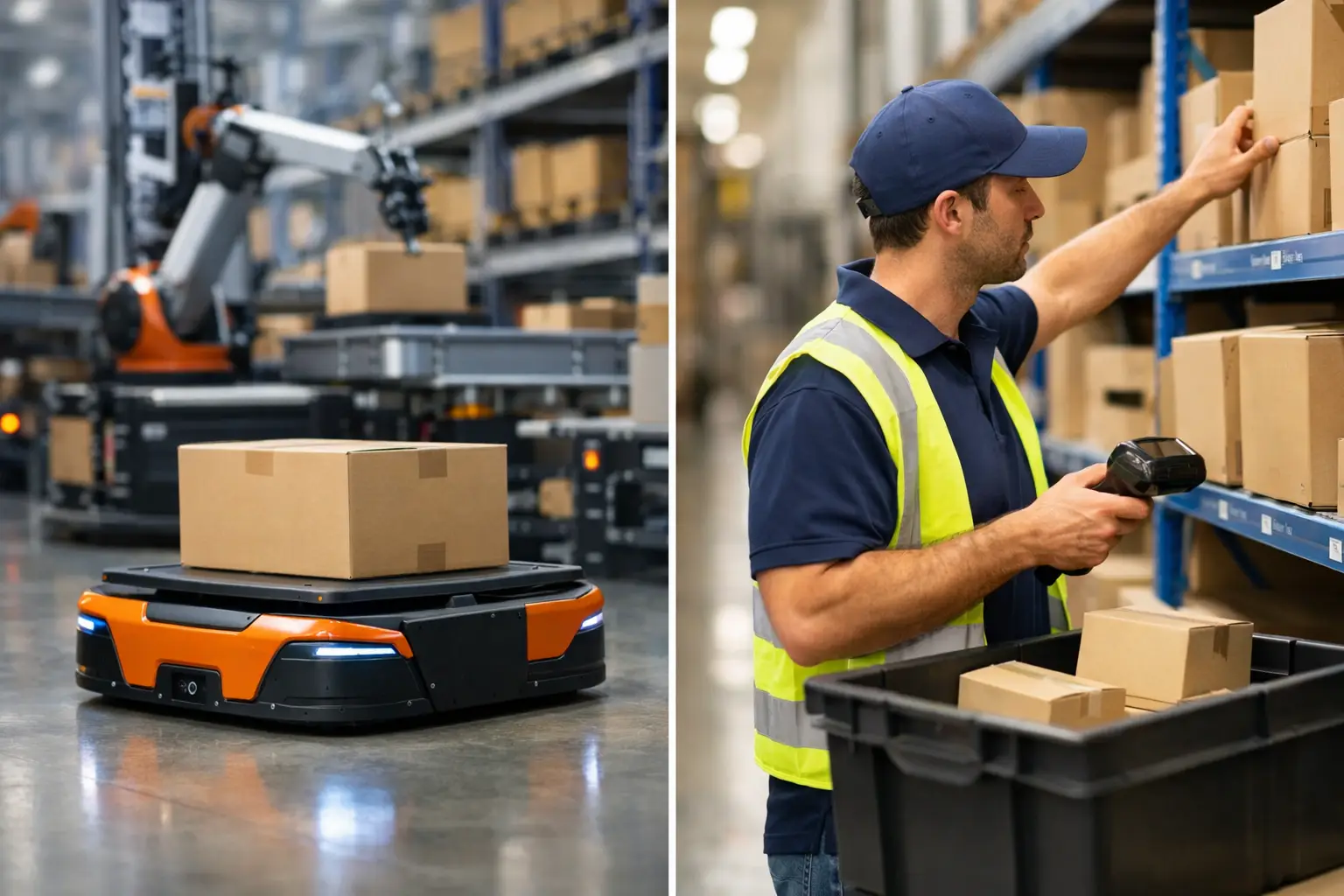
A picker walking 10 miles per shift is not just a labor-management issue. It is a material-flow issue that affects order cutoff times, accuracy, ergonomics, labor availability, and the facility’s ability to absorb growth. The decision between warehouse automation vs manual picking should start with the operating requirement, not a preference for technology or a desire to preserve the current process.
For many distribution and manufacturing operations, manual picking remains the right answer in parts of the warehouse. For others, automation is necessary to achieve service levels that a labor-dependent process can no longer support. The strongest designs often combine both, using automation where volume, repeatability, and travel time justify it while retaining manual processes where flexibility matters most.
Warehouse automation vs manual picking: the core difference
Manual picking relies on associates to travel to storage locations, identify inventory, pick product, confirm the transaction, and deliver orders to packing, staging, or production. The process may be paper-based, RF-directed, voice-directed, or supported by pick-to-light technology, but people perform the physical movement and selection.
Warehouse automation uses equipment and controls to reduce or reorganize that labor. The system may include conveyors, sortation, autonomous mobile robots, vertical lift modules, automated storage and retrieval systems, robotic picking cells, goods-to-person workstations, or pallet handling equipment. Automation does not necessarily eliminate labor. More often, it removes low-value travel, concentrates work at defined stations, and improves process consistency.
The difference is not simply speed. It is how the operation converts inventory into completed orders. A manual system is generally easier to alter as product mix, slotting, or customer requirements change. An automated system can deliver more predictable performance, but it must be designed around realistic volumes, product characteristics, maintenance requirements, and exception handling.
When manual picking remains the better business case
Manual picking is often the practical choice for operations with high SKU counts, irregular demand, frequent product changes, low order volumes, or unusually varied item dimensions. A facility that handles seasonal assortments, custom configurations, long-tail inventory, or a wide range of packaging conditions may need the adaptability of trained operators more than it needs fixed automation.
The initial capital requirement is also lower. This can matter when a business is entering a new market, operating in a leased building with a short remaining term, or working through uncertain volume projections. Manual processes can be deployed quickly using racking, mobile equipment, warehouse management system configuration, and disciplined operating procedures.
That does not mean manual picking should be treated as the low-cost option by default. Its true cost includes recruiting, training, turnover, overtime, workers’ compensation exposure, supervisory time, and productivity variation between shifts. When labor markets tighten or demand peaks sharply, a process that appears inexpensive on paper can become difficult to operate reliably.
Manual operations also benefit from targeted improvements before a major automation investment. Better slotting, optimized pick paths, zone picking, batch picking, carton-flow storage, RF discipline, and replenishment timing can materially improve throughput. In some facilities, these changes create enough capacity to defer automation. In others, they establish the process stability required for automation to work as intended.
Where automation creates measurable value
Automation is most effective where the work is repetitive, volumes are sustained, and process variability can be controlled. High-density storage systems can reduce a building’s footprint or release floor space for value-added activity. Goods-to-person solutions can reduce picker travel. Conveyance and sortation can improve movement between picking, packing, shipping, and value-added service areas. Automated pallet handling can support safer, more consistent flow in high-volume operations.
The financial case usually strengthens when the facility has one or more persistent constraints: labor availability, throughput limits, recurring accuracy issues, restricted space, demanding service windows, or a need to operate multiple shifts. Automation can also produce a more predictable capacity model, allowing leaders to plan around system rates rather than relying solely on headcount additions during peak periods.
Accuracy is another consideration. Automated processes can enforce scans, weight checks, location controls, and system-directed movement. Still, no system is immune to errors. Poor master data, inconsistent inbound labeling, damaged packaging, inadequate replenishment, and weak exception processes can reduce performance regardless of the equipment installed.
Automation requires operating discipline. Preventive maintenance, spare parts, controls support, training, and recovery procedures must be part of the project scope. A system that performs well during acceptance testing but lacks a clear support plan can become a throughput risk after go-live.
Evaluate the work before evaluating the equipment
The right comparison begins with data from the actual operation. Average daily volume is useful, but peaks drive facility design. A system sized for average demand may fail during the hours that determine customer service performance.
Review order lines per hour, units per order, SKU velocity, item dimensions and weights, inventory profile, replenishment frequency, order cutoffs, seasonal peaks, error rates, and required service levels. Separate full-case, each-pick, pallet, and value-added work. They may require different handling methods and should not be forced into a single solution.
Facility conditions matter just as much. Clear height, column spacing, slab condition, fire protection, electrical capacity, dock configuration, network infrastructure, and available staging space can determine which systems are viable. An automated design may require building modifications, new power distribution, controls integration, guarding, and changes to material flow. Those elements should be considered early, not treated as secondary installation details.
Questions leaders should answer
A disciplined business case should establish whether the operation needs capacity, labor reduction, accuracy improvement, storage density, safety improvement, or a combination of those outcomes. It should also answer four practical questions:
- Is the current volume trend sustained enough to support capital investment?
- Can the product and order profile be standardized for the proposed process?
- What happens when the system encounters an exception, outage, or peak surge?
- Can the facility maintain customer service while installation, commissioning, and cutover are underway?
These questions expose a common mistake: selecting equipment before defining the operating model. Equipment should support the process, not dictate it.
The hybrid model is often the most effective option
The choice is rarely fully automated or fully manual. A hybrid design can reserve automation for fast-moving, repeatable products while using selective racking and manual zones for slow movers, bulky items, irregular inventory, and exceptions. This approach can lower capital exposure while directing investment to the work that consumes the most labor or constrains the most capacity.
For example, a distributor may use goods-to-person picking for high-velocity eaches, pallet racking and lift trucks for reserve storage, carton flow for medium-volume case picks, and manual specialty zones for oversized inventory. The benefit is not just lower labor in one area. It is a more balanced facility where replenishment, picking, packing, and shipping can operate at compatible rates.
A hybrid approach also supports phased execution. An operation can improve layout, storage, and manual workflows first, then add automation as volumes and operating data validate the next investment. Phasing can reduce disruption, protect cash flow, and give teams time to adapt to new processes.
Plan implementation around continuity of operations
Automation projects succeed or fail in execution. The installation sequence, equipment commissioning, controls integration, safety validation, training, and cutover plan must be coordinated with daily production requirements. This is especially critical in facilities that cannot pause shipping or manufacturing for extended periods.
A turnkey project approach helps align the physical and operational scope. Storage systems, floor layout, electrical work, guarding, equipment installation, controls, and facility modifications affect one another. Managing these elements through a coordinated plan reduces handoff risk and makes it easier to control schedule, safety, and accountability.
Before approval, require a clear view of assumptions: anticipated throughput, labor model, uptime expectations, maintenance responsibilities, peak operating conditions, and fallback procedures. The business case should include the full cost of ownership, not only equipment purchase price. That means building work, installation, software and integration, training, maintenance, spare parts, and operational support during startup.
The best decision is the one that gives the operation enough capacity to meet its service commitment without creating unnecessary complexity. Start with the work, validate the constraints, and build a picking strategy that can perform on the busiest day of the year.