Customers do not see the inside of a warehouse, but they feel everything that happens there. A late shipment, a wrong item, or a damaged box all trace back to what happened on the warehouse floor before the order ever left the building. For operations managers, warehouse automation benefits are not just an internal efficiency story. They show up directly in what the customer experiences, from order accuracy to delivery speed.
MTLI Group works with operations teams across the US on warehouse automation projects, from conveyor and sortation systems to robotics and controls integration. This blog looks at how automation changes the customer experience, where the biggest gains show up, and what operations managers should weigh before committing to a project.
Why Customer Expectations Are Driving the Automation Conversation
Customer expectations around delivery speed and accuracy have shifted, and the pressure on warehouses has grown with them. According to the U.S. Census Bureau, e-commerce sales in the first quarter of 2026 accounted for 16.9% of total retail sales and grew 9.7% year over year, more than double the 4.0% growth rate for total retail sales overall. That growth puts sustained pressure on fulfillment operations to move more orders without adding proportional headcount or floor space.
This is the backdrop against which most operations managers evaluate warehouse automation benefits. It is not a theoretical upgrade. It is a response to order volumes and customer expectations that keep climbing while labor availability and facility footprints stay roughly fixed.
Where Warehouse Automation Benefits Show Up for Customers
Automation touches many parts of a warehouse, but the benefits that reach customers tend to cluster around a few specific areas.
Order accuracy improves when automated picking, sortation, and verification systems replace manual steps prone to human error. Barcode scanning, weight verification, and automated put walls catch mistakes before they leave the building, reducing the wrong-item and missing-item complaints that damage customer trust.
Fulfillment speed increases as automated systems move product through the warehouse faster than manual handling allows. Conveyor and sortation systems process high volumes continuously, without the fatigue or pace variation that affects manual labor over a long shift.
Delivery window consistency improves when automated systems reduce the variability that comes with manual processes. Customers notice inconsistent delivery times more than they notice average delivery times, and automation helps operations hit the same window reliably, order after order.
Order visibility often improves as a byproduct of automation, since automated systems generate data at every step. That data feeds into tracking updates customers see, giving them more accurate information about where their order actually stands.
Manual Versus Automated Fulfillment: A Direct Comparison
The table below compares typical performance metrics between manual and automated fulfillment processes. Actual results vary by facility size, order profile, and the specific automation technology deployed.
| Metric | Typical Manual Process | Typical Automated Process |
|---|---|---|
| Pick accuracy | 97% to 99% | 99.5% to 99.9% |
| Orders processed per labor hour | Baseline | 2x to 4x higher, depending on system |
| Order cycle time consistency | Variable across shifts | Consistent across shifts and volume spikes |
| Peak volume handling | Requires added labor | Scales within existing system capacity |
| Real-time order status data | Limited, often manual updates | Continuous, system-generated |
Fulfillment Speed: What Actually Changes on the Warehouse Floor
Fulfillment speed is often the metric operations managers care about most, since it connects directly to customer-facing delivery promises. Several categories of warehouse automation contribute to faster fulfillment, each in a different way.
Conveyor and sortation systems move product between zones without the walking time that manual handling requires. In a large facility, eliminating unnecessary travel distance alone can meaningfully reduce order cycle time.
Automated storage and retrieval systems (ASRS) bring inventory to the picker instead of sending the picker to the inventory. This goods-to-person model cuts the time spent searching for and retrieving items, particularly in facilities with a large SKU count spread across a wide footprint.
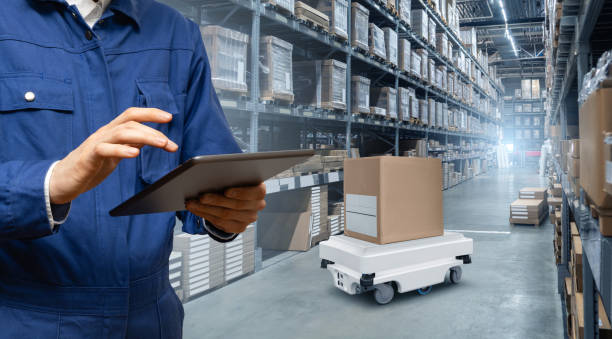
Robotics and Automated Guided Vehicles (AGVs) handle repetitive transport tasks, including moving totes or pallets between zones, freeing warehouse staff to focus on tasks that still require human judgment, such as quality checks and exception handling.
Pick-to-light and put-to-light systems guide workers through picking and sorting tasks with visual cues, reducing the time spent reading pick lists or searching for the correct location.
Each of these technologies contributes to fulfillment speed differently, which is why most automation projects combine several approaches rather than relying on a single system.
Matching Automation Technology to Customer-Facing Benefits
The table below maps common automation technologies to the customer-facing benefit each one primarily supports, which can help operations managers prioritize investment based on which customer metric matters most to their business.
| Automation Technology | Primary Customer-Facing Benefit |
|---|---|
| Conveyor and sortation systems | Faster fulfillment speed |
| Automated storage and retrieval systems | Faster picking, higher order accuracy |
| Robotics and AGVs | Consistent throughput during peak volume |
| Pick-to-light and put-to-light systems | Higher order accuracy |
| Warehouse control and execution software | Real-time order visibility |
| Automated packaging and labeling systems | Reduced shipping errors, faster dispatch |
Safety and Reliability Benefits That Reach the Customer Indirectly
Some warehouse automation benefits do not touch the customer directly but affect them indirectly through operational reliability. Manual material handling carries injury risk that automation reduces. The U.S. Bureau of Labor Statistics reported an incidence rate of 4.3 nonfatal injury and illness cases per 100 full-time workers in the transportation and warehousing sector in 2023, nearly double the 2.2 rate across private industry overall.
Fewer workplace injuries mean fewer disruptions to staffing and fewer gaps in fulfillment capacity. An operation that avoids the staffing shortfalls caused by injury-related absences maintains steadier order throughput, which customers experience as consistent, reliable service even though they never see the safety data behind it.
Evaluating Whether Automation Fits Your Operation
Not every facility needs the same level of automation, and the right starting point depends on order volume, SKU complexity, facility layout, and budget. Operations managers evaluating a project should look at a few key factors before committing.
Order volume and growth trajectory matter most. Facilities with high, steady volume typically see faster payback than those with unpredictable or seasonal demand, since automated systems perform best when utilized consistently.
Existing facility conditions, including clear height, floor condition, and column spacing, affect which automation technologies are practical without major construction work. A construction or renovation project planned alongside automation can address these constraints in a single coordinated scope.
Integration with existing racking and storage layout also affects project scope. Automation and storage and racking design work best when planned together, since retrofitting automation into a layout designed for manual picking often costs more than designing both systems as one project.
How MTLI Group Supports Warehouse Automation Projects
MTLI Group works with operations teams across the US and Canada to plan and deliver warehouse automation projects, including conveyor and sortation systems, robotics, controls engineering, and commissioning. Services also cover the installations work that ties automation systems into existing facility infrastructure, along with ongoing facility management to keep systems running reliably after commissioning.
With over 40 years of experience and more than 15,000 completed projects, MTLI Group brings the coordination needed to integrate automation with construction, racking, and electrical work under one accountable scope. This matters most for operations serving e-commerce fulfillment and 3PL and logistics clients, where fulfillment speed and accuracy are directly tied to contractual service levels.
Warehouse Automation Benefits Start With the Right Plan
Warehouse automation benefits reach customers in ways that are easy to overlook from inside the operation. Faster fulfillment speed, higher order accuracy, and more consistent delivery windows all trace back to decisions made on the warehouse floor, and the technologies that drive those outcomes vary depending on order profile, facility layout, and growth plans. Operations managers who match the right automation approach to their specific customer-facing goals tend to see the clearest return, both in operational metrics and in customer satisfaction.
MTLI Group helps operations teams evaluate, plan, and execute warehouse automation projects built around the outcomes that matter most to their customers. Contact the MTLI Group team to discuss automation options for your facility.