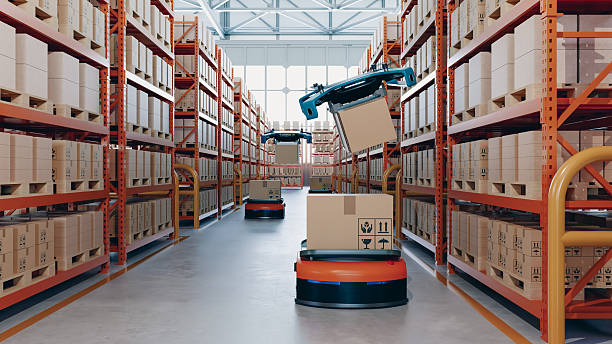
The warehouse of 2026 operates differently than it did five years ago. Supply chain executives are now working in an environment where artificial intelligence handles real-time decisions, robots manage inbound and outbound tasks at the same time, and smart warehouse technology adjusts automatically to shifts in demand. The pace of change is picking up, and the gap between early adopters and those who have not yet invested is growing.
For supply chain leaders deciding where to invest next, keeping up with warehouse automation trends is not just helpful; it directly affects how competitive their operations stay. MTLI Group has supported North American warehouse and distribution operations for over 40 years, partnering with operators to design, build, and implement automation solutions that produce real results. Here are the warehouse automation trends shaping 2026 and what each one means for your operation.
The Market Context: Why 2026 Is a Pivotal Year
The investment behind these trends is significant. According to the Association for Advancing Automation (A3), robot orders in North America during the first half of 2025 totaled 17,635 units valued at $1.094 billion; a 4.3% increase in units and a 7.5% rise in order value year over year. Non-automotive sectors including food, consumer goods, and logistics are accounting for a growing share of that demand. The global smart warehousing market stands at $32.68 billion in 2026 and is projected to reach $99.71 billion by 2034. For supply chain executives, these numbers point to an investment cycle that is already underway and not slowing down.
Trend 1: AI Moves From Planning Tool to Real-Time Operator
AI in warehousing used to mean back-office work; demand forecasting, inventory modeling, and reporting. In 2026, AI has moved onto the warehouse floor itself. AI systems now track how fast individual products move (known as SKU velocity), reorganize pick faces before congestion builds, flag optimal replenishment windows, and shift labor and robot assignments based on live order data. Instead of waiting for a manager to identify a bottleneck, the system acts on it first.
For supply chain executives, this matters because AI in warehousing is no longer just an add-on. It is becoming the layer that connects and coordinates robotics, labor, and inventory at the same time. Companies that have integrated AI into their warehouse management systems (WMS) report gains in order accuracy, pick rates, and equipment utilization that rule-based systems cannot produce.
Trend 2: Inbound Automation Gets Attention
Outbound fulfillment has received most automation investment for years. In 2026, inbound automation is catching up and early adopters are seeing real returns.
Receiving and putaway remain largely manual in most warehouses, which creates bottlenecks that limit throughput no matter how efficient downstream operations are. New systems address this directly. Robotic depalletizers handle mixed-product inbound loads using computer vision and adaptive gripping technology. AI-powered vision inspection identifies items and barcodes in real time, removing manual scanning steps. Autonomous mobile robots (AMRs) move cases and pallets from receiving docks to storage locations without human intervention.
For warehousing and distribution executives, faster inbound processing means inventory becomes available for outbound fulfillment sooner. Cutting inbound cycle time closes the gap between product arrival and when it can be sold or shipped, a key advantage for operations that keep lean safety stock levels.
Trend 3: Robotics-as-a-Service Lowers the Entry Cost
High upfront costs have historically been one of the biggest obstacles to warehouse robotics adoption, especially for mid-size operators and 3PL companies. The Robotics-as-a-Service (RaaS) model changes that.
Under RaaS, companies deploy robotic systems through subscription contracts rather than buying the equipment outright. The provider handles software updates, maintenance, and scaling. This converts a large capital expense into a predictable monthly operating cost and allows companies to increase or decrease their robotic capacity as volume changes.
For supply chain executives with tight capital budgets or significant seasonal swings, RaaS makes it possible to access the same AMR and goods-to-person systems that large fulfillment centers use, without the upfront investment that previously made those systems unavailable to smaller operations. This is one of the warehouse automation trends with the widest practical impact in 2026.
MTLI Group's warehouse automation services include guidance on equipment selection and deployment models, helping operations teams decide whether buying outright, leasing, or RaaS is the right fit for their financial structure and growth plans.
Trend 4: Digital Twins Become a Standard Planning Tool
Smart warehouse technology in 2026 goes beyond connected sensors and dashboards. The digital twin, a live virtual copy of the physical warehouse has become a standard planning and operations tool for leading supply chain organizations.
A digital twin lets managers model layout changes, test new automation setups, run throughput scenarios, and plan for disruptions, all without touching the physical facility. When a new client is coming on board, peak season is approaching, or a product line is expanding, operators can test their response virtually before committing real resources. Digital twins reduce the risk of large operational changes, speed up the design phase of automation projects, and give executives an ongoing view of how the facility is performing against targets.
Trend 5: Collaborative Robots Expand the Human-Robot Workflow
Automation discussions often focus on fully robotic facilities where robots replace all manual labor. The reality in 2026 is more practical. Collaborative robots, commonly called cobots, are growing fast because they work next to human operators rather than replacing them.
According to A3 data, cobots made up 18.1% of all robot units ordered in North America in Q3 2025, with revenue from cobot orders rising 78.2% year over year. Cobots handle repetitive or physically demanding work like picking, tote transport, packing support while workers take on tasks that require judgment, like handling exceptions and quality checks. The result is a combined human-robot model that improves productivity, lowers injury rates, and adjusts more easily to changes in product mix than a fully manual or fully automated approach.
Trend 6: Predictive Maintenance Reduces Unplanned Downtime
Unexpected equipment failure is one of the most costly problems a warehouse can face. In high-throughput environments, a conveyor stoppage or robot outage quickly leads to delayed orders and missed service commitments. Predictive maintenance, using sensor data and machine learning to spot likely failures before they happen, is now a built-in feature of many smart warehouse technology platforms.
In 2026, these systems monitor motor temperatures, vibration levels, cycle counts, and error rates across automated equipment continuously. When sensor readings suggest a failure is coming, the system notifies maintenance teams in advance so repairs can be scheduled during planned downtime rather than during peak operating hours. For supply chain executives, preventing unplanned downtime protects order commitments, extends equipment life, and cuts emergency repair costs. As automated systems grow more interconnected, predictive maintenance moves from a bonus feature to a basic operational requirement.
How MTLI Group Helps Operations Act on These Trends
Knowing which warehouse automation trends matter is one thing. Putting them into practice in a way that returns measurable value is another. That requires a partner with both technical knowledge and a track record of delivering projects.
MTLI Group brings over 40 years of experience and more than 15,000 completed projects across North America. Their work covers the full scope of an automation project, conveyor systems, AS/RS, AMRs, pick modules, shuttle systems, and automation retrofits, all supported by in-house construction and general contracting. Whether a business is making its first automation investment or expanding an existing system, MTLI Group handles assessment, design, installation, and commissioning.
Final Thoughts
The warehouse automation trends defining 2026 including AI real-time orchestration, inbound automation, RaaS, digital twins, cobots, and predictive maintenance, reflect a real and ongoing shift in how supply chain executives plan and run their operations. These technologies are in active use at scale across distribution, fulfillment, and 3PL environments today.
Supply chain leaders who invest in these trends now will build operations that are more efficient and more resilient over time. Those who delay will face rising labor costs, throughput limits, and growing difficulty meeting customer expectations.
MTLI Group works with supply chain executives across North America to design, build, and implement warehouse automation solutions. Connect with the team today to discuss how these trends apply to your operation.