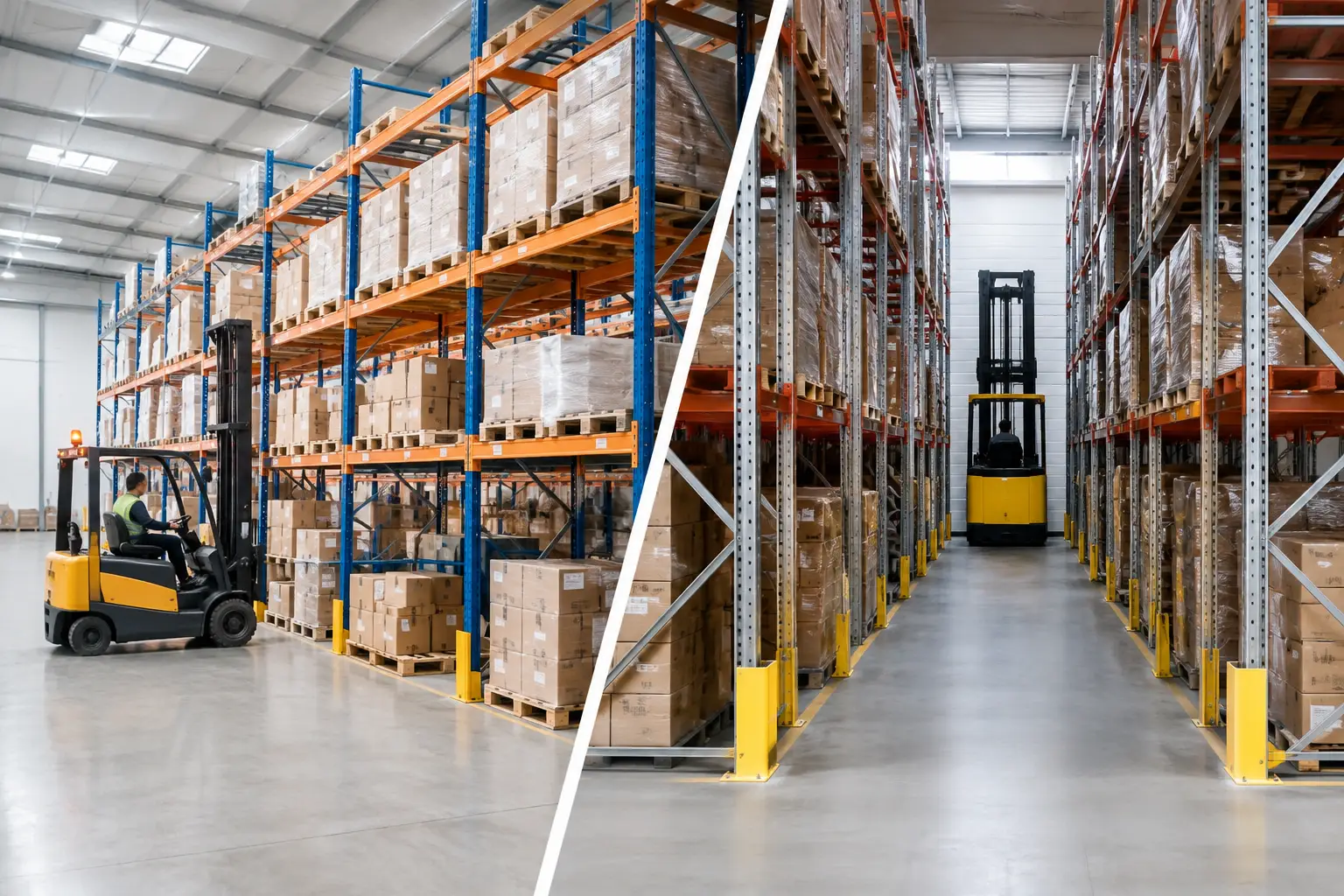
A pallet position that cannot be accessed when an order needs it is not productive capacity. That is the practical issue behind selective racking vs drive in decisions. Both systems can support high-volume warehouse operations, but they solve very different storage and material-flow problems. Choosing on price per pallet position alone can leave an operation with constrained throughput, poor inventory rotation, or an aisle layout that limits future changes.
For operations leaders, the right answer begins with SKU profile, pallet depth, inventory rotation, lift-truck travel, and the building itself. The rack system must work with the facility plan, material handling equipment, fire protection, and operating model - not simply fit within available floor area.
Selective racking vs drive in: the core difference
Selective pallet racking provides direct access to every pallet position. Rack rows are separated by aisles, allowing a lift truck to place or retrieve a pallet without moving adjacent loads. It is the most common pallet storage configuration because it handles broad SKU counts, mixed pallet quantities, and frequent picking or replenishment activity.
Drive-in racking reduces the number of aisles by creating deep storage lanes. A lift truck enters a lane to place or retrieve pallets on rails. This design stores more pallets within the same footprint, but it trades selectivity for density. In most drive-in applications, the last pallet loaded is the first pallet retrieved, making it a last-in, first-out, or LIFO system.
That distinction changes how each system performs. Selective racking supports access and flexibility. Drive-in racking supports dense storage of larger quantities of the same SKU, particularly when inventory does not require strict first-in, first-out rotation.
When selective pallet racking is the better fit
Selective racking is generally the stronger choice for distribution centers and manufacturing warehouses with diverse inventory. If the operation needs regular access to many SKUs, carries partial pallet quantities, or faces shifting product mixes, direct access has measurable value.
It also works well where inventory management requires FIFO rotation. While standard selective racking does not force FIFO by itself, operators can retrieve pallets in the required sequence because every location remains accessible. This matters for date-sensitive goods, regulated products, lot-controlled inventory, and operations where aging stock creates financial exposure.
The system is easier to reconfigure as requirements change. Beam levels can be adjusted, bays can be added or removed, and storage locations can be reassigned without redesigning deep lanes. For a facility that expects changing SKU velocity, new product lines, or a phased automation plan, that flexibility can reduce future capital disruption.
Selective racking does require more aisle space than drive-in storage. In a building where floor area is constrained and pallet quantities are concentrated in a small number of SKUs, those aisles may represent capacity that the operation cannot afford to give up. The question is whether the resulting density gain from drive-in outweighs the loss of immediate access.
Where drive-in racking delivers value
Drive-in racking is designed for dense, block-style storage of homogeneous pallet loads. It is a practical fit when an operation stores several pallets of the same SKU, has predictable lot sizes, and can work effectively with LIFO inventory flow.
Cold storage is a common example. Refrigerated and frozen facilities carry high building and energy costs per square foot, so maximizing pallet density can have a direct operating impact. Food and beverage operations may use drive-in racking for stable, high-volume products when rotation requirements allow it. Seasonal inventory, promotional goods, production buffers, and reserve storage are other frequent applications.
The design does require disciplined operation. Lift trucks travel into the rack structure, so the aisle, rack, rail, and pallet condition all affect safe performance. Operators need appropriate training, equipment clearances must be verified, and the rack must be engineered for the intended truck type and loading pattern.
Drive-in racking can also slow retrieval when an operator needs a pallet located behind other pallets in the same lane. A system may achieve excellent cubic utilization yet create avoidable handling time if high-velocity SKUs are assigned to deep lanes without considering order frequency. High density is beneficial only when it supports the required throughput.
Compare the operational trade-offs
The best way to evaluate each option is to connect storage design to operating behavior rather than treating racking as a standalone purchase.
Storage density and building utilization
Drive-in racking usually provides substantially greater pallet density because it eliminates many operating aisles. It is often the stronger choice when square footage is limited, construction expansion is expensive, or conditioned space carries a premium.
Selective racking uses more floor area per pallet position, but it can deliver better functional utilization in a mixed-SKU environment. A dense system full of inaccessible or slow-moving inventory is not necessarily more productive than a less-dense system that enables faster replenishment and accurate order fulfillment.
SKU count and accessibility
Selective racking is built for broad accessibility. It is appropriate when a warehouse must reach many SKUs throughout the day, handle multiple lots of the same product, or frequently change slotting assignments.
Drive-in racking performs best with fewer SKUs and more pallets per SKU. The deeper the lane, the more important it becomes that each lane is assigned to stable inventory. Deep lanes can be inefficient for products with inconsistent demand or low pallet quantities.
Inventory rotation
If FIFO is a fixed operating requirement, standard drive-in racking is usually not the preferred configuration. Selective racking offers the control needed to manage date codes, lot numbers, and expiration-sensitive inventory. Other high-density options, such as drive-through or pallet flow systems, may warrant evaluation when FIFO and density are both priorities.
If LIFO is acceptable, drive-in racking can be an efficient solution. That is often true for nonperishable goods, stable production inventory, or products where the most recent receipt should be consumed first.
Throughput and lift-truck travel
Selective racking allows multiple operators to work different aisles and access locations without entering storage lanes. This supports higher activity across a varied inventory profile and can reduce delays during peak shipping and receiving periods.
In drive-in storage, a truck must enter and back out of a lane for each sequence of placements or removals. This can be efficient for full-pallet movements of the same SKU, but it introduces more travel within the rack and can create congestion when several operators need the same storage block. Throughput modeling should consider peak-hour activity, not just average daily volume.
Safety, damage, and maintenance
Both systems require proper installation, load signage, inspections, and repair procedures. Drive-in racks need particular attention because trucks operate inside the rack structure. Upright protectors, guide rails, pallet quality standards, clear operating rules, and routine inspection are central to keeping the system in service.
Selective racking is generally more forgiving operationally because trucks stay in the aisle, though impacts at aisle-facing uprights remain a common source of rack damage. In either configuration, a damaged component should be assessed promptly rather than left in operation until the next planned maintenance cycle.
Design decisions that should happen before procurement
Racking selection should follow a facility assessment, not precede it. A useful project scope accounts for the pallet itself, including dimensions, weight, load overhang, condition, and whether the unit load remains stable in storage. It also accounts for lift-truck model, mast height, turning requirements, battery or charging strategy, and operator visibility.
The building creates another set of constraints. Clear height, slab capacity, column layout, dock flow, sprinkler design, egress, seismic requirements, and local code requirements can materially change the final configuration. A high-density design may require fire protection modifications or specific flue spaces that affect the anticipated pallet count.
Before committing to selective or drive-in racking, a project team should validate five inputs:
- Current and projected pallet positions by SKU and inventory lot
- Pallet dimensions, maximum weights, and load quality standards
- Receipt, putaway, replenishment, and shipping activity by shift
- Required inventory rotation method, including lot and date control
- Building, fire protection, code, and lift-truck constraints
This information turns a general storage question into an engineered layout decision. It also helps identify whether a hybrid layout is more effective. Many facilities use selective racking for active and mixed inventory, then place dense drive-in storage in reserve areas for high-volume SKUs. That approach can protect accessibility where it matters while increasing capacity for predictable inventory.
Plan for installation without disrupting operations
A racking project affects more than storage locations. It can involve demolition, slab repairs, permitting, sprinkler modifications, lift-truck changes, inventory moves, and commissioning. For an operating warehouse, sequencing is as important as final layout. A plan that accounts for temporary storage, phased installation, traffic separation, and cutover timing can reduce downtime and protect service levels.
MTLI Group approaches these projects as integrated facility work, coordinating racking design, installation, construction requirements, equipment integration, and operational transition under a single project scope. That coordination is particularly valuable when capacity needs are tied to a relocation, expansion, automation project, or facility modernization.
The right rack system should make the next shift easier to run, not just make the layout look denser on paper. Start with the inventory and the operating constraints, then build the storage plan around the access, rotation, and throughput your facility must deliver.