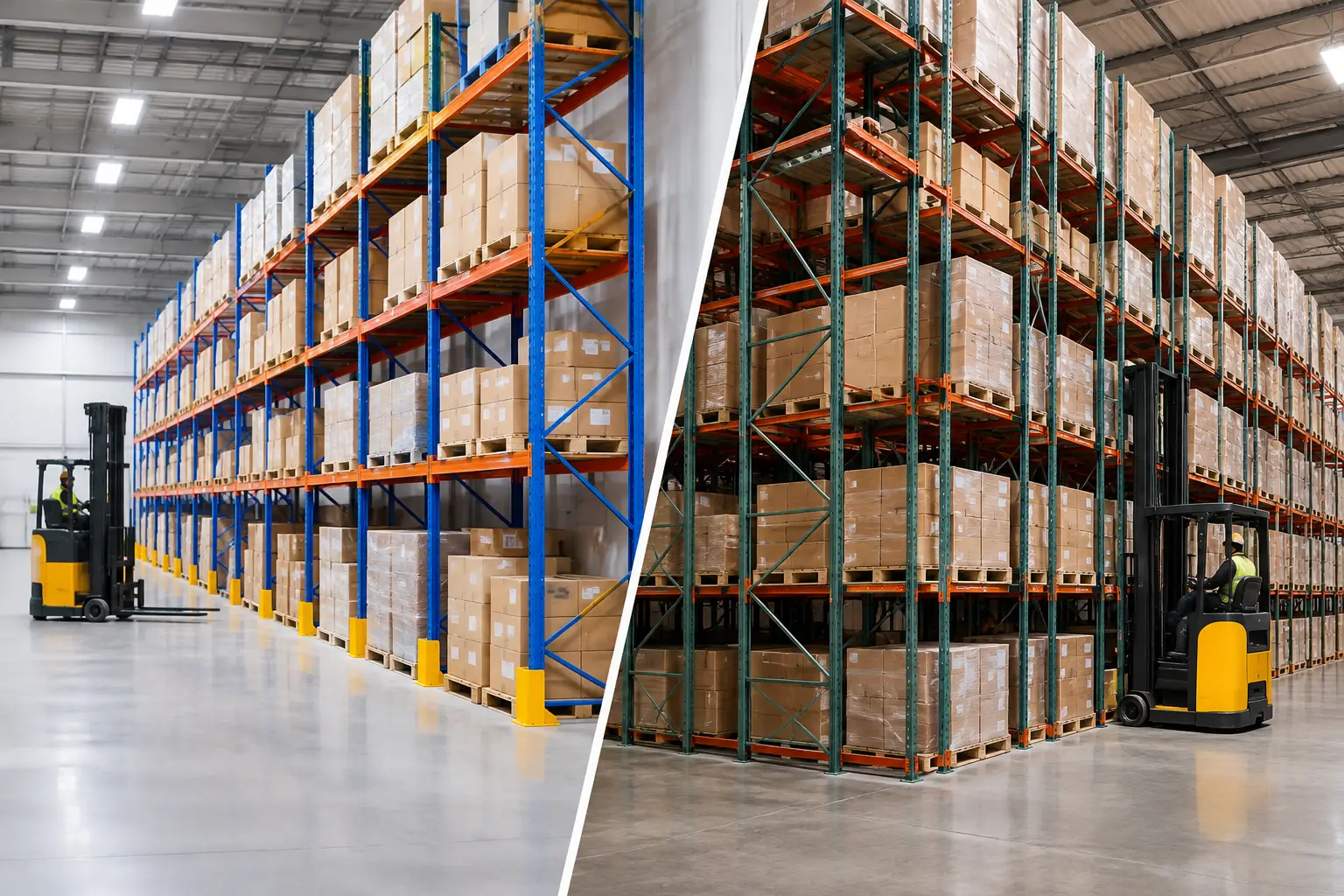
A warehouse that is short on pallet positions does not automatically need a larger building. In many cases, the decision comes down to how effectively the current cube is being used. Selective racking vs double-deep is one of the most common design decisions for operations balancing SKU access, storage density, equipment capability, and throughput.
Selective pallet racking provides direct access to every pallet. Double-deep racking trades some of that access for higher storage density by placing pallets two positions deep. Neither system is universally better. The right choice depends on inventory profile, replenishment discipline, forklift fleet, building constraints, and the cost of lost operating flexibility.
Selective Racking vs Double-Deep: The Core Difference
Selective racking stores one pallet deep on each side of an aisle. Every pallet position faces an aisle, allowing operators to access any load directly. It is the most widely used pallet storage configuration because it supports a broad range of SKUs, lot-controlled inventory, and frequent picking or replenishment activity.
Double-deep racking places one pallet behind another on each rack face. This reduces the number of aisles required to store the same volume of pallets. The result is a meaningful increase in storage density, often in the range of 20% to 40% compared with conventional selective racking, depending on the layout, pallet dimensions, clear height, and aisle requirements.
That density gain comes with a trade-off. The rear pallet is not directly accessible until the front pallet has been removed. Double-deep systems therefore work best where pallet flow follows a predictable sequence and where a portion of the inventory can tolerate last-in, first-out storage behavior.
When Selective Racking Is the Better Operating Choice
Selective racking is designed for access and flexibility. It is generally the stronger option for distribution centers with a large SKU count, variable inventory levels, or frequent outbound order activity. It also supports operations that must maintain strict first-in, first-out rotation, lot tracking, or expiration-date control without adding another storage system to manage those requirements.
For food and beverage, pharmaceutical, automotive, and many 3PL operations, direct pallet access can carry more value than maximum storage density. A rack layout that makes every pallet available helps reduce travel and handling steps when inventory must be pulled in a specific sequence.
Selective racking also works with standard counterbalance forklifts, reach trucks, and many narrow-aisle truck configurations, depending on the aisle width selected. This can reduce the capital impact of a storage expansion when the facility already operates compatible equipment.
The limitation is straightforward: selective racking consumes more aisle space. In a building with constrained square footage, low vacancy alternatives, or rising occupancy costs, the amount of floor area dedicated to aisles can become difficult to justify. A selective layout may also leave vertical capacity underused if beam elevations and pallet loads have not been engineered around the actual clear height of the facility.
When Double-Deep Racking Delivers More Value
Double-deep racking is a practical choice when a warehouse stores multiple pallets of the same SKU and needs more positions without expanding the facility footprint. It is commonly used for reserve storage, buffer inventory, production support, and distribution operations with stable, medium-to-high-volume pallet quantities.
The system is particularly effective when pallets can be grouped by SKU, production run, customer program, or other logical inventory segment. If the front and rear locations hold the same item, the reduced access is far less disruptive. Operators can pull the front pallet first and then reach the rear position as demand continues.
Double-deep storage requires specialized lift trucks. Reach trucks must be equipped with pantograph mechanisms, telescopic forks, or another suitable attachment capable of placing and retrieving loads in the rear position. Equipment selection must account for the full lift height, pallet weight, load dimensions, residual capacity, aisle width, and floor condition.
This requirement should be evaluated early. A rack design may look efficient on a layout drawing, but it will not deliver expected throughput if the lift truck fleet cannot safely operate at the required depth and elevation. Battery charging capacity, fleet maintenance, operator training, and spare equipment coverage should also be part of the business case.
Access, Density, and Inventory Control
The most significant operational difference between the two systems is not simply pallet count. It is the relationship between storage density and access.
Selective racking gives warehouse teams maximum choice. Any pallet can be retrieved at any time, which supports high SKU variety and changing demand patterns. It also makes cycle counting, damage inspection, and location audits easier because each pallet is visible and independently accessible.
Double-deep racking reduces the number of available pick faces and introduces blocked positions. If an operation stores two different SKUs in a double-deep lane, the rear pallet may be unavailable until the front pallet moves. That can create extra handling, delayed replenishment, or inventory sequencing problems if slotting is not tightly managed.
For that reason, double-deep racking is rarely the right answer for every pallet in a facility. A blended storage strategy is often more effective. Selective racking can serve high-mix, fast-moving, or date-sensitive inventory, while double-deep racking supports deeper reserve quantities of stable products. The mix should reflect actual velocity and inventory data, not broad assumptions about what a facility stores.
Throughput and Labor Considerations
Selective racking typically supports faster, more predictable retrieval because operators do not need to account for a second pallet position behind the first. This can matter in operations with tight shipping cutoffs, high replenishment frequency, or labor-sensitive order profiles.
Double-deep racking can maintain strong throughput when inventory is appropriately slotted and operators are moving full pallets in consistent sequences. However, its handling time can increase when the operation frequently needs rear pallets before the front positions are depleted. Those extra moves may be acceptable for reserve storage, but they can become costly in a high-touch picking environment.
Labor planning should consider more than lift-truck travel distance. Teams should assess putaway logic, replenishment triggers, staging space, exception handling, and warehouse management system rules. A storage system performs best when the physical design and the inventory-control process support one another.
Design Details That Affect the Decision
Racking decisions should be based on a complete facility assessment rather than a simple pallet-position calculation. Pallet quality, load overhang, load weight, beam capacity, seismic requirements, fire protection, flue spaces, egress, and sprinkler clearances all influence the final layout.
Clear height is especially important. A facility with available vertical space may gain more from additional beam levels than from changing to a denser rack configuration. Conversely, a building that has already reached its practical vertical limit may benefit substantially from reducing aisle count through double-deep storage.
Aisle width must be coordinated with the selected lift truck, not estimated from a standard template. Too little clearance creates safety and productivity issues. Excess aisle width gives away storage capacity that the project was intended to recover. The same applies to rack protection, column guards, end-of-aisle barriers, and loading practices. These are operating requirements, not optional add-ons.
Permitting and code compliance also need to be addressed before installation. Changes to rack layout can affect fire protection design, occupancy conditions, permit requirements, and local authority approvals. Addressing these items during engineering helps avoid project delays and rework after equipment is on site.
Making the Right Investment
The best choice is usually tied to the inventory profile. Operations with many SKUs, frequent access requirements, and strict rotation needs typically benefit from selective racking. Facilities carrying deeper quantities of fewer SKUs, particularly in reserve storage, may recover significant capacity with double-deep racking.
The capital comparison should include more than rack material and installation. Evaluate lift-truck changes, battery infrastructure, warehouse management system configuration, training, fire protection modifications, project phasing, and the cost of operational disruption. A lower-cost rack layout can become the more expensive option if it creates persistent handling inefficiency or requires frequent reconfiguration.
MTLI Group approaches storage projects as facility and operations projects, not as isolated rack installations. That means aligning rack engineering, material handling equipment, installation sequencing, safety requirements, and facility constraints before work begins. For active warehouses, the installation plan should protect throughput and limit downtime as much as possible.
Before committing to either configuration, validate the design against actual SKU velocity, pallet counts by SKU, projected inventory growth, lift-truck capability, and peak-season requirements. The right racking system is the one that creates capacity without making the warehouse harder to operate.