A warehouse can gain substantial pallet positions and still create a slower, less controllable operation. That is the central decision behind pallet flow versus pushback storage. Both systems increase storage density by reducing aisles, but they move inventory differently, support different rotation rules, and place different demands on product profiles and material handling equipment.
For operations leaders, the better choice is rarely the system that produces the highest position count on a drawing. It is the system that protects throughput, inventory accuracy, product quality, and labor performance under actual operating conditions.
Pallet Flow Versus Pushback: The Core Difference
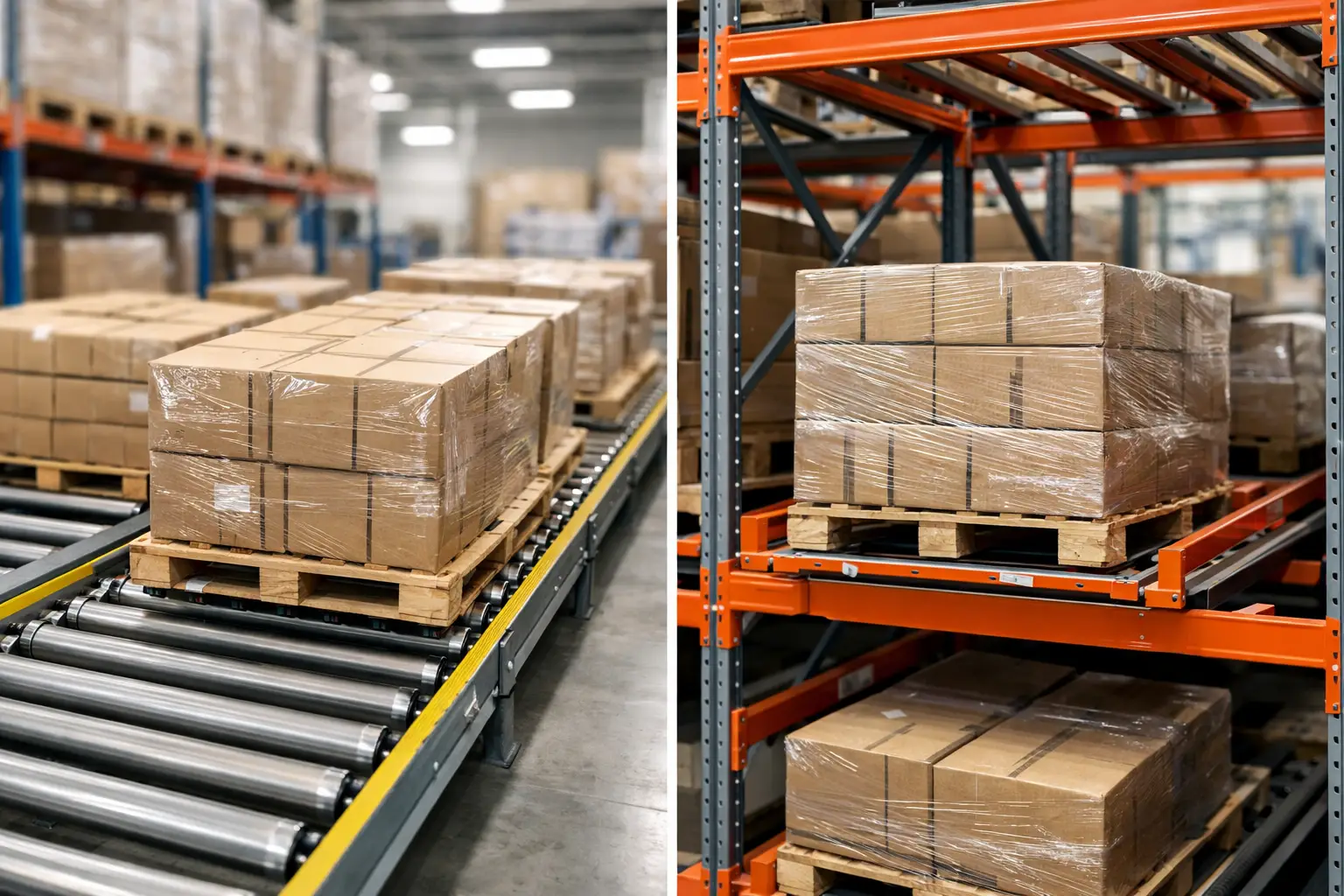
Pallet flow rack uses gravity-fed lanes with rollers or wheels. Pallets are loaded at the higher end of a lane and travel forward to the pick face as downstream pallets are removed. Loading and unloading occur from opposite sides of the system, creating a first-in, first-out, or FIFO, inventory flow.
Pushback rack stores pallets on nested carts that travel on inclined rails. A lift truck pushes each new pallet into the lane, which moves the pallets already stored farther back. When the front pallet is removed, the remaining pallets roll forward. Loading and unloading happen from the same aisle, creating a last-in, first-out, or LIFO, inventory flow.
That distinction affects more than rotation. It influences dock and aisle layout, replenishment strategy, available storage depth, lift truck travel, and how easily an operation can recover from a quality hold or inventory issue.
When Pallet Flow Is the Better Fit
Pallet flow is built for operations where inventory rotation cannot be compromised. Food and beverage distribution, cold storage, pharmaceutical products, date-sensitive goods, and high-volume replenishment operations often benefit from its FIFO discipline. The oldest pallet loaded into a lane is positioned to be picked first, helping reduce the chance that older inventory remains trapped behind newer receipts.
The system also separates loading activity from picking activity. Receiving or replenishment trucks work from one side, while order picking or shipping activity occurs at the opposite face. This separation can reduce traffic conflicts and support higher throughput, especially where the same SKUs are moving continuously through defined lanes.
Pallet flow performs well when an operation has a relatively stable SKU profile and enough volume per SKU to justify dedicated lanes. A lane that turns quickly is productive. A lane holding slow-moving product may tie up valuable space and introduce avoidable handling complexity.
The trade-off is that pallet flow requires access to both ends of the rack. That requirement has meaningful layout implications. It can consume floor space for loading and pick aisles, and it may not fit every existing building or retrofit footprint. The dynamic components also require careful design, installation, commissioning, and periodic maintenance. Roller speed controls, pallet separators, lane depth, pallet quality, and load weight must work together reliably.
For freezer environments, pallet flow can be particularly valuable because it concentrates storage and supports FIFO movement. However, cold storage applications require components selected for low-temperature performance and a maintenance plan that accounts for condensation, debris, and equipment access.
Operational strengths of pallet flow
Pallet flow provides predictable FIFO rotation, high-density storage, and separate replenishment and retrieval faces. It is often the stronger choice for fast-moving, perishable, regulated, or time-sensitive inventory. It can also reduce replenishment congestion when designed around the operation's actual load and pick patterns.
Its limitations are equally practical: higher initial system complexity, two-sided access requirements, and less flexibility for many low-volume SKUs. It is not a universal answer for any warehouse that needs more capacity.
When Pushback Rack Is the Better Fit
Pushback rack is often selected when density is the primary goal and LIFO inventory handling is acceptable. It allows multiple pallets to be stored deep while requiring access from only one aisle. This can make it an efficient option for warehouses with limited floor area, variable building constraints, or an existing selective-rack layout being converted to a higher-density solution.
Because loading and retrieval occur from the same side, pushback generally simplifies the physical layout. It is commonly used for reserve storage, staging, buffer inventory, and product categories with longer shelf life. Manufacturing facilities may use it to hold components, packaging materials, or finished goods where strict date rotation is not required. Distribution operations may use it for medium-velocity SKUs that do not warrant a dedicated FIFO flow lane.
Pushback is also suited to operations with multiple SKUs but fewer pallets per SKU than a typical pallet flow application. Lane depth can be configured to suit inventory requirements, but each lane should generally contain a single SKU. Mixing SKUs within a pushback lane creates inventory control risk because the pallet at the back cannot be accessed until the pallets ahead of it are removed.
The main limitation is LIFO. The newest pallet loaded is the first pallet available for retrieval. That can be acceptable for stable, nonperishable inventory, but it is a poor fit for products with expiration dates, lot control requirements, or customer-specific rotation rules. Warehouse management system logic can help manage inventory allocation, but software does not change the physical sequence of pallets in a lane.
Operational strengths of pushback
Pushback provides high density from a single aisle, reducing the aisle space required compared with selective pallet rack. It can be a practical capacity improvement where a facility needs more reserve storage without a major building expansion. The system is typically less layout-intensive than pallet flow because it does not require loading access on the back side of the rack.
It still requires disciplined operating practices. Lift truck operators must place pallets squarely and consistently, and the system must be designed for pallet dimensions, load weights, truck type, and lane depth. Damaged pallets, inconsistent load overhang, or unsuitable pallet construction can interfere with cart movement and create maintenance or safety issues.
Compare the Decisions That Affect Performance
The most effective comparison starts with inventory behavior, not a rack preference. FIFO requirements should be the first screening factor. If lot rotation, freshness, or expiration control is mandatory at the storage-lane level, pallet flow is generally the better fit. If LIFO is operationally acceptable, pushback becomes a strong candidate.
Next, assess SKU velocity and pallet depth. Pallet flow is most effective for high-throughput SKUs that can keep lanes moving. Pushback can work well for moderate-volume inventory where storing several pallets deep creates a meaningful density gain. In either system, overly deep lanes assigned to slow movers can reduce accessibility and create stranded capacity.
Available aisle configuration matters as well. Pallet flow needs replenishment access on one side and retrieval access on the other. Pushback needs one working aisle. In an existing facility, that difference may determine whether a project can be installed within the current footprint or requires a broader layout change.
Lift truck selection is another practical consideration. Reach trucks, counterbalance trucks, turret trucks, and pallet handling attachments all have different clearances, capacities, and operating characteristics. Rack geometry must account for the actual equipment that will work the system, including elevated handling, turning radius, operator visibility, and battery or charging strategy.
Finally, evaluate total cost rather than rack cost alone. The installed price includes structural support, dynamic components, fire protection impacts, controls or guarding where needed, equipment access, and commissioning. It should also reflect the operational cost of travel, replenishment, product rotation, maintenance, and downtime risk over the system's service life.
Design Details That Should Not Be Deferred
Dynamic storage systems are not interchangeable rack modules. Engineering must address pallet size, pallet condition, load distribution, maximum and minimum pallet weights, lane depth, clearances, floor slab conditions, seismic requirements, and local code compliance. A system that looks correct in plan view can still perform poorly if the pallet fleet is inconsistent or the loading process does not match the rack design.
Fire protection review is especially important in high-density storage. Changes to storage depth, commodity classification, storage height, flue spaces, and sprinkler design may affect permitting and project scope. Facilities should coordinate rack design with building, fire protection, and material handling requirements before procurement, not after installation has begun.
Commissioning deserves the same attention. Operators need clear rules for lane assignment, pallet inspection, loading sequence, exception handling, and damage reporting. Maintenance teams need access to inspection criteria and replacement procedures for rollers, brakes, carts, rails, and safety components. These details determine whether the system delivers its projected capacity without disrupting throughput.
Choosing a System That Supports the Whole Facility
Pallet flow and pushback can both be part of the same warehouse. A facility may use pallet flow for date-sensitive, high-velocity finished goods and pushback for reserve inventory, staging, or stable components. The right answer can be a blended storage strategy rather than a single rack type applied across every product category.
Before finalizing a design, model the operation around SKU velocity, inventory turns, pallet quantities, product rotation requirements, lift truck traffic, and future growth. A storage system should support the building, fire protection, equipment, process flow, and operating team as one coordinated project. That is how added density becomes usable capacity rather than a constraint that appears after go-live.