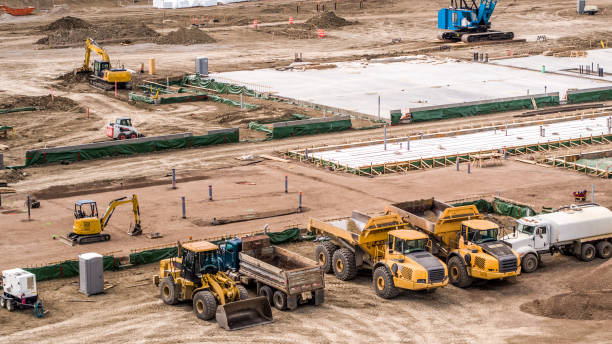
A single warehouse build is hard enough to keep on schedule. A multi-site rollout across ten, twenty, or fifty locations multiplies every one of those challenges, since a delay at one site can ripple into procurement, staffing, and go-live dates at every other site in the program. Operations managers running these programs need a plan that holds up across different cities, permitting offices, and crews, not just one strong project manager at headquarters.
MTLI Group works with operations teams on construction and general contracting programs that span multiple locations at once, and this guide lays out what separates a smooth multi-site rollout from one that drags on for months past its target date.
According to the U.S. Census Bureau, total construction spending in the United States reached a seasonally adjusted annual rate of $2.21 trillion in May 2026. That level of nationwide construction activity means contractors, permitting offices, and skilled trades are in high demand at the same time your program needs them, which is exactly why a multi-site rollout needs tighter coordination than a single build.
What a Multi-Site Rollout Program Actually Involves
A multi-site rollout is the coordinated construction, installation, or renovation of the same type of facility across several locations, usually on a shared design and timeline. Retail chains use this model to open new stores. Distribution networks use it to stand up regional fulfillment centers. Manufacturers use it to bring several plants up to the same production standard.
The defining feature is repetition with variation. Every site follows the same core design and equipment package, but each one also has its own permitting rules, site conditions, and local labor market. A rollout plan that only accounts for the repeatable parts and ignores the local variation tends to run into delays at the sites nobody planned closely enough.
How Rollout Project Management Differs from a Single Build
Rollout project management carries a different set of pressures than managing one site. The table below outlines where the two approaches diverge.
| Factor | Single-Site Project | Multi-Site Rollout |
|---|---|---|
| Design | Custom to one location | Standardized template, adapted per site |
| Permitting | One jurisdiction | Multiple jurisdictions, each with its own timeline |
| Labor | One local crew | Several regional crews, often working in parallel |
| Procurement | One purchase order cycle | Bulk ordering with staggered delivery schedules |
| Risk exposure | Contained to one site | A delay at one site can affect the whole program |
| Reporting | Single project update | Program-level dashboard across all sites |
Because of this last point, a multi-site rollout needs program-level oversight, not just strong site-level management. Someone has to track how each location is progressing against the shared timeline and flag when one site's delay is about to affect procurement or staffing at another.
Building a Standardized Playbook Across Locations
The single biggest factor separating a well-run rollout from a chaotic one is a standardized playbook. This means locking in a repeatable design for warehouse automation equipment, racking layout, and electrical specs before the first site breaks ground, then applying that same package everywhere with only the adjustments each site's building code or site conditions require.
A standardized approach to storage and racking systems, for example, lets a program order in bulk, train installation crews once on the same configuration, and troubleshoot issues at one site using lessons learned at another. Without this consistency, every site effectively becomes its own custom project, which erases most of the cost and time savings a rollout is supposed to deliver.
A good playbook covers:
- Design standards. A base building and equipment layout that applies to every site, with a clear list of what can and cannot be adjusted locally.
- Vendor agreements. Pre-negotiated contracts with material and equipment suppliers that cover the whole program instead of one-off purchases per site.
- Permitting templates. A standard permit application package that gets adapted to each jurisdiction's specific requirements rather than rebuilt from scratch.
- Quality checklists. The same inspection and sign-off criteria applied at every site, so quality does not vary based on which crew built it.
Coordinating National Installation Services and Local Crews
Most multi-site programs rely on a mix of national installation services and local subcontractors. National installation services keep the technical work (racking, conveyor, automation, electrical) consistent across every site, since the same crews or the same trained standards move from location to location. Local crews handle the site-specific work, such as foundation, site prep, and local code compliance, since regional teams already know the permitting offices and inspectors.
The coordination challenge is scheduling these two groups so they are never waiting on each other. A facility that finishes its shell construction two weeks early but has to wait for the national installation crew to arrive loses that time. Programs that map out both tracks on one shared calendar, rather than managing them as separate projects, avoid most of this dead time.
Common Risks That Derail Multi-Site Programs
A few risks show up again and again across rollout programs:
Permitting delays
Different cities and counties have different review timelines, and a rollout schedule built around the fastest jurisdiction will fall behind everywhere else.
Labor availability
The Bureau of Labor Statistics projects employment of construction managers to grow 9 percent from 2024 to 2034, with about 46,800 openings projected each year on average. That growth reflects steady demand for the people who run these programs, and a rollout competing for the same regional labor pool as other projects needs to plan staffing early rather than assume crews will be available on short notice.
Equipment lead times
Automation and racking components often have order-to-delivery windows of several months. A rollout that does not order early enough for its later sites risks a bottleneck near the end of the program.
Vendor inconsistency
Using different vendors at different sites for the same equipment type makes maintenance and part replacement harder later, since a facility maintenance team then has to support multiple equipment standards instead of one.
Scope creep at individual sites
Small local adjustments can add up. A program that allows unlimited per-site customization eventually loses the cost and schedule benefits of standardization.
Where This Model Fits Best
Multi-site rollouts are common across several sectors, though the pace and complexity vary.
| Industry | Typical Rollout Driver |
|---|---|
| Retail | New store openings tied to a growth or refresh plan |
| 3PL and logistics | Adding regional distribution nodes to shorten delivery times |
| Manufacturing | Standardizing production capability across multiple plants |
| E-commerce fulfillment | Expanding fulfillment capacity ahead of demand growth |
Retail rollouts tend to run on tight seasonal deadlines, since a store opening date is often tied to a marketing calendar. 3PL and logistics rollouts usually prioritize speed to market, since each new node shortens delivery times for a defined region. Manufacturing rollouts tend to move slower but carry higher stakes, since a production standard has to work correctly at every plant from day one.
How MTLI Group Supports Multi-Site Rollout Programs
MTLI Group manages multi-site rollout programs from the initial design template through the last site's final walkthrough. Our team combines construction, racking, automation, and electrical work under one program structure, so every location follows the same standard instead of drifting based on which regional contractor built it.
For programs that involve closing or repurposing older facilities as part of the rollout, our warehouse relocation team can handle the transition without adding a separate vendor relationship to manage. With more than 40 years in the industry and over 15,000 completed projects across North America, our team has run enough of these programs to build a realistic schedule from the start rather than discovering the gaps mid-program.
Ready to Plan Your Multi-Site Rollout?
A multi-site rollout succeeds or fails based on the planning that happens before the first site breaks ground. The programs that stay on schedule are the ones with a standardized design, a clear labor and procurement plan, and one team accountable for the whole program rather than separate vendors managing each site independently.
MTLI Group is ready to help you build that plan. Get a free quote and talk through your rollout timeline with our team.