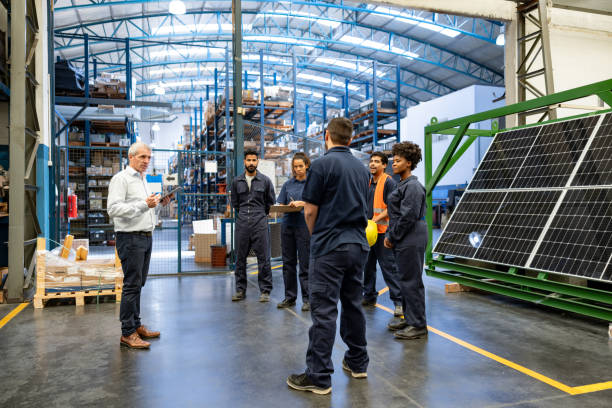
Energy costs eat into warehouse operating budgets every month, and the bill rarely goes down on its own. For operations managers watching utility spend climb year over year, warehouse energy efficiency is not a side project. It is a direct lever on the bottom line, one that competes for attention with labor, throughput, and safety, but pays back in ways those other priorities do not.
MTLI Group works with operations teams across the US and Canada on facility management and construction projects that touch this exact problem, from lighting upgrades to building envelope improvements. This blog focuses on the practical steps that move the needle on warehouse energy efficiency, what they cost, and where the payback tends to land.
Why Warehouse Energy Efficiency Matters More Than Ever
Warehouses are not the most energy-intensive commercial buildings on a square-foot basis. According to the U.S. Energy Information Administration (EIA), warehouse and storage buildings ranked among the least energy-intensive building types in the 2018 Commercial Buildings Energy Consumption Survey, well behind food service and healthcare facilities. That is the good news.
The less comfortable news is scale. Large facilities consume a disproportionate share of total energy, and warehouses have gotten larger and more automated over the past decade. Lighting, refrigeration, material handling equipment, and climate control all add up quickly across a 200,000 square foot floor plan. The same EIA survey found that commercial buildings overall used 12% less energy per square foot in 2018 than in 2012, showing that efficiency gains are achievable and already happening across the sector.
For operations managers, that trend line matters. Facilities that fall behind on efficiency measures pay a real cost, both in utility bills and in how they compare to competitors who have already made the upgrades.
Where Warehouse Energy Actually Goes
Before making any changes, it helps to know where energy use concentrates in a typical warehouse. Lighting, heating and cooling, and material handling equipment account for the largest shares in most facilities, though the exact mix depends on climate zone, building age, and whether the site includes refrigerated storage.
Lighting often represents one of the largest and easiest opportunities. Many older warehouses still run metal halide or fluorescent high-bay fixtures that consume far more electricity than modern alternatives while producing less usable light.
Heating, Ventilation, and Air Conditioning (HVAC) systems account for a significant share of energy use, particularly in facilities with inconsistent insulation or aging rooftop units. Warehouses with high ceilings and large dock door openings lose conditioned air quickly if seals and insulation are not maintained.
Material handling equipment, including conveyors, forklifts, and automated systems, draws power throughout operating hours. As more facilities add automation, this category becomes a larger share of total consumption, even as automation itself often reduces energy use per unit handled.
Lighting Upgrades: The Fastest Payback Available
Light Emitting Diode (LED) lighting remains the single most reliable warehouse energy efficiency upgrade available today. LED fixtures typically use 50% to 75% less energy than the metal halide and high-pressure sodium fixtures common in older facilities, according to the U.S. Department of Energy.
The Department of Energy's Interior Lighting Campaign, a program that tracks results from real facility upgrades, reports that participants have replaced more than 3.5 million lighting systems, saving roughly 800 million kilowatt-hours of electricity annually and $85 million in energy costs. Those are not projections. They are measured results from buildings similar to the ones operations managers run every day.
Beyond the electricity savings, LED fixtures last considerably longer than the systems they replace, which cuts maintenance costs and reduces the need for lift equipment and labor to service high-bay fixtures. Pairing LED lighting with occupancy sensors and daylight harvesting controls in areas with natural light can push total lighting energy reduction well past the baseline savings from the fixtures alone.
For facilities planning a lighting retrofit alongside other electrical work, the installations team at MTLI Group coordinates fixture replacement with broader facility upgrades to avoid running separate projects that duplicate labor and downtime.
Comparing Common Efficiency Measures
The table below summarizes typical costs, payback periods, and expected savings ranges for the most common warehouse energy efficiency measures. Actual figures vary by facility size, climate, and current equipment condition.
| Efficiency Measure | Typical Payback Period | Expected Energy Savings | Best Suited For |
|---|---|---|---|
| LED lighting retrofit | 1 to 3 years | 50% to 75% on lighting load | Nearly all facilities |
| Occupancy sensors and controls | 1 to 2 years | Additional 20% to 30% beyond LED alone | Intermittent-traffic zones |
| Dock door seals and weatherstripping | Under 1 year | Varies by dock traffic and climate | High dock-traffic facilities |
| Roof and wall insulation upgrade | 3 to 7 years | Reduced HVAC load, varies by climate | Older, uninsulated buildings |
| HVAC system upgrade or replacement | 5 to 10 years | 10% to 30% on HVAC energy use | Aging or oversized systems |
| Energy management and submetering system | 1 to 2 years | Enables ongoing 5% to 15% reduction | Multi-zone or multi-tenant facilities |
Equipment Scheduling and Automation's Role
Material handling equipment does not run at a constant rate throughout the day, but many facilities operate it as though it does. Reviewing equipment schedules against actual demand patterns often reveals conveyor sections, sortation lines, or climate zones running longer than the operation requires.
Automation plays a dual role here. Automated systems, including Automated Guided Vehicles (AGVs) and automated storage and retrieval systems, generally use energy more efficiently per unit moved than manual equivalents, since they follow optimized paths and run only when needed. At the same time, automation adds new equipment to the building's total energy load, so the efficiency gain depends on replacing less efficient manual processes rather than simply adding automated capacity on top of existing operations.
Facilities evaluating a warehouse automation project should factor energy use into the return on investment calculation alongside labor savings and throughput gains. A well-planned automation layout, developed alongside the racking and storage design, can reduce both travel distance and idle equipment time.
Energy Management Systems and Ongoing Monitoring
A single round of upgrades delivers savings, but warehouse energy efficiency is not a one-time project. Facilities that sustain their gains typically install some form of energy management or submetering system that tracks consumption by zone, equipment type, or shift.
This visibility matters because it catches problems that would otherwise go unnoticed. A refrigeration unit running longer than normal, a lighting zone left on overnight, or an HVAC system cycling inefficiently all show up in submetered data long before they show up as an unexplained spike on the monthly utility bill.
The table below outlines a simple framework operations managers can use to prioritize efficiency projects based on cost and impact.
| Priority Level | Typical Investment | Example Measures |
|---|---|---|
| Low cost, fast payback | Under $10,000 | Dock seals, LED spot upgrades, control adjustments |
| Moderate cost, solid payback | $10,000 to $100,000 | Full LED retrofit, occupancy sensors, submetering |
| Higher cost, long-term value | Over $100,000 | HVAC replacement, insulation upgrade, automation integration |
Working through this framework in order, rather than tackling the largest project first, builds momentum and generates savings that can help fund the next phase.
Building Toward a Sustainable Warehouse Operation
Individual upgrades matter, but the facilities that see the largest long-term gains treat warehouse energy efficiency as an ongoing operational priority rather than a single capital project. A sustainable warehouse operation combines efficient equipment, disciplined maintenance, and data that shows whether the current approach is working.
This mindset shift also affects how facilities plan future projects. When a relocation, expansion, or renovation is already on the calendar, folding energy efficiency measures into that project timeline costs less than addressing them as a separate initiative later. A sustainable warehouse strategy considers efficiency at every stage, from initial construction through ongoing operations and eventual facility upgrades.
How MTLI Group Supports Warehouse Energy Efficiency Projects
MTLI Group works with operations teams across the US and Canada on the construction, installation, and facility management projects that make warehouse energy efficiency achievable. Services include lighting and electrical installations, building envelope and construction work, racking and storage layout design, and ongoing facility management and maintenance programs.
With over 40 years of experience and more than 15,000 completed projects, MTLI Group brings the coordination that these projects require, particularly when energy efficiency work overlaps with construction, renovation, or automation projects already underway. For facilities in specialized environments, including cold storage and food and beverage production, MTLI Group's industry-specific experience helps address the added complexity these operations bring to energy planning.
Making Warehouse Energy Efficiency a Standing Priority
Warehouse energy efficiency is not a single fix. It is a combination of lighting upgrades, building envelope improvements, smarter equipment scheduling, and ongoing monitoring that together reduce consumption and protect the facility against rising utility costs.
MTLI Group supports operations teams working through this exact planning process, from initial assessment through construction and ongoing facility management. Reach out to the MTLI Group team to discuss warehouse energy efficiency options for your facility.