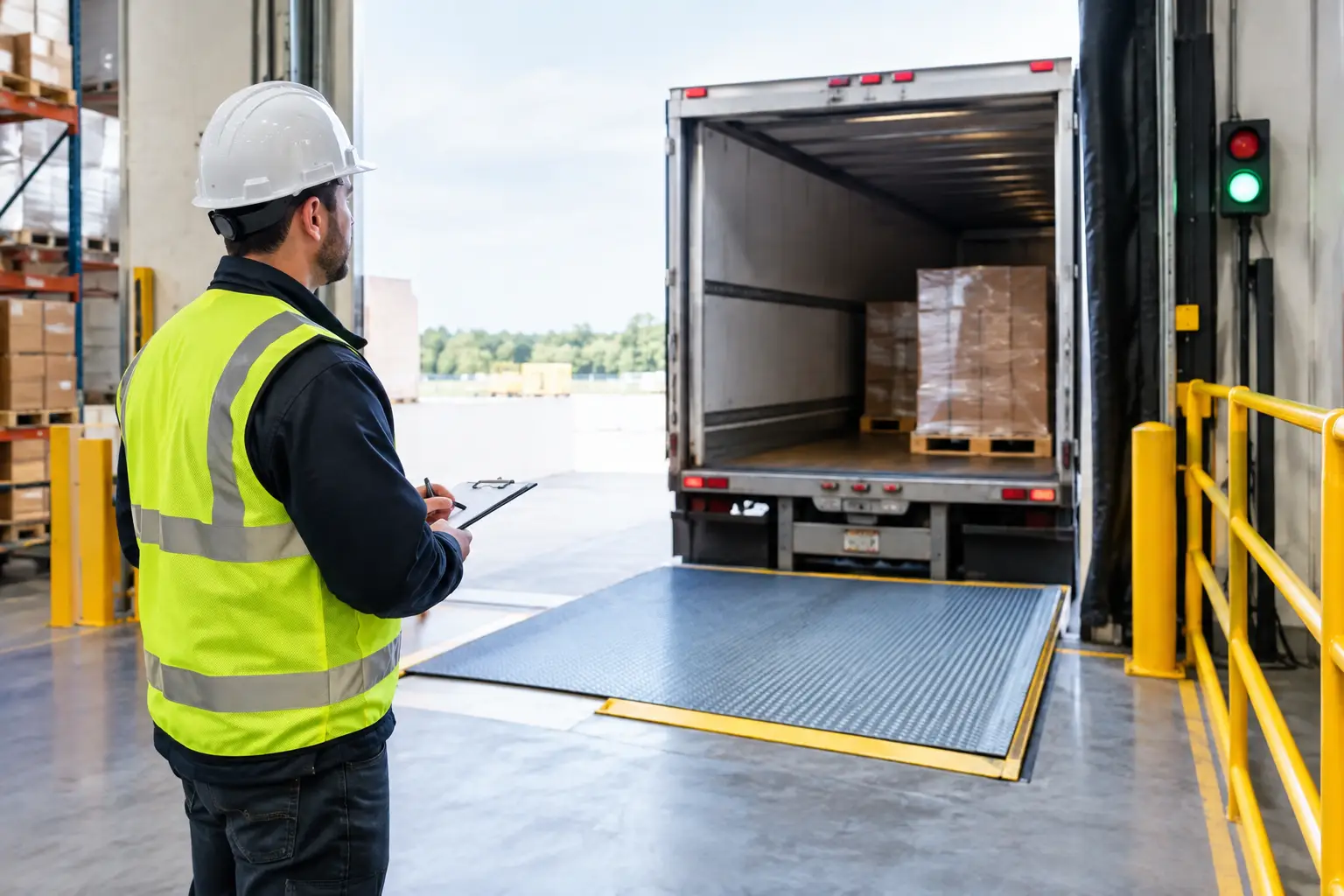
A loading dock can move hundreds of pallets in a shift while placing people, forklifts, trailers, and pedestrians in the same confined work zone. A single breakdown in communication or equipment condition can create a serious injury, product loss, trailer damage, or unplanned downtime. To improve warehouse dock safety, operations leaders need to treat the dock as a controlled system rather than a collection of separate tasks.
The most effective dock safety improvements protect employees without slowing the flow of freight. That requires practical controls that fit the building, trailer mix, traffic volume, labor model, and operating schedule. The goal is not to add procedures for their own sake. It is to create consistent conditions for safe loading, unloading, staging, and vehicle movement.
How to Improve Warehouse Dock Safety Through System Design
Dock safety is strongest when physical safeguards, operating procedures, and employee behavior reinforce one another. A well-marked floor will not compensate for unsecured trailers. A restraint system will not prevent a pedestrian strike if walkways cross forklift travel lanes without separation. Start by assessing the full movement of people and product from yard arrival through trailer departure.
1. Control trailer movement before loading begins
Unexpected trailer movement is one of the most severe loading dock hazards. Trailer creep, early departure, landing gear failure, and poor alignment can cause forklifts and employees to fall from the dock or become caught between equipment.
Use a trailer restraint or another verified securement method appropriate to the trailers your operation receives. Wheel chocks can be effective when correctly placed and consistently managed, but they depend heavily on human compliance and may not suit high-volume operations. Vehicle restraint systems provide a more controlled solution, particularly where dock activity is frequent or trailer turnover is high.
The process must also include clear communication. Drivers should know when they may back into a door, when they must remain in a designated safe area, and when they are cleared to leave. Red-green dock communication lights, visible status indicators, and documented release procedures reduce ambiguity at the point where it matters most.
2. Inspect docks, trailers, and levelers at the start of each shift
Many dock incidents are preceded by equipment conditions that employees can identify if there is a simple, enforced inspection process. Operators should inspect dock levelers, vehicle restraints, dock doors, bumpers, trailer floors, lighting, and approach conditions before work begins.
Damaged trailer flooring deserves particular attention. A forklift can fall through a weakened trailer floor, especially when handling concentrated pallet loads. Employees should be authorized to stop the process when they find soft spots, broken boards, unsecured plates, excessive gaps, or visible structural damage. Freight urgency should never override an unsafe trailer condition.
Inspections should lead to action, not just paperwork. Tag unsafe equipment out of service, communicate the issue to maintenance and supervision, and maintain a clear record of repair status. If operators see that reported issues are resolved promptly, compliance becomes more consistent.
3. Separate pedestrians from powered industrial equipment
The dock is often a mixed-traffic environment. Forklift operators are watching load placement, rack clearances, dock edges, and trailer conditions. Pedestrians may be checking paperwork, wrapping pallets, handling returns, or coordinating with drivers. Relying on eye contact alone is not an adequate traffic-control strategy.
Create designated pedestrian routes that avoid active forklift lanes whenever possible. Use barriers, guardrails, marked crossings, swing gates, and controlled access points to make the safe route the easiest route. High-visibility floor markings help, but physical separation is more reliable in busy areas.
Pay close attention to cross-traffic near staging lanes, battery charging areas, dock offices, and break rooms. If pedestrians must enter an active loading area, establish a clear right-of-way rule and a method for communicating with equipment operators. The correct layout varies by facility, but the principle remains the same: reduce opportunities for people and powered equipment to occupy the same space unexpectedly.
4. Improve visibility at every transition point
Dock operations involve frequent transitions from bright exterior light to darker trailer interiors, from open floor to trailer threshold, and from clear aisles to congested staging areas. Poor visibility increases the likelihood of struck-by incidents, damaged freight, and missed hazards.
Install adequate lighting inside trailers, at dock doors, and along exterior approaches. LED dock lights should be positioned to illuminate the trailer floor without creating glare for forklift operators. Exterior lighting is equally important for early-morning, overnight, and winter operations.
Use mirrors or camera systems where sightlines are restricted, especially around corners and entrances to dock staging zones. Audible warnings, blue spot lights, and motion alerts can support awareness, but they should supplement a sound traffic plan rather than replace it. A noisy facility may limit the value of audible alarms, while visual devices may be less effective in direct sunlight. Select controls based on actual operating conditions.
5. Manage dock edges and fall exposures
An open dock door is a fall hazard when no trailer is present. It is also a drop-off risk for forklifts and pallet jacks. Every facility needs a defined approach to open-door protection, including procedures for doors that are temporarily unoccupied during shifts.
Dock gates, barrier systems, or other fall-protection measures should be used where employees work near an open edge. The right solution depends on door configuration, material flow, and the type of equipment in use. A barrier that employees routinely bypass because it disrupts normal work will not deliver reliable protection.
Evaluate the condition of dock plates and levelers as part of this control. Equipment must have adequate rated capacity for the combined weight of the load, forklift, operator, and attachments. It must also be properly positioned and secured. Make sure operators understand the limits of each device rather than assuming all dock positions can handle the same loads.
6. Reduce congestion in staging areas
Safety and throughput often fail at the same point: excess product staged too close to active doors and travel lanes. Congestion narrows forklift paths, obscures pedestrian routes, increases backing, and makes emergency access more difficult.
Define staging zones with enough room for the normal volume of inbound and outbound freight, plus reasonable peak variation. Mark pallet positions, keep fire protection equipment and electrical panels clear, and establish maximum stack heights based on product stability and packaging. Empty pallets, dunnage, stretch wrap, and damaged product should have designated removal points instead of accumulating at the dock.
Capacity constraints sometimes require more than better housekeeping. If dock congestion is chronic, review the facility layout, storage strategy, door utilization, and material flow. Changes to racking, conveyor interfaces, staging design, or dock equipment may be needed to create a lasting improvement.
7. Train for the decisions employees make under pressure
Dock safety training should address the specific decisions people face during a busy shift. Generic orientation materials are not enough for employees who are loading uneven pallets, working around visiting drivers, moving oversized freight, or handling a damaged trailer.
Train forklift operators on dock approach speed, trailer entry, load stability, horn use, backing rules, and the conditions that require them to stop work. Train dock associates on trailer securement verification, pedestrian zones, dock-edge protection, and communication protocols. Supervisors need the authority and expectation to pause a load when equipment, freight, or trailer conditions are unsafe.
Refresher training should follow incidents, near misses, layout changes, equipment upgrades, and changes in the freight profile. Near-miss reporting is especially valuable because it identifies weak controls before an employee is injured. The response should focus on correcting the process, not assigning blame for every report.
8. Build preventive maintenance into the operating plan
Dock equipment operates under repeated impact, vibration, weather exposure, and heavy loads. Worn bumpers, damaged door tracks, leaking hydraulic systems, failing restraints, and degraded seals can all become safety issues as well as maintenance issues.
Set service intervals based on actual use, manufacturer guidance, equipment age, and the severity of the operating environment. A cold storage dock, for example, may require different inspection priorities than a dry distribution center. Maintain repair records and prioritize defects that affect trailer securement, fall protection, door operation, leveler performance, or forklift access.
For larger upgrades, coordinate construction, equipment installation, and operations planning as one scope of work. A turnkey partner such as MTLI Group can help align dock equipment, facility modifications, traffic controls, and commissioning so the finished system supports safe operations with minimal disruption to throughput.
Measure What Changes at the Dock
Safety performance should be reviewed alongside operational performance. Track recordable incidents and near misses, but also monitor trailer securement compliance, open maintenance items, dock equipment downtime, forklift impacts, congestion events, and loading delays caused by equipment failures. These indicators show where controls are weakening before an injury or major interruption occurs.
The strongest dock safety programs are not built around a one-time audit. They are maintained through regular observation, fast corrective action, and investments that fit the way the facility actually operates. When the dock is designed and managed as a critical part of the material flow, safer work and more reliable throughput become mutually reinforcing outcomes.