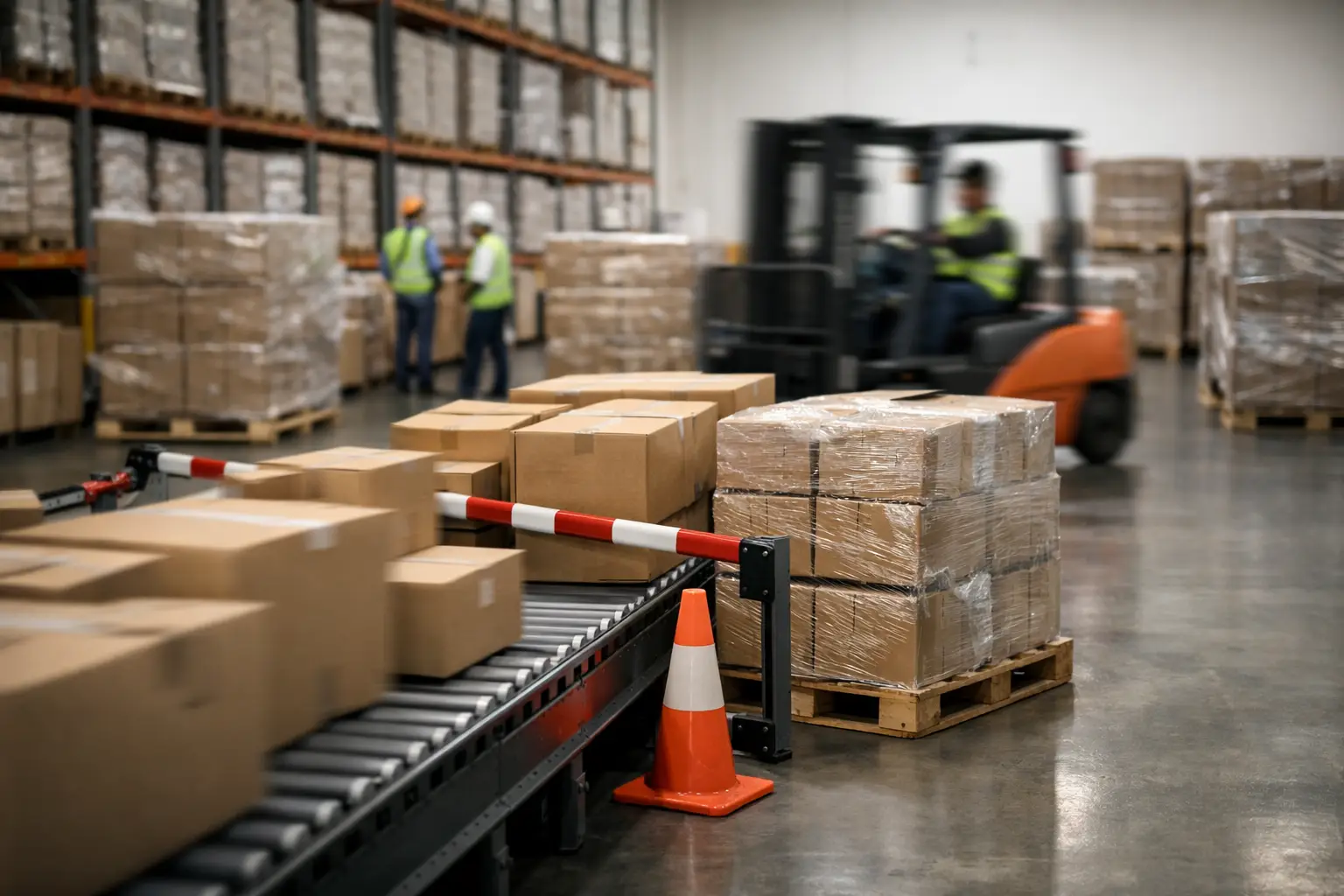
A warehouse rarely slows down everywhere at once. More often, throughput is constrained by one receiving door, a congested pick module, a shortage of replenishment labor, or a packing station that cannot keep pace with order volume. Knowing how to reduce warehouse bottlenecks starts with identifying that limiting point instead of treating every delay as a labor or space problem.
For operations leaders, the objective is not simply to make each department busier. It is to create reliable flow from receipt through storage, picking, packing, shipping, and returns. That requires a practical view of physical layout, equipment capacity, system logic, staffing, and maintenance. A change in one area can shift the constraint somewhere else, so improvements should be planned as an operating system rather than isolated fixes.
Find the Constraint Before Buying Capacity
The most visible delay is not always the true bottleneck. A shipping lane may look congested because cartons are waiting for labels, but the actual constraint may be a late wave release, insufficient packing capacity, or an upstream picking process that delivers work in large, uneven batches.
Start with flow data and direct observation. Review throughput by hour, queue lengths, dwell time, travel time, labor utilization, dock turn time, equipment downtime, and missed shipping cutoffs. Then walk the operation during peak conditions. Data identifies patterns; observation shows the workarounds, blocked aisles, staging overflow, and handoffs that reports often miss.
A useful diagnostic question is: where does work accumulate consistently, even when downstream teams are ready? That point is often the current constraint. Validate it across shifts and order profiles. A bottleneck during promotional e-commerce volume may be different from the one that limits palletized B2B orders or manufacturing replenishment.
Do not assume that utilization near 100% is a positive sign. A workstation, conveyor zone, or lift truck fleet operating continuously has no room to absorb variability. In most warehouse environments, some planned capacity buffer is necessary to protect service levels when inbound schedules shift, inventory is misplaced, equipment requires service, or order mix changes.
Reduce Warehouse Bottlenecks by Improving Flow
Once the constraint is known, begin with the simplest changes that improve movement without creating unnecessary disruption. Many bottlenecks are caused by avoidable travel, poor slotting, unclear staging rules, or work released in the wrong sequence.
Reconfigure the layout around actual movement
Warehouse layouts often reflect an earlier operating model. Product mix, order profiles, customer requirements, and shipping patterns change, while storage and work areas remain fixed. The result is excessive travel and cross-traffic.
Map the movement of pallets, cases, cartons, people, and material handling equipment. High-velocity inventory should be positioned to reduce repetitive travel, but proximity alone is not enough. Consider replenishment access, pick-face capacity, aisle width, forklift turning requirements, emergency egress, and the separation of pedestrian and vehicle traffic.
Receiving and shipping require particular attention. If inbound product sits in dock staging because putaway locations are unavailable, the issue may be storage density, slotting discipline, system-directed putaway, or a lack of available lift equipment. If outbound trailers are delayed, examine the path from packing and sortation to manifesting, staging, and loading. Adding dock doors will not solve a process that cannot build complete loads on time.
Align storage design with inventory behavior
Storage systems should support the work, not merely maximize pallet positions. Deep-lane storage can improve density for high-volume, low-SKU inventory, while selective racking supports direct access across a broader SKU base. Carton flow, shelving, pick modules, mezzanines, and automated storage systems each serve different order profiles and replenishment needs.
The trade-off is clear: higher density can reduce travel and expand capacity, but it may also increase access complexity or replenishment pressure. A storage redesign should be evaluated against SKU velocity, cube utilization, inventory rotation, handling method, and expected growth. It should also account for fire protection, permitting, rack safety, seismic requirements where applicable, and installation sequencing.
Control work release and replenishment
A large share of pick and pack congestion is created by uneven work release. Releasing too many orders at once overwhelms pick faces, pack stations, sortation, and shipping lanes. Releasing too little leaves labor and equipment waiting.
Wave logic, waveless processing, batch picking, zone picking, and order prioritization can all improve flow, depending on the operation. The goal is to feed work at a pace the downstream process can absorb. This requires coordination between the warehouse management system, labor plan, carrier cutoff schedule, and floor-level capacity.
Replenishment deserves the same discipline. When pickers repeatedly wait for inventory, the bottleneck is not picking productivity. It is replenishment timing, reserve location accuracy, lift truck availability, or pick-face design. Establish replenishment triggers that account for demand peaks rather than responding only after a pick location is empty.
Match Labor, Equipment, and Automation to the Constraint
Labor is often the first lever managers pull because it can be adjusted quickly. Additional people can protect short-term throughput, but staffing alone will not correct a poor material flow or an undersized process. It may simply add congestion.
Build staffing plans around workload by function and hour, not daily averages. Receiving, putaway, picking, replenishment, packing, and loading have different demand curves. Cross-training can provide flexibility, particularly where demand changes sharply by shift or day, but it must be supported by clear standard work and supervisory coverage.
Material handling equipment should also be evaluated by task, travel distance, battery or charging availability, maintenance condition, and dispatch logic. A fleet can look adequate on paper while operators still wait for the right truck at the right location. Equipment availability, including chargers, battery rooms, and service response, is part of warehouse capacity.
Automation is most effective when it addresses a stable, well-defined constraint. Conveyors, sortation, autonomous mobile robots, pick-to-light, automated storage and retrieval systems, dimensioning equipment, and print-and-apply solutions can reduce repetitive handling and improve process consistency. They also introduce dependencies on controls, integration, preventive maintenance, spare parts, and trained support staff.
The right question is not whether automation is appropriate in general. It is whether the expected volume, labor profile, SKU characteristics, process variability, and facility infrastructure justify it. A phased deployment may be preferable when order growth is uncertain or operations cannot tolerate a broad cutover. In a mature, high-volume process, a fully integrated solution may produce stronger long-term results.
Protect Throughput During Facility Changes
Major improvements can create temporary bottlenecks if installation and construction are not sequenced around operating requirements. Racking modifications, conveyor installation, electrical upgrades, automation commissioning, and relocations all affect access, safety, and daily throughput.
Define operational constraints before the project begins. Identify blackout periods, shipping cutoffs, inventory moves, restricted work zones, temporary staging needs, and safety controls. A detailed phasing plan should state what work occurs when, which areas remain operational, and how material will continue to move through the building.
Commissioning matters as much as installation. Test equipment under realistic conditions, including peak order profiles, exception handling, system downtime procedures, and recovery after a power or controls issue. Train supervisors and operators before go-live, not after production is already affected. The strongest projects connect construction, equipment installation, systems integration, and operational readiness under one accountable plan.
For complex facilities, a turnkey partner such as MTLI Group can help coordinate the physical and operational workstreams that are often managed separately. That coordination is especially valuable when a capacity project must be completed without interrupting customer commitments.
Use Maintenance and Metrics to Keep Bottlenecks From Returning
A bottleneck removed today can return if the underlying operating discipline does not change. Preventive maintenance for conveyors, lift trucks, dock equipment, racking, charging systems, and automated equipment should be tied to actual duty cycles and criticality. Repeated minor failures at a high-volume process point can cost more than a single visible breakdown.
Measure performance in a way that reveals flow. Units per labor hour is useful, but it should be paired with queue time, order cycle time, dock-to-stock time, replenishment completion, equipment uptime, trailer dwell, and on-time shipment performance. Review these measures by shift and hour. Daily averages can conceal the two-hour window that determines whether the operation meets its commitments.
When a constraint moves, recognize it quickly. That is evidence that the previous improvement worked. The next decision is whether to elevate the new constraint through process changes, capacity investment, or a different operating model.
The most effective warehouse improvement programs do not chase every visible delay. They build the discipline to identify the limiting process, make targeted changes, and protect the flow of product while the facility evolves. That discipline keeps capacity decisions tied to service performance, not just square footage or headcount.