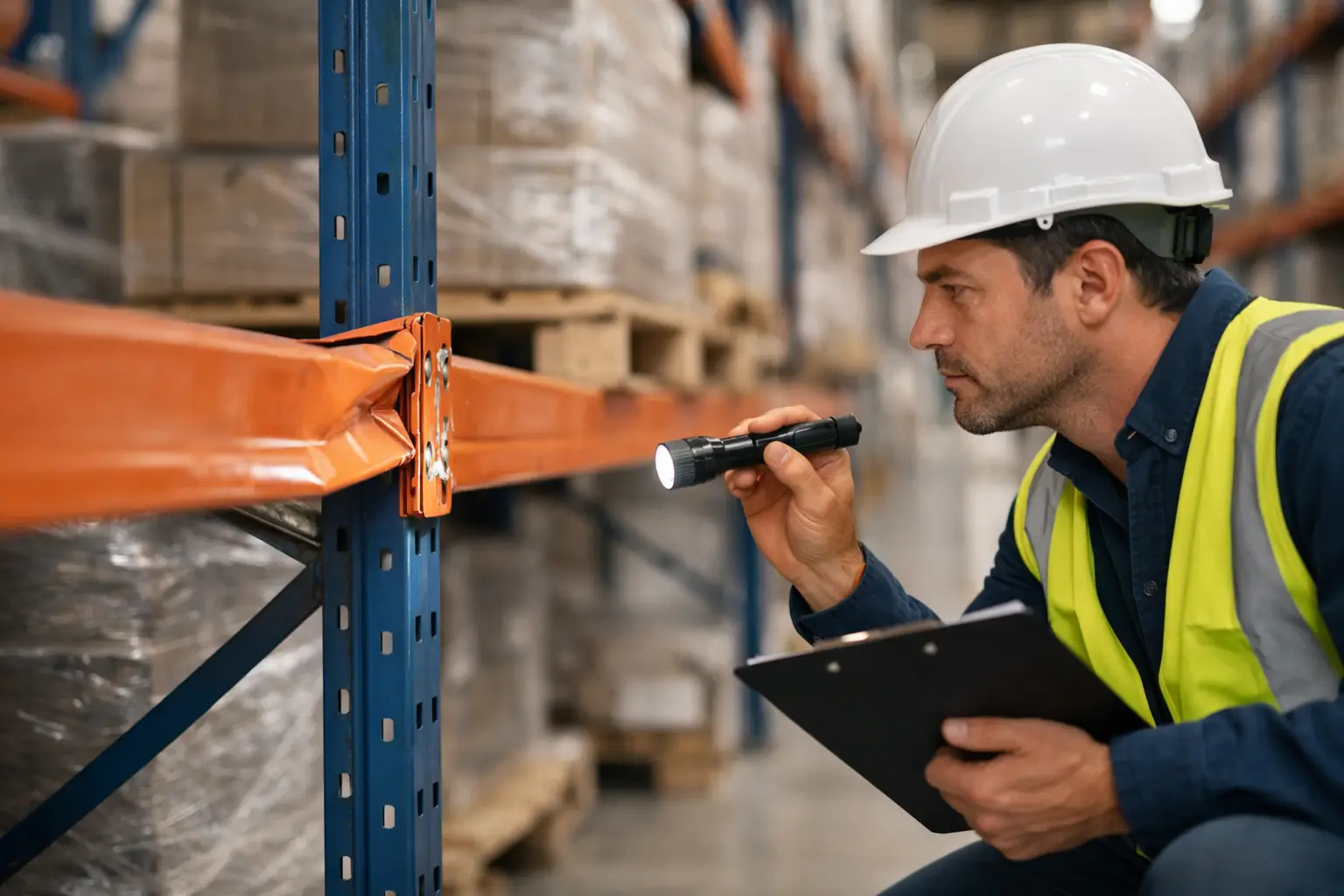
A bent upright in an active aisle is not a cosmetic issue. It can change load paths, reduce capacity, and create a localized failure risk that affects people, product, lift equipment, and adjacent rack bays. Knowing how to assess rack damage gives warehouse leaders a disciplined way to act quickly without making assumptions that create a larger operational problem.
The right response depends on the rack system, the type of damage, the loads in the affected area, and the manufacturer’s requirements. A qualified assessment should separate conditions that require immediate unloading and isolation from those that can remain in service under controlled conditions while a repair plan is developed.
Start by Controlling the Area
The first decision is operational, not administrative: can personnel and equipment safely continue to work around the damaged rack? If the condition appears severe, stop activity in the affected bay and prevent additional pallet placement, retrieval, or forklift travel nearby.
Visible distortion in a loaded upright, a displaced beam, missing structural components, damaged anchors, or a rack section that has been struck multiple times should be treated as an immediate escalation. Isolate the area with clear physical barriers and communicate the restriction to lift truck operators, supervisors, and shift leads. Do not rely on verbal handoffs alone in a busy operation.
The scope of isolation should account for the rack’s structural connection to adjacent bays. Damage in one upright frame or beam level may affect neighboring bays, back-to-back rows, or connected bracing. Where there is uncertainty, expand the restricted area until a qualified person reviews the condition.
Identify What Was Damaged
A useful rack inspection does more than record that a forklift made contact. It identifies the exact component, location, and apparent direction of force. This information helps determine whether the rack has a localized repair need or whether the event has compromised a larger section.
Inspect the upright frames first. Look for bent columns, crushed or torn steel, twisting, cracked welds, damaged frame bracing, and distortion near the base plate. Uprights transfer vertical load to the floor and provide stability for the rack system, so even damage that appears small can matter when it occurs in a high-stress location.
Then inspect beams and beam connections. A beam that is bowed, dented, twisted, or no longer fully seated in its connectors should not be treated as serviceable until it is evaluated. Check safety clips or locking devices as well. A missing or damaged safety lock can allow a beam to disengage when a pallet is placed or removed.
Continue the review at the floor. Loose, sheared, missing, or pulled anchors can indicate that a rack frame has shifted under impact. Inspect base plates for deformation and look for cracked or spalled concrete around anchors. Floor conditions matter because a sound rack component cannot perform as intended if its connection to the slab has been compromised.
Evaluate the Damage in Context
The same visible dent can carry different risk depending on where it is located and how the rack is used. A minor scrape on a rack protector is not equivalent to an impact that bends an upright at beam level. Likewise, a lightly loaded hand-storage section does not carry the same consequence as a high-bay selective rack supporting dense pallet loads.
Document the rack configuration, bay location, load levels, pallet weights, and whether the rack is single-deep, double-deep, drive-in, pushback, cantilever, or part of an automated storage system. Also note whether seismic requirements, sprinkler clearances, wire decking, pick modules, conveyors, or automation interfaces affect the repair scope.
Do not make capacity decisions based on visual judgment alone. Rack systems are engineered assemblies, and capacity depends on component specifications, bracing, elevations, beam spacing, load distribution, anchorage, and the original design. A damaged component may have less capacity than it did before impact, even if it remains standing and the rack looks generally aligned.
Look Beyond the Impact Point
Forklift impacts often produce damage that is more extensive than the first visible mark. An upright can twist along its length, a frame can move out of plumb, or a beam connection can be partially disengaged without an obvious failure at eye level.
Walk the full rack elevation and inspect adjacent bays. Compare upright alignment with undamaged frames in the same row. Check for irregular beam elevations, gaps at connectors, shifted pallets, damaged flue spaces, and unusual rack movement during loading or unloading. If an impact occurred at the lower level, inspect the first beam level and the base connection closely, since these areas frequently absorb significant force.
Also review the condition of protective equipment. Damaged post protectors, end-of-aisle guards, guide rails, and bollards may indicate that the impact force was substantial. Protection systems should be repaired or replaced along with the rack components they are intended to protect. Leaving failed protection in place invites a repeat event.
Document Findings for a Defensible Repair Plan
Clear documentation supports fast, correct decisions. Photograph the damage from close range and from a wider view that shows the rack row, bay number, and affected levels. Record the date, shift, equipment involved if known, and whether the rack was loaded at the time of impact.
A practical damage record should include:
- Rack row, bay, frame, and beam-level location
- Component type and visible condition
- Approximate load and pallet position at the time of inspection
- Anchor, floor, bracing, and connector observations
- Immediate controls taken, including isolation or unloading
- Recommended next action and responsible party
This record creates continuity between operations, safety, maintenance, and the repair provider. It also helps identify repeat impact locations, which may point to aisle-width constraints, poor travel paths, inadequate rack protection, lift truck handling issues, or changes in pallet quality.
Decide Whether to Repair, Replace, or Reconfigure
Some rack damage can be addressed by replacing a specific beam, safety clip, anchor, protector, or upright frame with compatible components. Other conditions require a broader repair scope, partial rack replacement, or engineered modification. The correct path depends on the original rack manufacturer, the availability of matching components, the condition of adjacent structure, and the system’s load requirements.
Avoid field straightening, welding, drilling, or altering rack members unless the work is specifically designed and approved by qualified engineering and the rack manufacturer’s requirements. Improvised repairs can create hidden weaknesses, void equipment ratings, and complicate future inspections. The goal is to restore the system to a known, supportable condition, not simply make it look straight again.
Replacement also requires attention to compatibility. Rack components that appear interchangeable may have different steel gauges, connection geometries, capacities, or hole patterns. A qualified provider can verify the system, source appropriate components, coordinate unloading and reinstall work, and return the area to service with minimal disruption.
Build Inspection Into Daily Operations
Formal annual inspections are valuable, but they do not replace routine operator awareness. Lift truck drivers, supervisors, and maintenance teams should know what to report immediately: any rack contact, shifted beam, damaged upright, loose anchor, missing safety device, or unstable pallet condition.
Daily visual checks are especially valuable in high-traffic receiving lanes, staging areas, narrow aisles, high-density storage, and locations where pallet overhang is common. These checks do not need to slow throughput when responsibilities are clear. The purpose is to identify changes before repeated impacts or added load turn a manageable repair into a shutdown.
For facilities with recurring damage, the corrective action may extend beyond rack repair. Reviewing aisle dimensions, truck type, rack protection, traffic direction, operator training, and pallet handling practices can reduce the likelihood of another incident. A repair resolves the immediate condition; an operational review addresses why it occurred.
Use Qualified Support When the Risk Is Unclear
When damage affects load-bearing members, anchors, bracing, or a heavily loaded rack section, bring in a qualified rack professional promptly. This is particularly necessary after a significant forklift strike, facility relocation, seismic event, floor movement, or modification to rack elevations and load profiles.
MTLI Group supports rack inspection, repair coordination, storage-system installation, and facility work as part of a broader turnkey approach. For operations teams, that means the damaged area can be assessed in the context of the rack system, material flow, safety requirements, and the need to keep the rest of the facility productive.
A disciplined response to rack damage protects more than the affected bay. It gives operations leaders a clear path to keep people safe, preserve inventory access, and return capacity only when the storage system is ready to carry it.