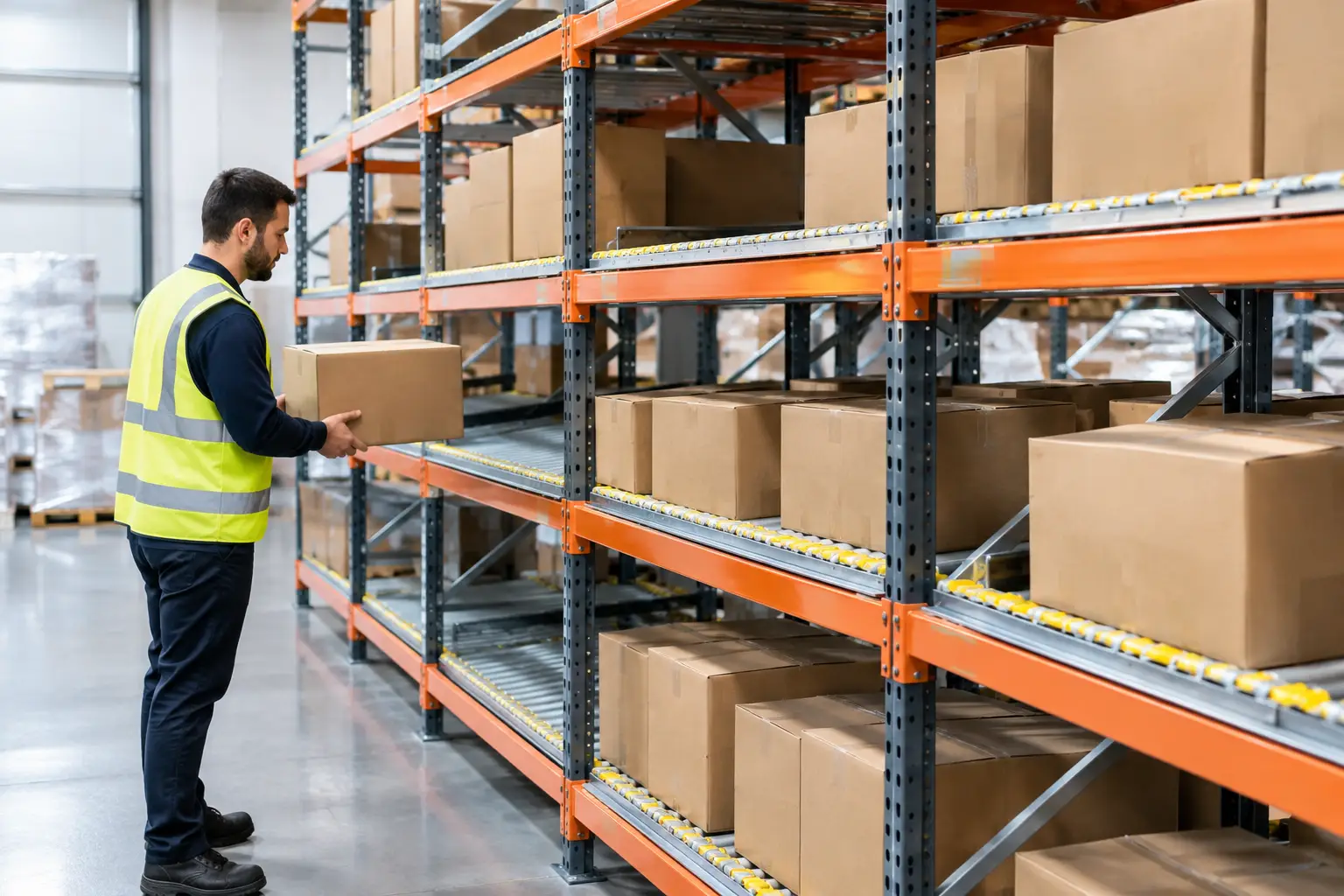
Carton flow is often considered when a pick module is short on faces, pickers are walking too far, or FIFO inventory control is becoming difficult to manage manually. This guide to carton flow racks explains where the system performs well, what must be engineered before installation, and where another storage method may be the better operational decision.
Carton flow racks use inclined roller or wheel lanes to move cartons, totes, and cases from a replenishment side to a pick side by gravity. Replenishment occurs at the high end of the lane. As an operator removes a unit from the front, the next unit advances into the pick position. The result is a dense, accessible picking system designed around high-frequency SKU movement.
How Carton Flow Racks Work
A carton flow system is built into a rack structure with multiple levels of gravity-fed lanes. Each lane is set at a controlled pitch, typically with brakes or speed controllers that regulate product movement. A lane separator keeps adjacent SKUs distinct, while entry guides, end stops, and pick-side accessories help protect products and operators.
The basic process is simple, but the application is not. Carton dimensions, base condition, weight range, case strength, and picking method all affect how reliably a product flows. A corrugated case with a flat, consistent bottom behaves very differently from a soft-sided package, an irregular carton, or a tote with protruding feet.
Carton flow generally supports first-in, first-out rotation because replenishment happens from the rear and picking happens from the front. That separation can reduce aisle conflicts and supports inventory discipline for dated, lot-controlled, or shelf-life-sensitive products. It is particularly useful in food and beverage, pharmaceutical, consumer goods, e-commerce, and production kitting operations.
Where Carton Flow Delivers Value
The strongest carton flow applications share a common profile: high pick frequency, repeatable case or tote characteristics, and a need to increase pick-face density. Rather than giving every active SKU a full static shelf location, operations can use multiple flow lanes across vertical rack levels. This puts more pick faces into the same footprint while keeping commonly picked items within an efficient reach zone.
For discrete order picking, the benefit is often reduced travel. Pickers can work a concentrated set of forward locations while replenishment teams service the opposite side. In batch, zone, and pick-to-carton operations, that separation can improve throughput by reducing interruptions at the face.
Flow racks can also improve visual management. Empty or low lanes are easy to identify, product remains presented at the front of the lane, and pick locations can be labeled consistently. When paired with a warehouse management system and disciplined replenishment rules, the system helps maintain a cleaner, more predictable forward-pick environment.
The value is not automatic. Carton flow does not solve slotting problems on its own. If slow-moving items consume flow lanes, the operation may invest in density it does not need. If demand patterns change weekly, adjustable or modular designs may be more appropriate than a fixed, highly tailored installation.
Design the System Around the Product and Process
The most expensive carton flow mistakes usually occur before the first rack component arrives. A layout built from average carton measurements, rather than actual product data and operating conditions, can create product hang-ups, lane damage, poor ergonomics, or underused capacity.
Start with SKU and carton data
Design begins with the active SKU profile. Review each candidate item for carton length, width, height, weight, bottom surface, packaging durability, and expected inventory depth. Measure actual inbound cartons, not just master-data dimensions. Vendor packaging changes, crushed corrugate, taped bottoms, and label placement can all affect flow performance.
Velocity matters as much as physical fit. Fast movers may justify dedicated lanes with greater depth or multiple facings. Moderate movers may share a level with smaller lane allocations. Slow movers may belong in static shelving, selective rack, or another reserve storage area. The right mix depends on order profile, replenishment labor, and the service-level objective for the operation.
Set lane geometry and depth correctly
Lane width needs enough clearance for reliable movement without allowing cases to turn, skew, or bind. Lane depth should support the target replenishment quantity while avoiding excess inventory at the pick face. Deep lanes can reduce replenishment frequency, but they also increase capital cost, may make cycle counting more involved, and can hold inventory that would be better positioned in reserve storage.
Pitch must be matched to product weight and surface characteristics. Too little pitch can cause cartons to stop before reaching the pick face. Too much pitch can create excessive product speed, impacts, and damaged packaging. Flow-bed selection, brake placement, and lane controls should be determined through product testing rather than assumptions.
Design for the person picking the order
A productive pick module is not simply the densest one. Frequently picked products should be positioned in the primary ergonomic zone, generally between knee and shoulder height, with heavier items lower in the structure. Pick-face presentation must allow safe hand access without forcing operators to reach under beams, around lane dividers, or over product restraints.
Consider the downstream process as well. A worker picking to a cart, conveyor, pallet jack, or automated conveyance needs clear aisle space and a layout that supports the actual travel path. In high-volume areas, light-directed picking, scan verification, replenishment indicators, and pick-to-voice processes may influence face size and labeling requirements.
A Guide to Carton Flow Racks and Replenishment Planning
Carton flow performs best when replenishment rules are as deliberate as the rack design. Rear loading protects FIFO, but it also requires sufficient replenishment access, clear aisle capacity, and safe travel patterns for lift equipment or carts. A system that improves picking while creating congestion in the replenishment aisle has shifted the problem rather than solved it.
Establish minimum and maximum quantities by SKU, then align them with demand, supplier case pack, lead time, and replenishment labor availability. A very shallow forward location may require frequent replenishment during peak shifts. A very deep lane can conceal aging inventory and consume capacity that a faster SKU needs.
For operations with seasonality or changing assortments, review the slotting plan on a defined cadence. ABC velocity classifications are useful, but they should be supplemented with order-line frequency, cube movement, product compatibility, and forecasted promotions. A carton flow module should be treated as an operating asset that requires ongoing slotting management, not a one-time storage purchase.
Safety, Maintenance, and Installation Controls
Gravity systems need routine inspection. Damaged rollers, bent wheel beds, missing dividers, loose fasteners, and compromised end stops can affect both flow reliability and worker safety. Operators should report product hang-ups and repeated carton damage early, since those conditions often indicate an issue with pitch, carton quality, brake settings, or lane configuration.
Installation quality is equally important. Rack anchoring, load capacities, beam elevations, seismic requirements, fire protection clearances, egress, and local code requirements must be evaluated as part of the complete facility plan. When carton flow is integrated into existing racking, the engineering review should confirm that the structure can support the added loads and changed load distribution.
Before go-live, test representative cartons at expected minimum and maximum weights. Test them in normal condition and, where practical, with realistic packaging variation. Verify that cartons advance consistently, stop correctly at the pick face, and can be replenished without contact between personnel and moving equipment. Training should cover safe loading, jam response, damage reporting, and the intended FIFO process.
Choosing Between Carton Flow and Other Storage Systems
Carton flow is not the default answer for every forward-pick area. Static shelving can be more flexible for slow movers, irregular packaging, and frequently changing assortments. Selective pallet rack may be better when full-case access and reserve capacity matter more than pick-face density. Pushback or pallet flow systems address different pallet-level storage needs and should not be confused with carton flow.
The decision should be based on measurable conditions: order lines per SKU, pick frequency, replenishment cost, available footprint, carton consistency, inventory rotation requirements, and peak-period throughput. A pilot with representative products can be worthwhile when product characteristics vary widely or the operation is transitioning to a new picking method.
For larger facility programs, carton flow should be coordinated with rack layout, conveyor interfaces, automation controls, fire protection, electrical work, and operational cutover planning. MTLI Group approaches these projects as connected infrastructure decisions, helping teams align the storage system with the building, equipment, and workflow around it.
A well-designed carton flow system gives pickers reliable access to the products they need most often. The practical next step is to validate the SKU data and operating assumptions on the floor before committing to a layout. That discipline protects the investment and makes the resulting pick module easier to run when volume is at its highest.