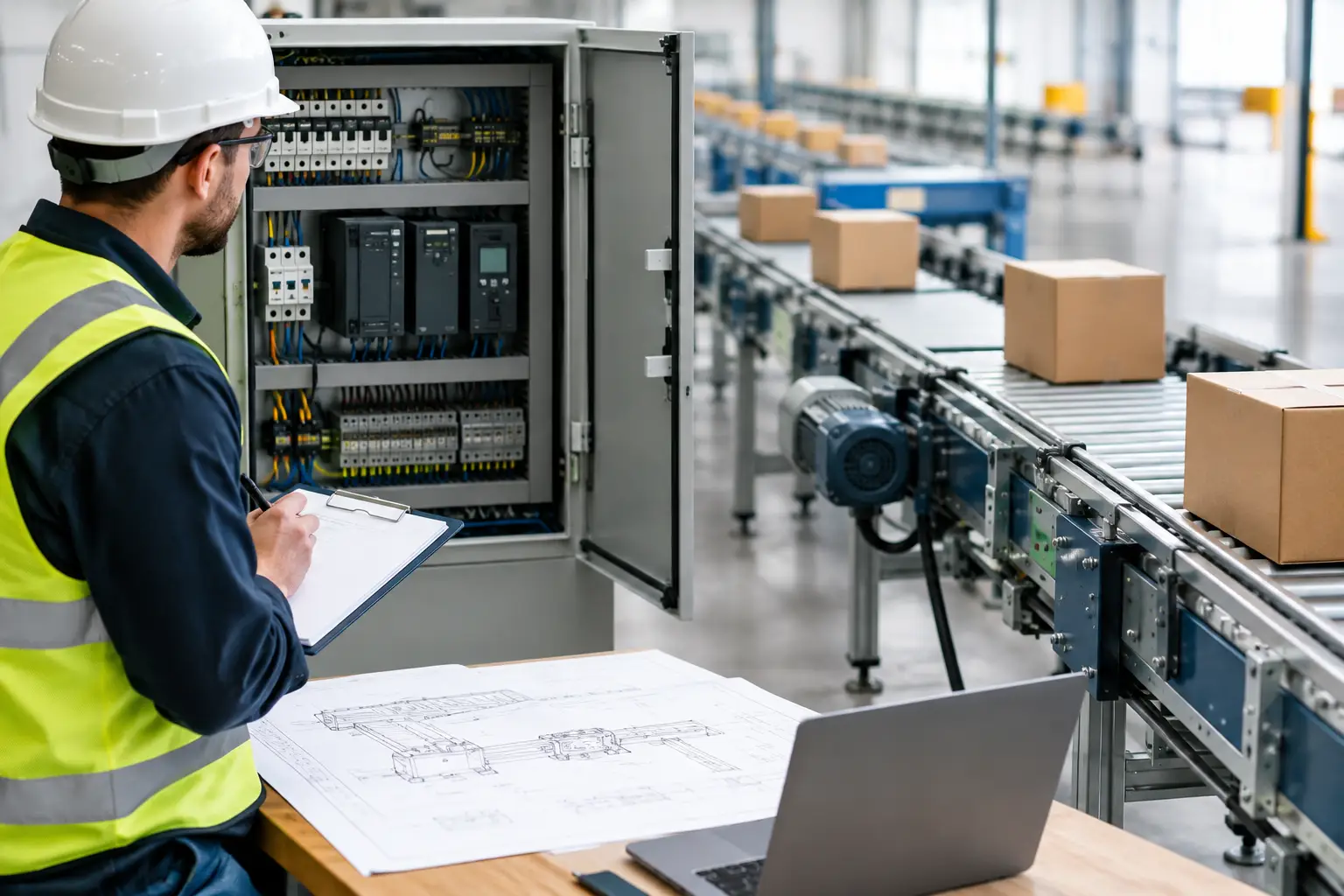
A conveyor system can be mechanically sound and still fail its operation if the controls do not reflect actual product flow, exception handling, and workforce needs. This conveyor controls design guide focuses on the decisions that determine whether a system moves product predictably, recovers quickly from disruptions, and can expand without forcing a complete controls rebuild.
For warehouse and manufacturing leaders, controls design is not a programming detail to defer until installation. It establishes how equipment communicates, where product accumulates, when operators intervene, and how the system protects people and inventory. The best approach starts with operational requirements, then carries those requirements through electrical design, controls logic, commissioning, and long-term support.
Start With the Operating Requirements
Controls should be designed around the work the facility must perform, not simply around the conveyor hardware selected. Before defining inputs, outputs, or PLC architecture, document the expected operating profile: product dimensions and weights, hourly rates, peak conditions, shift patterns, SKU mix, induction methods, and downstream processes.
A system moving uniform cartons to shipping has different logic requirements than one handling variable totes feeding picking, packing, and sortation. Food and beverage, cold storage, pharmaceutical, and automotive operations may also have sanitation, environmental, traceability, or validation requirements that affect component selection and software behavior.
Exception flow deserves the same attention as normal flow. Ask what happens when a carton is unreadable, overweight, damaged, misaligned, or sent to an occupied lane. Define how the system handles a stopped downstream machine, a full takeaway conveyor, loss of a scanner signal, or a temporary network interruption. If those decisions are left to field programming, the project can lose time and create inconsistent operating behavior.
Establish measurable design criteria
The controls team needs agreed performance criteria. This usually includes design throughput, maximum accumulation time, recovery rate after a fault, acceptable product spacing, and required availability. These criteria give the project team a basis for testing the completed system rather than relying on a general impression that the conveyor is running.
Peak rate should not be treated as the everyday design condition in every area. Overdesigning every conveyor zone can add unnecessary cost. However, underdesigning merge points, divert locations, induction stations, and shipping feeds creates bottlenecks that software cannot fully correct. The right capacity depends on the process constraints on either side of the conveyor.
Define the Conveyor Controls Architecture Early
A clear controls architecture identifies the role of each PLC, distributed I/O node, variable frequency drive, scanner, photo eye, safety device, and operator interface. It also defines how the conveyor control system exchanges data with warehouse management, warehouse control, manufacturing execution, sortation, labeling, and shipping systems.
For a smaller, self-contained line, a single PLC and local HMI may be appropriate. Larger facilities often benefit from distributed controls organized by conveyor area or process function. That structure can reduce wiring distances, simplify troubleshooting, and limit the effect of a local equipment issue. It also introduces more requirements for network design, naming conventions, spare capacity, and software version control.
The architecture should specify ownership at every interface. If a warehouse control system releases work, the conveyor PLC must still manage safe physical movement and protect accumulation zones. If a third-party sortation system controls divert decisions, the handoff signal, timing window, fault behavior, and recovery process must be documented. Unclear boundaries between vendors are a common source of startup delays.
Plan for future capacity without paying for unused complexity
Scalability does not require installing every future component on day one. It means selecting a platform with room for practical expansion and documenting the path to add conveyor zones, drives, sort lanes, scanners, or software functions later.
Leave physical and electrical provisions where future equipment is likely. Reserve panel space, I/O capacity, network ports, and control power where justified by the facility plan. At the same time, avoid specifying enterprise-level controls for a fixed, low-volume conveyor line that has no credible expansion case. Controls design should match the operation's risk, scale, and growth plan.
Design Zone Logic Around Product Behavior
Accumulation is more than stopping and starting conveyor motors. The controls must understand product presence, release timing, available downstream space, and the behavior of different product types. Poorly coordinated zone logic creates carton contact, unstable gaps, blocked merges, and repeated photo-eye faults.
Zero-pressure accumulation is often the preferred approach where product protection and controlled release matter. The controls release loads based on downstream availability, maintaining separation between cartons or totes. In contrast, certain bulk handling or rugged product applications may tolerate contact accumulation and use a simpler control strategy. The selection depends on product characteristics, throughput targets, conveyor length, and budget.
Merge logic requires particular discipline. Each feed line needs rules for priority, demand, starvation, and lane recovery. A fixed priority model can be appropriate when one process must be protected, such as a high-volume packing line. In other applications, weighted or dynamic release logic may better balance flow. The design must also define what happens when one lane is blocked or sends a continuous stream of product.
Diverts need confirmed tracking, not assumptions. The system should verify that the product reached the decision point, received the correct command, and cleared the divert area. Depending on the application, this may require barcode reads, encoder-based tracking, photo-eye confirmation, or a combination of methods. A missed confirmation should trigger a defined exception path rather than allow product to disappear from the operating record.
Build Safety Into the Control Strategy
Safety circuits and safety-rated control functions must be designed as part of the system, not added after mechanical layout is complete. Emergency stops, pull cords, safety interlocks, guarding, access gates, and controlled stop functions need to align with the equipment layout and the way operators service the line.
The required safety category or performance level depends on the hazard assessment and applicable standards. The practical question is straightforward: when a safety device is activated, what equipment must stop, what may continue operating, and what is required before restart? Stopping an entire facility for every local access event may be operationally impractical. Allowing adjacent equipment to run without appropriate safeguards is unacceptable. Zoned safety can provide a workable balance when it is properly engineered and validated.
Restart behavior should be deliberate. Following a safety event or power interruption, equipment should not resume automatically unless the risk assessment specifically supports it. Operators need a clear indication of the affected zone, the condition preventing reset, and the correct restart sequence. Good HMI design reduces the temptation to bypass safety devices or repeatedly reset alarms without fixing the underlying problem.
Specify Networks, Panels, and Field Devices for the Environment
Controls reliability often depends on details that are easy to overlook during early planning. Panel locations, heat load, washdown exposure, dust, vibration, cable routing, and electrical noise can all affect uptime. A well-written controls specification addresses enclosure ratings, disconnects, labeling, circuit protection, spare capacity, grounding, and access for maintenance.
Industrial networks require similar discipline. Segmenting networks, documenting IP addresses, managing wireless coverage, and protecting access credentials helps prevent avoidable communication failures. Networked drives and smart devices can provide valuable diagnostics, but they increase the need for configuration management and qualified support.
Sensors should be selected for the product and environment, not merely for initial price. Reflective photo eyes can perform well in predictable conditions but may struggle with highly variable packaging, reflective surfaces, dust, condensation, or inconsistent gaps. Through-beam sensing, retroreflective devices, vision systems, and barcode readers each have a place. The right choice depends on detection reliability at the decision point.
Commission With Operations at the Table
Factory acceptance testing, site acceptance testing, and operational readiness testing should be treated as separate gates. A controls program can pass simulated testing and still reveal issues when real products, real operators, and upstream systems are introduced.
Before startup, test normal sequences, emergency stops, accumulation, merges, diverts, fault recovery, data handoffs, and loss-of-communication scenarios. Run representative product at expected peak conditions, including the cases most likely to cause problems: skewed cartons, short gaps, unreadable labels, mixed weights, and full downstream lanes.
Operations and maintenance teams should participate in acceptance testing. They can identify unclear alarms, inconvenient reset locations, poor visibility at manual workstations, and recovery steps that look acceptable on paper but consume too much time during a live shift. Their input is especially valuable for projects that must maintain throughput during phased cutovers or facility expansions.
A turnkey project partner can coordinate controls design with conveyor installation, electrical work, guarding, software integration, and commissioning. That accountability reduces the risk of individual vendors treating interface problems as someone else's scope. For complex facilities, the project plan should also include training, as-built documentation, software backups, spare parts, and a defined escalation path after go-live.
Treat Controls as an Operating Asset
After commissioning, conveyor controls require disciplined maintenance. Track recurring faults, sensor failures, drive alarms, blocked zones, and operator interventions. A pattern of small interruptions often reveals a larger issue in product presentation, mechanical alignment, logic timing, or upstream release strategy.
Changes should be controlled and documented. A quick adjustment to a timer, merge rule, or scanner setting can solve an immediate issue while creating an unexpected condition elsewhere. Maintain current electrical drawings, network records, PLC and HMI backups, and change logs so the facility can recover quickly when equipment, personnel, or operating requirements change.
The practical goal is not a conveyor system with the most elaborate controls package. It is a system that gives operators clear information, gives maintenance teams manageable diagnostics, and gives the business dependable flow when volume is highest. Designing for those outcomes early is what keeps controls from becoming the limiting factor in an otherwise capable facility.