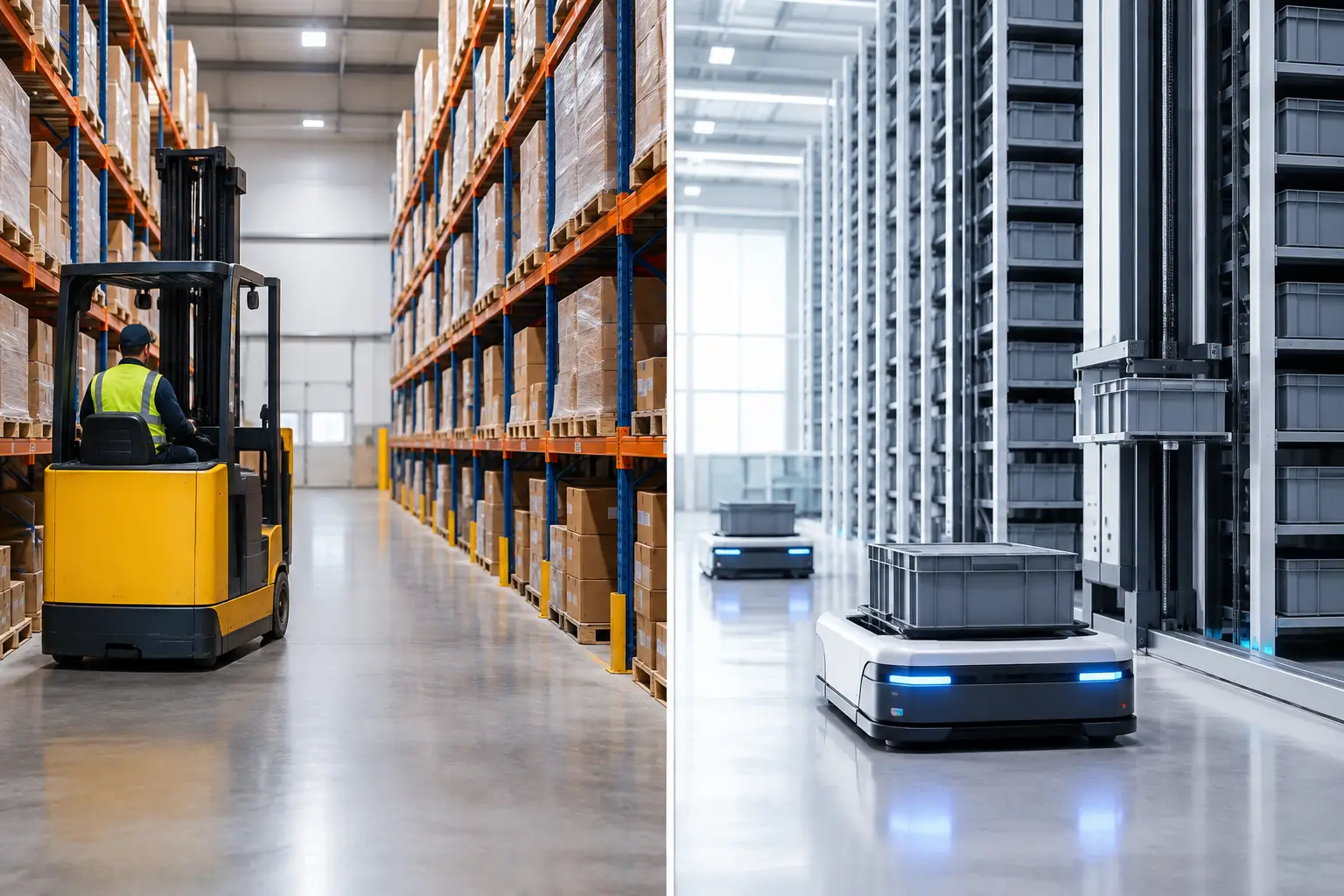
A warehouse running out of usable space does not automatically need automation. Likewise, a facility with rising labor costs and missed shipping windows may not be solved by adding more conventional racking. The right answer to conventional versus automated storage depends on the operating profile behind the problem: SKU count, order velocity, building constraints, labor availability, service requirements, and the cost of disruption.
For operations leaders, the decision is less about choosing a newer technology and more about selecting a storage and material flow system that can perform reliably under actual demand. That requires a clear view of what each model does well, where it introduces constraints, and how it affects the facility as a whole.
Conventional Versus Automated Storage: The Core Difference
Conventional storage relies on people operating forklifts, pallet jacks, carts, and other manually directed equipment to receive, put away, replenish, pick, and ship inventory. Selective pallet rack, drive-in rack, pushback rack, carton flow, shelving, and floor stacking all fall within this category. The systems are familiar, adaptable, and generally faster to modify when inventory profiles change.
Automated storage uses equipment and controls to move, store, retrieve, or present inventory with limited direct travel by workers. Common examples include automated storage and retrieval systems, shuttle systems, vertical lift modules, vertical carousels, automated mobile racking, and goods-to-person picking systems. These systems exchange some operational flexibility for higher storage density, repeatable movement, and tighter process control.
Neither approach is inherently better. A high-volume, stable pallet operation may produce a strong business case for an automated pallet shuttle system. A 3PL managing frequently changing customers, package profiles, and inventory rules may benefit more from reconfigurable conventional rack supported by selective automation at key process points.
Capacity Is About More Than Rack Positions
Storage density is often the first point of comparison. Automated systems can use building height more effectively and reduce the aisle space required for lift trucks and pedestrians. In high-cost real estate markets or facilities with limited expansion options, that can postpone or eliminate the need for a new building.
However, density must be matched to access requirements. A deep-lane storage system works well when there are multiple pallets of the same SKU and predictable inventory rotation. It is less effective for broad SKU assortments requiring immediate access to every pallet position. Selective rack may use more floor area, but it provides direct access and supports frequent changes in product mix.
Facility geometry also matters. Clear height, slab condition, column spacing, fire protection, egress, dock configuration, and seismic requirements can influence the viability and cost of either solution. An automation concept that looks efficient in a layout drawing may require structural, electrical, or fire protection upgrades that change the project economics.
Evaluate cube utilization alongside accessibility
The relevant question is not simply how many pallets or totes fit in the building. It is how many of those positions remain accessible at the right time, at the required service level, without creating excessive travel, congestion, or inventory handling. A capacity plan should account for seasonal peaks, reserve inventory, damaged-product hold areas, replenishment lanes, and future SKU growth.
Throughput and Labor Drive the Operational Case
Conventional storage can achieve high throughput when travel paths are short, product is properly slotted, and operators have dependable equipment. It also offers flexibility during peak periods because management can add trained labor and lift trucks, within the limits of available space and supervision.
That flexibility has a cost. Labor-intensive operations are exposed to hiring difficulty, turnover, inconsistent travel time, and variable performance across shifts. As order volumes rise, more lift truck traffic can create aisle congestion and increase the risk of product damage or near misses.
Automated storage is most compelling when it removes repeatable, high-frequency travel from the process. A shuttle system can move pallets in dense storage lanes while operators remain at induction and discharge points. A goods-to-person system can bring inventory to pick stations rather than requiring associates to walk long distances. The benefit is not only fewer labor hours. It is more predictable cycle time and a process that can sustain performance across shifts.
Automation does not remove the need for labor planning. It changes the work. Facilities still need employees for receiving, exception handling, quality checks, replenishment, maintenance support, inventory control, and shipping. The strongest designs identify which tasks should be automated and which still require human judgment.
Cost Should Be Measured Over the Operating Life
Conventional systems usually have a lower upfront capital requirement. They can be installed in phases, relocated more easily, and adjusted as the operation evolves. For companies facing uncertain volume forecasts or a short lease term, this lower commitment can be a meaningful advantage.
Automated storage typically requires greater capital investment in equipment, controls, integration, electrical infrastructure, and commissioning. It also requires disciplined project planning because the storage system must work with warehouse management software, material handling equipment, safety systems, and the physical building.
The decision should not stop at purchase price. A lifecycle analysis should include labor, equipment maintenance, energy use, space savings, lease or expansion avoidance, damage reduction, inventory accuracy, downtime exposure, and expected system life. It should also account for the cost of operating through implementation. A system that requires a major shutdown may create more risk than one that can be phased around active operations.
Protect the business case from unrealistic assumptions
Automation proposals can appear attractive when labor savings, utilization rates, and throughput are modeled at ideal levels. Conventional alternatives can appear inexpensive when ongoing labor, travel, and damage costs are understated. A credible analysis uses actual operating data, includes peak-season conditions, and tests what happens if volumes, labor rates, or SKU profiles vary from the forecast.
Safety, Reliability, and Maintenance Requirements
Both storage approaches can support safe operations when designed, installed, and maintained correctly. Conventional facilities need clear aisle management, rack protection, operator training, inspection programs, and a process for addressing rack damage. The operational risk often rises as forklift and pedestrian traffic increase in the same areas.
Automated systems can reduce travel and separate people from some higher-risk movements. At the same time, they introduce controls, sensors, motors, conveyors, and software that must be maintained as a connected system. A minor fault in a critical automated zone can have an outsized effect if there is no bypass process or recovery plan.
Reliability starts before installation. Equipment selection, system layout, spare parts strategy, remote support, preventive maintenance, and operator training should be defined during project development. Critical facilities should also consider how receiving, picking, and shipping will continue if a subsystem is unavailable.
When a Hybrid Storage Strategy Makes Sense
Many facilities do not need to choose one model exclusively. A hybrid design often delivers the best balance of capital efficiency and operational performance. Fast-moving, repeatable products can move through automated storage, while slow-moving, oversized, irregular, or volatile inventory remains in conventional racking.
This approach also supports phased modernization. A company may first improve slotting, rack configuration, and travel paths in a conventional operation. It can then automate the specific process that creates the greatest bottleneck, such as pallet buffering, case picking, or high-density reserve storage. Phasing reduces implementation risk and gives the organization time to build maintenance and controls capabilities.
A Practical Decision Framework
Before selecting equipment, establish the operational requirements the system must meet. Start with current and projected SKU counts, inventory depth, pallet and carton dimensions, throughput by hour and shift, order profiles, seasonality, labor availability, and service-level commitments. Then evaluate the building and project constraints, including clear height, slab capacity, utilities, fire protection, schedule, and continuity requirements.
The resulting concept should show more than storage capacity. It should map receiving, quality control, reserve storage, replenishment, picking, packing, shipping, returns, and exception flows. It should also define where inventory changes hands between people, lift trucks, conveyors, and automated equipment. Those transition points frequently determine whether a system performs as designed.
A turnkey partner can be especially valuable when a project includes construction modifications, racking, automation, controls integration, installation, commissioning, and an active facility that cannot stop shipping. Coordinating those workstreams under one accountable delivery plan reduces handoff gaps and helps protect the go-live schedule.
The best storage strategy is the one that gives the operation enough capacity and throughput to meet demand without locking the business into unnecessary complexity. Whether the answer is conventional racking, targeted automation, or a hybrid system, the decision should be built around reliable execution and a practical path to operate the facility on day one.