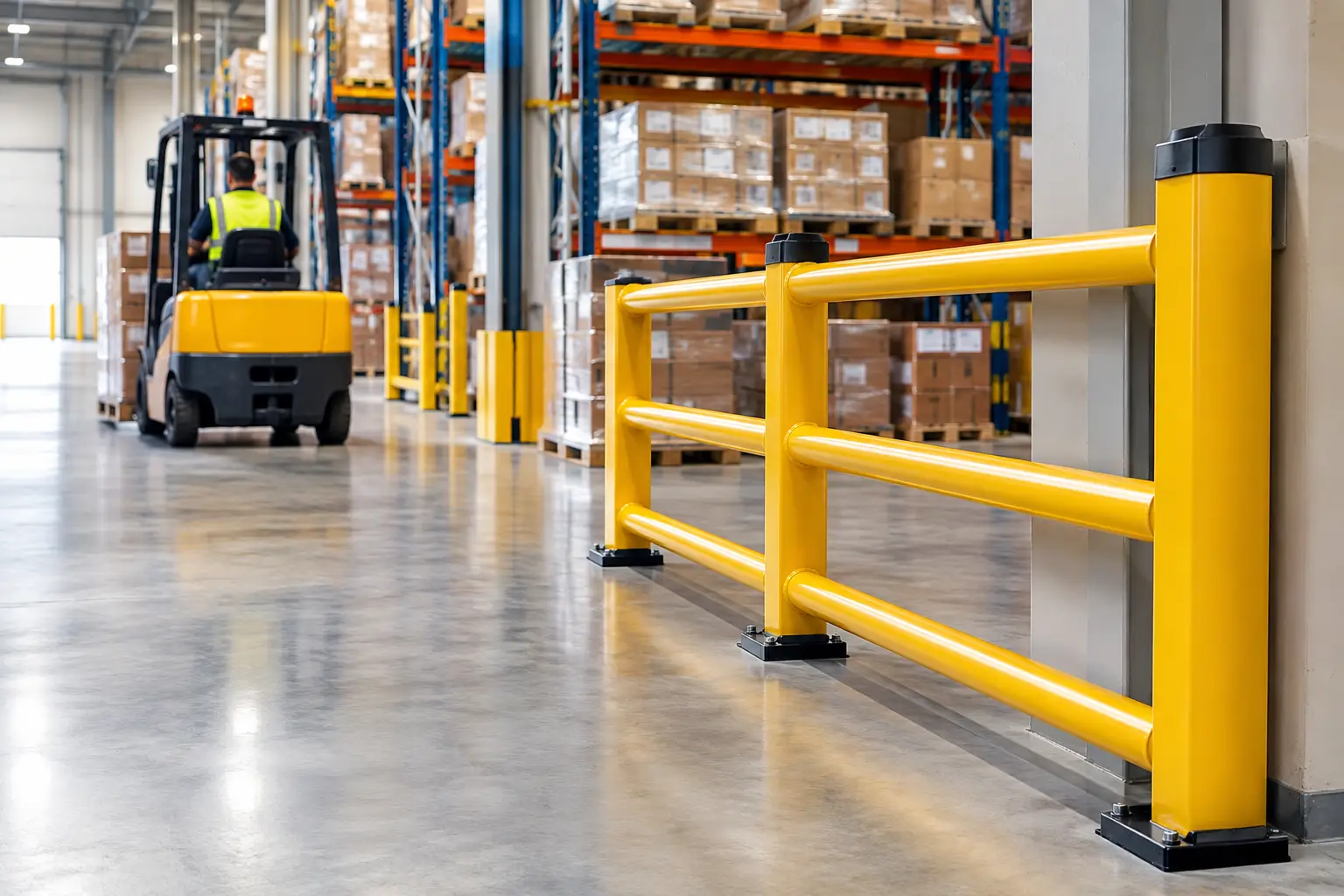
A forklift clips a rack upright near the end of a shift. The visible damage may look minor, but the incident can compromise a storage system, disrupt inventory access, and create a serious risk for employees working below. The best warehouse safety barriers are selected to prevent this type of event before it affects people, product, or throughput.
Barrier selection is not simply a purchasing decision. It is a facility design decision that must account for vehicle speed, load weights, aisle geometry, rack layout, pedestrian traffic, dock activity, and the consequences of an impact. A barrier that performs well at a pedestrian crossing may be the wrong solution for a high-traffic reach truck aisle. The objective is to control risk without creating new constraints on material flow.
Start With the Hazard, Not the Product
Warehouse safety barriers should be specified around the hazard they are intended to control. Facilities often begin with a catalog of bollards, guardrails, rack guards, and gates. A more effective approach begins with an assessment of where equipment and people can conflict, what is exposed to impact, and how operations move through the space.
Review incident history, near-miss reports, equipment routes, and shift-specific traffic patterns. A daytime walkthrough may not reveal the congestion created during replenishment, peak shipping periods, or maintenance activity. Look closely at blind intersections, travel lanes near staging areas, battery charging rooms, end-of-aisle rack positions, dock approaches, and pedestrian entrances.
The severity of a potential impact matters as much as the likelihood. A low-speed pallet jack contact at a protected office doorway requires a different control than a loaded counterbalance forklift operating beside rack-supported equipment. This is why a consistent facility-wide barrier standard is useful, but a one-size-fits-all barrier plan is not.
Best Warehouse Safety Barriers by Application
The best warehouse safety barriers typically combine several barrier types across the building. Each has a defined role in separating people, vehicles, and critical infrastructure.
Rack-End and Upright Protection
Rack ends are among the most frequently struck components in a warehouse. They sit at the edge of travel lanes, turning zones, and staging areas where forklifts need clearance to maneuver. Rack-end barriers and column-style rack protectors help absorb or deflect incidental contact before force reaches the rack structure.
For exposed rack uprights, select protection that matches the rack configuration and operating equipment. A small formed-steel upright guard may be appropriate for limited exposure, while heavy-duty end-of-aisle protection may be required where forklifts turn with elevated loads or travel at higher speeds. Protection should not interfere with pallet placement, base plates, seismic bracing, or required inspection access.
It is also essential to distinguish between rack protection and rack repair. If an upright has already been damaged, adding a guard does not restore its structural capacity. The rack must be evaluated and repaired or replaced as needed before protection is installed.
Pedestrian Guardrails and Safety Gates
Pedestrian barriers create a physical separation between employees and powered industrial trucks. Painted walkways, floor markings, and signs are useful visual controls, but they do not stop a forklift from entering a pedestrian area. Guardrails, handrails, and controlled crossing gates provide a more dependable layer of protection where foot traffic and equipment traffic operate close together.
Guardrail systems are particularly effective around work cells, packing stations, offices, break rooms, battery charging areas, and maintenance spaces. The design should include sufficient clearance so pedestrians are not forced into travel lanes when doors open, materials accumulate, or two people pass each other.
At designated crossings, self-closing or interlocked safety gates can help control entry into active equipment zones. Gate placement must support the actual work sequence. If a gate adds unnecessary travel or slows a commonly used route, employees may bypass it. The safest design is one that supports compliant behavior during a busy shift.
Heavy-Duty Bollards
Bollards protect fixed assets that cannot be moved out of harm's way. Common applications include building columns, fire protection equipment, electrical panels, dock doors, refrigeration equipment, racking corners, and facility entrances.
The key specification is not the bollard's appearance. It is its ability to withstand the expected impact. Consider whether the bollard is surface-mounted, core-drilled, or embedded in concrete; the condition and thickness of the existing slab; vehicle type and speed; and the required stand-off distance from the protected asset. A poorly anchored bollard can fail under an impact that the post itself might otherwise withstand.
Bollards also need to be located carefully. Placing them too close to a door, control panel, or column can leave insufficient room for access and maintenance. Placing them too far away can reduce usable aisle width or create a snag point for operators.
Machine and Conveyor Protection
Conveyors, sortation equipment, automated storage systems, robotics, and control panels require protection tailored to their operating envelope. A fixed guardrail may protect a conveyor drive assembly, but it cannot obstruct maintenance access, emergency stops, or automated equipment travel.
For automation areas, barrier design should be coordinated with the equipment supplier, controls layout, safeguarding requirements, and maintenance plan. This is especially important when a facility is adding automation into an existing building with legacy rack layouts and tight clearances. The barrier package should support safe access, not become an obstacle to recovery, troubleshooting, or preventive maintenance.
Dock and Exterior Traffic Barriers
Loading docks concentrate vehicle movement, trailer activity, pedestrians, and building infrastructure in a confined area. Barriers may be needed to protect dock door frames, trailer restraint controls, personnel doors, propane storage, charging infrastructure, and exterior building corners.
Exterior systems must also account for weather, drainage, snow removal, trailer swing paths, and truck turning radii. A barrier placed without considering these conditions may be damaged repeatedly or create a new restriction for yard operations. At docks, the most effective protection plan is coordinated with the full traffic pattern, from yard entry through trailer departure.
Match Barrier Capacity to Operating Conditions
Barrier performance should be evaluated against credible impact scenarios, not assumed from material thickness alone. Steel construction is common, but the system's resistance depends on its geometry, mounting method, connection details, foundation conditions, and the direction of impact.
A facility operating electric walkie pallet jacks at low speed has different requirements than a distribution center using high-capacity forklifts around dense pallet storage. Cold storage also introduces considerations around floor penetrations, insulated slabs, condensation, and materials that can tolerate low-temperature conditions. Food and pharmaceutical environments may require finishes and configurations that support sanitation and cleaning protocols.
Ask suppliers and project teams for clear information on intended use, impact performance, anchorage requirements, and installation limitations. Where exposure is high or the protected asset is business-critical, an engineered solution is often warranted. This can include verification of slab capacity, anchorage design, and clearances around racks, doors, and utilities.
Avoid Common Barrier Planning Failures
Many barrier programs underperform because they are installed after damage occurs, one location at a time. This reactive approach can produce inconsistent protection levels and a patchwork of barriers that narrows aisles, obstructs access, or complicates future layout changes.
Another common failure is relying on visual controls where physical separation is needed. Floor striping and signs reinforce safe behavior, but they are not substitutes for barriers in areas with regular vehicle-pedestrian interaction. Conversely, overusing fixed barriers can reduce flexibility in staging zones and make it harder to adapt to seasonal volume changes.
Installation quality is equally important. Anchors must be installed to the specified depth and torque, base plates must sit on suitable concrete, and layouts must be verified before drilling. Field changes should be reviewed against operational clearances, fire protection access, egress paths, and rack inspection requirements.
Build Barrier Planning Into Facility Projects
The right time to plan safety barriers is during layout design, not after equipment is operating. New construction, rack reconfiguration, automation installation, and facility relocations all create an opportunity to integrate protection with the operating plan. Coordinating barriers with racking, equipment routes, slab work, electrical systems, and fire protection reduces rework and helps preserve throughput at startup.
For existing facilities, a phased approach can control disruption. Prioritize high-severity exposure points first, then address recurring damage locations and pedestrian conflict zones during planned maintenance windows. A single accountable project team can coordinate assessment, layout, product selection, installation, and post-installation verification across the facility.
MTLI Group supports this type of integrated execution by connecting warehouse infrastructure, racking, material handling equipment, and installation scope under one project plan. The benefit is not simply fewer vendors. It is better coordination between the barrier system and the facility operations it is meant to protect.
The most effective barrier plan is one employees barely have to think about. It keeps people separated from moving equipment, protects the assets that keep orders moving, and fits the real conditions of the floor without slowing the operation down.