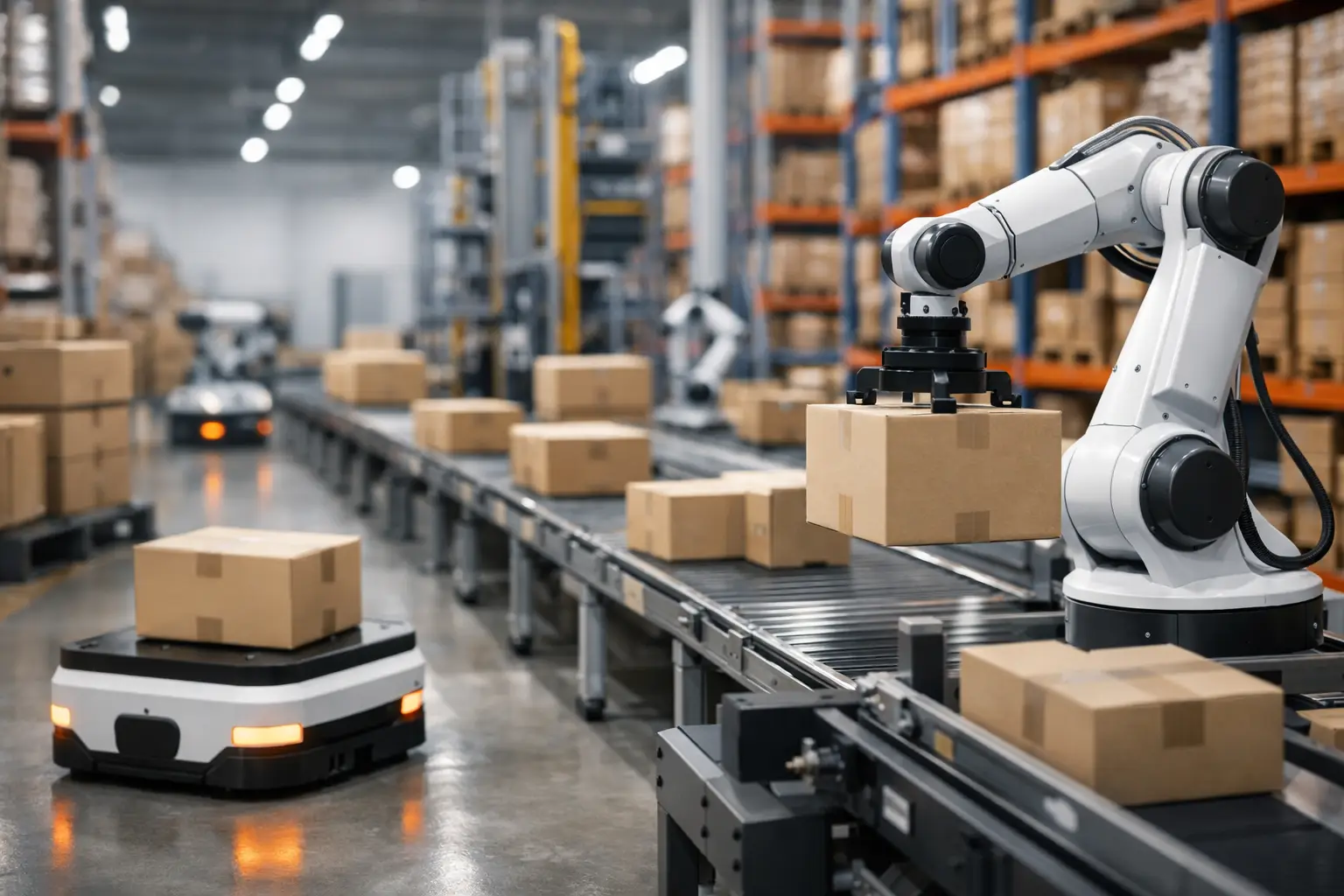
A warehouse can add labor, overtime, and shifts for only so long before the building itself becomes the constraint. Travel time expands, staging areas fill, picking errors rise, and maintenance windows become harder to find. The best warehouse automation technologies address those specific operating constraints, but the right investment is rarely the most advanced machine on the market. It is the system that improves flow without creating a new bottleneck upstream, downstream, or inside the facility.
For distribution, manufacturing, 3PL, and fulfillment operations, automation decisions should begin with measurable requirements: order profiles, peak volumes, SKU velocity, pallet dimensions, labor availability, service-level commitments, and expected growth. Technology selection follows that analysis. A high-throughput e-commerce operation has different needs than a food and beverage distributor handling full pallets, just as a plant warehouse faces different integration demands than a greenfield fulfillment center.
What Makes Warehouse Automation Worth the Investment
Automation produces value when it removes non-value-added handling, increases repeatability, improves inventory control, or allows more productive use of available cubic space. The benefits are not limited to labor reduction. In many facilities, the stronger business case is better throughput during peak periods, safer movement of heavy loads, fewer shipping errors, and less disruption from labor turnover.
Capital cost, operating cost, and facility readiness need to be evaluated together. A system with an attractive productivity model can fail to deliver if floor conditions, clear heights, fire protection, power distribution, network coverage, or material flow paths were not addressed during project planning. The technology is only one part of the operating system.
Best Warehouse Automation Technologies by Application
Warehouse Management and Execution Software
Warehouse management systems (WMS), warehouse control systems (WCS), and warehouse execution systems (WES) provide the operating logic behind modern material flow. A WMS directs inventory, work assignments, replenishment, and fulfillment processes. A WCS manages equipment-level communication, while a WES helps balance labor, orders, and automated assets in real time.
Software is often the first priority because it establishes accurate inventory and clear process rules before equipment is added. It also becomes essential when conveyors, sortation, mobile robots, automated storage, and picking technologies must work as one operation. The trade-off is implementation discipline. Poor item master data, inconsistent location control, or undefined exception processes will limit results regardless of the platform selected.
Conveyor and Sortation Systems
Conveyors remain one of the most effective technologies for predictable, high-volume movement. They reduce repetitive travel between receiving, storage, picking, packing, shipping, and production areas. Sortation systems add routing capability for cartons, totes, parcels, and cases based on destination, order, carrier, or shipping lane.
These systems are a strong fit where product flow is stable and throughput is sustained. They are particularly useful in parcel fulfillment, retail distribution, and manufacturing environments with repeatable handoff points. Their limitation is fixed infrastructure. If product profiles, routing patterns, or building layouts change frequently, a heavily conveyorized design may be less flexible than mobile automation. Controls design, accumulation, merge logic, guarding, maintenance access, and contingency routing require careful engineering.
Autonomous Mobile Robots
Autonomous mobile robots, commonly called AMRs, move materials using onboard sensors, navigation software, and fleet-management controls. They can transport totes, carts, pallets, or specialized payloads between work areas without fixed guide paths. Common uses include goods-to-person picking, replenishment, line-side delivery, returns processing, and movement of finished goods to staging.
AMRs are often selected for their flexibility. They can be deployed in phases, rerouted as workflows change, and added as volume grows. That flexibility makes them well suited to operations with variable demand or facilities where permanent conveyor installation would disrupt existing processes.
However, AMRs are not automatically the best answer for every travel problem. Fleet performance depends on aisle widths, pedestrian traffic, travel distances, charging strategy, floor quality, Wi-Fi coverage, and clear rules for exceptions. A facility with constant, high-speed carton flow may still achieve better results with conveyor and sortation. In many operations, the strongest design uses both.
Automated Storage and Retrieval Systems
Automated storage and retrieval systems, or AS/RS, use cranes, shuttles, lifts, carousels, or robotic vehicles to store and retrieve inventory from dense storage locations. Configurations range from pallet-load systems for reserve storage to tote- and bin-based systems that feed piece-picking workstations.
AS/RS is especially valuable where space is constrained, inventory is high value, storage density matters, or consistent access to inventory is required. It can support cold storage, pharmaceutical distribution, parts operations, high-volume e-commerce, and manufacturing component storage. By building vertically and reducing aisle requirements, it can substantially improve cubic-space utilization.
The trade-off is a higher level of system dependency. Equipment availability, redundancy, controls architecture, spare parts, and service response must be planned from the start. A dense automated system should also include practical recovery procedures for power interruptions, inventory exceptions, and equipment downtime. The goal is not simply density. It is density that remains accessible and productive under real operating conditions.
Goods-to-Person Picking Systems
Goods-to-person systems bring inventory to a stationary operator rather than requiring associates to travel through the warehouse. They may use AMRs, shuttles, vertical lift modules, carousels, mini-load systems, or automated tote storage. The approach can significantly reduce walking time, which is often the largest hidden cost in manual piece-picking operations.
This technology fits operations with a large number of order lines, fast-moving SKUs, and significant labor spent traveling between locations. It can improve pick rates and ergonomics while creating more controlled picking zones. The system design must account for replenishment capacity, workstation layout, cartonization, dunnage, quality checks, and downstream pack-out. Improving pick speed only shifts the problem if packing and shipping cannot absorb the added volume.
Robotic Picking, Palletizing, and Depalletizing
Robotic arms and vision systems are increasingly used for repetitive handling tasks, including case picking, palletizing, depalletizing, induction, singulation, and packaging. They are most effective when product dimensions, weights, orientations, and handling rules are sufficiently consistent for reliable operation.
Palletizing is often a practical starting point because the work is repetitive, physically demanding, and easier to define than mixed-SKU order picking. Depalletizing and piece picking can deliver major value, but they require more detailed analysis of package variability, label placement, surface conditions, and exception rates. A robot that handles 90 percent of cases well still needs a plan for the remaining 10 percent.
Dimensioning, Weighing, Scanning, and Vision Technology
Automated dimensioning, weighing, scanning, print-and-apply, and machine vision systems improve the accuracy of receiving, packing, shipping, and quality control. These technologies are often less visible than mobile robots or AS/RS, yet they can produce immediate operational gains by reducing manual data entry, shipping charge errors, mislabels, and inventory discrepancies.
For parcel and e-commerce operations, accurate dimensions and weights can directly affect carrier cost control. For manufacturing and regulated environments, scanning and vision can improve traceability and verification. These systems work best when they are integrated into defined process points rather than added as isolated equipment.
Selecting Technology Around the Facility, Not Just the Process
The automation plan must account for the building. Clear height, slab condition, column spacing, dock configuration, rack layout, egress, fire protection, electrical capacity, and network infrastructure all affect what can be installed and how quickly the facility can return to full operation. In occupied buildings, phasing is equally critical. A technically sound system can still create unacceptable risk if installation blocks shipping lanes or takes inventory out of service during peak season.
A turnkey project approach helps align construction, storage systems, material handling equipment, controls, installation, commissioning, and facility support under one accountable delivery plan. For complex projects, this reduces handoff gaps between building modifications and automation integration. MTLI Group applies this coordinated execution model to help clients modernize facilities while protecting continuity of operations.
Build the Business Case in Phases
Not every operation needs a full-scale automated fulfillment center. A phased plan may start with WMS improvements, slotting changes, barcode verification, and targeted conveyor or AMR deployment. The next phase can add goods-to-person picking, automated storage, or robotics once demand, process stability, and operating data support the investment.
The business case should measure more than labor savings. Include throughput at peak, order cycle time, shipping accuracy, storage capacity, safety exposure, maintenance requirements, expected asset life, and the cost of disruption during implementation. Define the baseline before procurement, then establish acceptance criteria for commissioning and post-launch performance.
The best automation program is one that gives the operation more control as volume changes. Start with the constraint that is costing the most time, capacity, or service risk, then design the technology, facility work, and implementation sequence around solving it without compromising the rest of the operation.