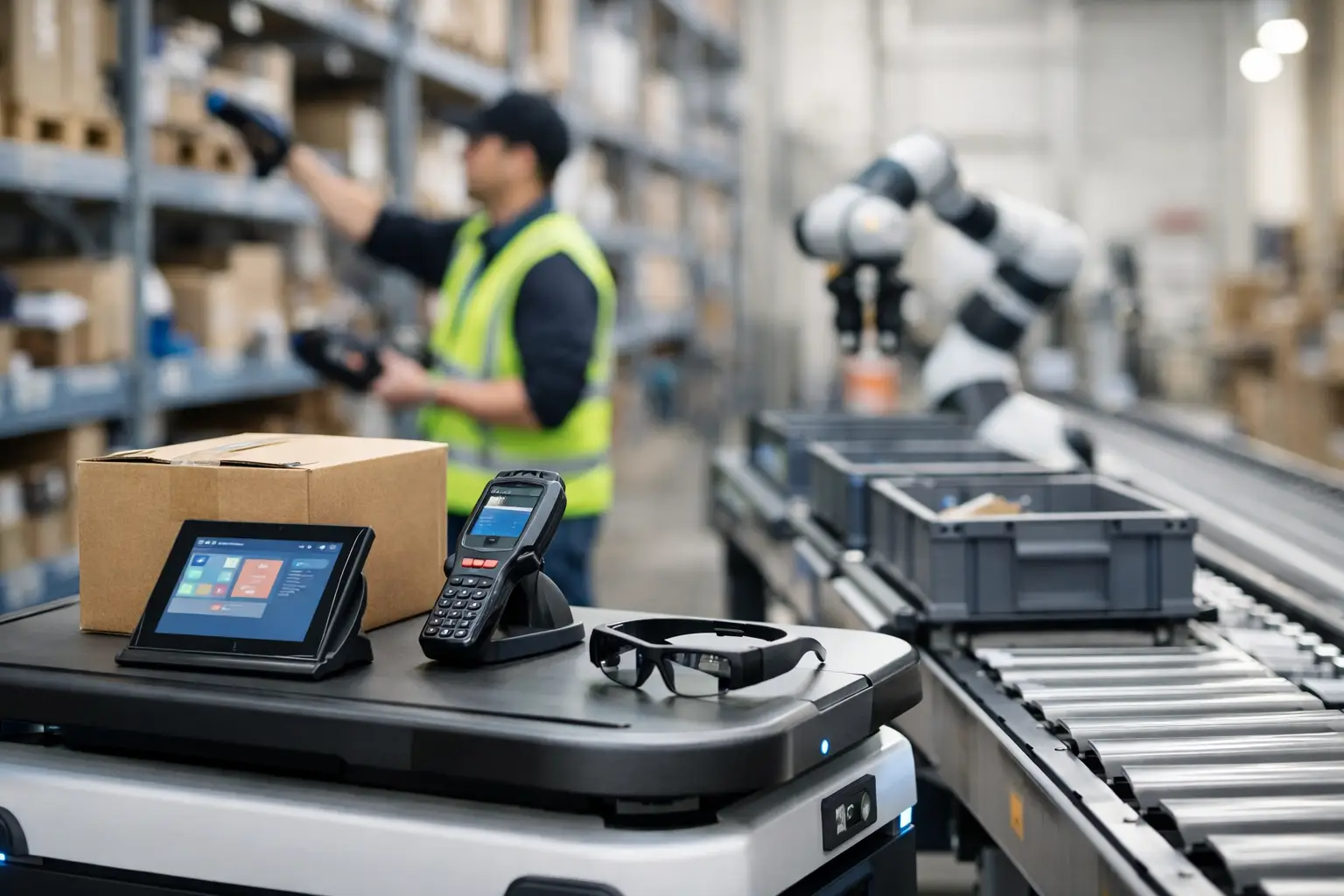
A picker walking miles per shift to complete low-line orders is not simply a labor issue. It is a material flow, slotting, and technology-fit issue. The best order picking technologies reduce unproductive travel, guide associates to the correct inventory, and support dependable throughput as order volume, SKU counts, and customer expectations change.
For warehouse and distribution leaders, the right answer is rarely a single technology. A practical picking strategy combines the appropriate picking method, storage system, software controls, replenishment process, and building infrastructure. The objective is not to automate every movement. It is to remove the constraints that create errors, congestion, and missed shipping windows without introducing unnecessary operational risk.
What Makes an Order Picking Technology Effective?
Picking technology should be evaluated against the work it must perform, not its novelty. A system that performs well in a high-volume e-commerce fulfillment center may be a poor fit for a pallet distribution operation, a cold storage facility, or a manufacturing parts warehouse.
Start with order profile. Consider lines per order, units per line, SKU velocity, item size and weight, seasonality, required service levels, and the percentage of eaches, cases, and pallets moving through the facility. Also assess the existing building. Clear height, floor condition, rack layout, fire protection, power availability, wireless coverage, and available staging space all affect implementation options.
The business case must account for more than pick rate. Accuracy, training time, labor availability, ergonomics, maintenance requirements, system redundancy, and the ability to operate during peak demand are equally material. In many operations, a lower-cost solution that can be deployed quickly and maintained by the site team creates more value than a highly complex system with a long commissioning period.
Best Order Picking Technologies by Operating Need
RF Scanning and Mobile Picking
Radio-frequency scanning remains one of the most widely applicable picking technologies. Associates receive tasks through handheld or wearable devices, scan locations and items, and receive confirmation before moving to the next task. It provides real-time inventory validation and a strong foundation for directed picking, replenishment, cycle counting, and exception management.
RF is often the right starting point for facilities moving away from paper pick tickets or disconnected processes. It works across case, pallet, and each-pick operations, and it can support batch, zone, and wave picking strategies. Its limitations are straightforward: pickers still rely on screens, travel remains substantial in conventional layouts, and device handling can slow work where picks are frequent and hands need to remain free.
Voice-Directed Picking
Voice systems direct the picker through a headset and confirm tasks through spoken responses. Because associates do not need to read a screen or manage a handheld device at every pick, voice can improve focus and support hands-free work. It is particularly useful for high-travel case picking, freezer applications, and operations where workers handle bulky or awkward products.
Voice is not automatically faster in every environment. Noise levels, multilingual workforce requirements, user acceptance, and integration quality need careful planning. Organizations should also validate how the system handles exceptions, such as short picks, damaged product, or inventory found in the wrong location. When deployed with disciplined location labeling and warehouse management system logic, voice can produce meaningful accuracy and productivity gains.
Pick-to-Light and Put-to-Light Systems
Light-directed systems use illuminated modules at pick or put locations to show the associate where to work and how many units to handle. Pick-to-light is effective in dense, high-volume pick faces with repeatable activity, such as fast-moving eaches, kitting components, or small-parts fulfillment. Confirmation buttons create an immediate verification point and can reduce training time for new workers.
Put-to-light is commonly used after batch picking. An associate picks a group of items, then distributes them to order positions indicated by lights. This approach can increase efficiency when many small orders share common SKUs.
The trade-off is physical infrastructure. Light systems require controls, modules, wiring or wireless hardware, maintenance access, and a pick-face design that supports stable product locations. They are best applied selectively to high-velocity areas rather than across every storage location in a large warehouse.
Vision Picking and Wearable Devices
Vision picking uses smart glasses or head-mounted displays to provide visual directions and confirmation prompts in the associate's field of view. Wearable scanners, ring scanners, and wrist-mounted computers can deliver many of the same hands-free advantages without a full visual display.
These technologies can support complex workflows where a picker needs to see item images, quality instructions, or serial-number information. They may also reduce time spent looking between a device, location label, and product. However, comfort, battery life, device durability, cleaning protocols, and user adoption must be tested under actual operating conditions. A pilot should include full shifts and representative order volume, not just a controlled demonstration.
Autonomous Mobile Robots
Autonomous mobile robots, or AMRs, reduce walking by bringing carts, totes, or shelving to associates, or by following associates through assigned pick zones. They are a flexible option for facilities that need to increase capacity without committing immediately to fixed conveyor infrastructure. AMRs can also be phased into an operation as volume grows.
Their success depends on process design. Robot travel paths, charging areas, traffic rules, pick-station layout, tote handling, and recovery procedures must be established before deployment. A facility with narrow aisles, poor floor conditions, unstable Wi-Fi, or significant forklift traffic may need building or operational modifications first. AMRs address travel time well, but they do not correct poor inventory accuracy, weak replenishment discipline, or inefficient slotting.
Goods-to-Person Automation
Goods-to-person systems bring inventory to a stationary operator through automated storage and retrieval systems, vertical lift modules, horizontal carousels, shuttle systems, or robotic storage solutions. By removing most picker travel, these systems can deliver high throughput, dense storage, and stronger ergonomic control for suitable products.
This category requires the most disciplined planning because it has the greatest impact on facility design, controls integration, fire protection, electrical service, mezzanines, and material flow. It is often justified for high-volume each-picking, small-item storage, controlled inventory, and operations with significant labor constraints. It may not be the best investment for widely variable product dimensions, low order density, or facilities that require frequent changes to inventory profiles.
Pair Technology With the Right Picking Method
Technology performs best when paired with a deliberate operating method. Discrete picking works well for lower order volume or large orders. Batch picking reduces travel when multiple orders contain similar SKUs. Zone picking assigns associates or automation to defined areas, while wave picking releases work based on carrier cutoff times, labor availability, or shipping priorities.
The selection process should include a travel and throughput analysis that maps receiving, replenishment, reserve storage, forward pick locations, packing, and shipping. A new picking device will have limited impact if fast-moving inventory is poorly slotted or replenishment blocks active pick aisles. Likewise, goods-to-person automation can underperform if downstream packing stations cannot absorb its output.
A Practical Technology Selection Process
Before committing capital, establish a baseline using actual data. Measure picks per labor hour, lines per hour, order accuracy, travel distance, replenishment interruptions, congestion points, and shipping cutoff performance. Segment the analysis by product family and order type. Averages can hide the process conditions that drive most overtime and service failures.
Then develop several future-state concepts, including process improvements that require little or no automation. Re-slotting high-velocity SKUs, changing carton flow, adding forward pick faces, or revising replenishment timing may create immediate gains and clarify where automation has the strongest case.
For larger projects, the design must cover more than equipment. Confirm software interfaces, network requirements, rack and storage configuration, power, controls, safety guarding, egress, permitting, installation sequencing, operator training, and contingency procedures. Commissioning should include peak-volume scenarios and planned failure modes, not only standard transactions.
A turnkey approach can reduce coordination risk when a project involves building modifications, racking, automation, and operational cutover. One accountable execution team can align the physical facility with the equipment and controls required to keep the operation running with minimal disruption.
The best investment is the one that makes the next shift more predictable while preserving room for the operation that follows. Begin with the constraints that cost the most time and create the greatest service risk, then build a picking system that can scale without forcing the warehouse into a process it cannot reliably sustain.