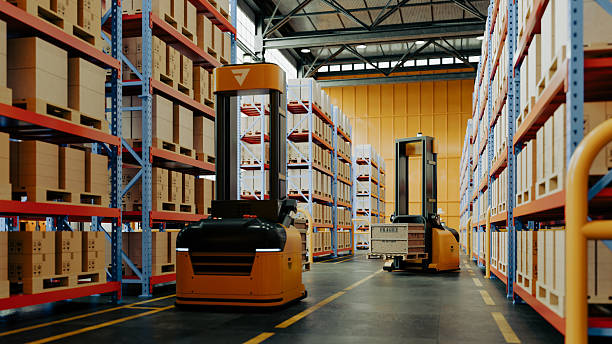
Warehouse automation decisions used to come down to a fairly simple question: manual labor or a fixed conveyor system. Today, one of the most common questions operations managers ask is AMR vs AGV, or more specifically, which type of mobile robot fits their facility best. Both technologies move materials without a human driver, but the AMR vs AGV comparison comes down to how each one navigates, and picking the wrong one can mean paying for flexibility you don't need or missing flexibility you do.
MTLI Group's technical automation teams work through this exact tradeoff with operations groups across the US on a regular basis. This blog walks through how warehouse systems actually differ, where each performs best, and how to land on the right answer for your operation.
AMR vs AGV: The Core Difference in Navigation
The AMR vs. AGV question starts with how each vehicle finds its way around a building. AGV warehouse systems follow a fixed path, typically defined by magnetic tape, embedded wires, or floor-mounted markers. Remove or damage that infrastructure, and the vehicle stops working. This makes AGVs predictable and well suited to repetitive, high-volume routes that rarely change, although they may require more frequent automated system maintenance as facilities update or repair their navigation infrastructure.
Autonomous mobile robots take a different approach entirely. They use onboard sensors, cameras, and mapping software to navigate a facility without fixed infrastructure, adjusting their path in real time if an obstacle appears or the layout changes overnight. This adaptability is the defining trait of mobile robots and the main reason many facilities choose them over traditional guided systems.
Safety Requirements Apply to Both Technologies
Both categories of equipment fall under a shared safety framework once they share floor space with people. Facilities running either AMR fleets or warehouse systems need documented procedures, marked pedestrian pathways, and staff trained on how to interact with automated equipment moving through the aisles. Getting this right matters as much as picking the technology itself, since a poorly planned rollout of either system creates the same hazards regardless of which one you chose.
Where AGV Warehouse Systems Deliver the Most Value
AGV warehouse systems have been in commercial use for decades, and they remain a strong fit for specific, well-defined operational patterns.
High-volume, repetitive routes are the classic use case. A facility moving pallets between the same receiving dock and the same storage zone thousands of times a day benefits from the predictability and lower per-unit cost that a guided vehicle offers over a more adaptive robot. Facilities with stable layouts get the most out of this kind of investment, since any change to the floor plan, a new storage zone or a relocated dock door, means reworking the guide path itself.
Heavier, more consistent loads often favor AGV platforms too, since many models are purpose-built around specific load types and weights, an area where MTLI Group's AGV systems integration work focuses heavily on matching equipment to actual load data rather than manufacturer defaults.
Where Mobile Robots Make More Sense
Autonomous mobile robots address a different set of challenges, particularly in facilities that need to adapt on short notice. Frequently changing layouts favor mobile robots over warehouse systems, since facilities that reshot inventory seasonally, open new pick zones, or shift operations for promotional volume benefit from a robot that reroutes itself in software rather than requiring new floor infrastructure.
Mixed and variable order profiles work well with mobile robots for the same reason. The robots adjust their paths dynamically based on current order data instead of following one fixed route regardless of what a given shift order actually looks like. This is where MTLI Group's autonomous mobile robot deployment services tend to get involved earliest, since fleet sizing and mapping decisions made at the outset shape performance for years afterward.
The table below summarizes how AMR vs AGV decisions typically play out across the factors operations managers weigh most.
| Factor | AGV Warehouse Systems | Autonomous Mobile Robots |
|---|---|---|
| Navigation method | Fixed paths (wire, tape, markers) | Dynamic mapping and sensor-based navigation |
| Layout flexibility | Low, requires new infrastructure for route changes | High, adapts to layout changes without reprogramming |
| Best fit | Stable, high-volume, repetitive routes | Variable order profiles and changing layouts |
| Upfront infrastructure cost | Higher, due to guide path installation | Lower, minimal fixed infrastructure required |
| Scalability | Requires planning for guide path expansion | Easier to add units incrementally |
| Typical load handling | Often built for specific, consistent loads | Varies by model, generally more flexible |
Why the AMR vs AGV Decision Carries More Weight in 2026
Labor availability is a big part of why this decision matters more now than it did a few years ago. According to the U.S. Bureau of Labor Statistics, employment of material moving machine operators is projected to grow just 1 percent from 2024 to 2034, slower than the average for all occupations, even as roughly 83,200 openings are expected each year due to workforce turnover. That gap between flat employment growth and steady turnover is exactly the pressure pushing many operations toward mobile robots and warehouse systems alike.
Adoption data backs up how fast this shift is happening. The International Federation of Robotics reported that industrial robot installations in the United States rose 11 percent year-on-year to reach 38,000 units in 2025, with growth driven partly by non-manufacturing sectors including warehousing and logistics. Facilities weighing AMR vs AGV today are entering a market where both technologies are maturing quickly.
Hybrid Deployments: Using AMR and AGV Systems Together
Many facilities do not need to be chosen exclusively between the two. A hybrid deployment puts warehouse systems on stable, high-volume routes and mobile robots on tasks where flexibility matters more, letting each technology do the job it handles best. A pharmaceutical distribution operation illustrates this well, since a core replenishment route between receiving and bulk storage often stays fixed year-round for compliance reasons, while the picking side of the operation needs mobile robots to keep up with order composition that shifts daily.
Automotive parts distribution shows a similar split, where high-volume, predictable lanes favor warehouse systems while variable; just-in-time order handling favors the flexibility of mobile robots.
Total Cost Considerations Beyond the Sticker Price
The AMR vs AGV comparison often starts with upfront cost, but a full evaluation needs to weigh a few additional factors that show up over the life of the system. Infrastructure investment for warehouse systems includes the guide path installation itself, which adds cost and lead time before the system goes live. Autonomous mobile robots typically need less physical infrastructure, though facilities still need to plan for adequate wireless connectivity and mapping setup during commissioning.
Reconfiguration cost becomes relevant at the moment when a facility's layout changes. AGV guide paths require physical rework, while mobile robots generally adjust through a software update. This is a common consideration during a facility expansion or renovation project, since new square footage often changes the calculus between the two technologies entirely.
A Short Checklist Before Choosing Between AMR and AGV
Operations managers preparing to settle the AMR vs AGV question benefit from working through a short set of questions before committing capital to either direction. How often does the facility layout change, and how disruptive would reconfigure a fixed guide path actually be? How variable is the daily order profile, and does that variability justify the added flexibility of mobile robots?
What is the facility's growth trajectory over the next three to five years, and does the chosen technology scale easily to match it? Facilities weighing a move to a larger or differently configured building sometimes find that a warehouse relocation is the better moment to introduce mobile robots, since starting fresh avoids retrofitting guide-path infrastructure into an existing layout.
Cold Storage and Temperature-Controlled Considerations
Cold storage facilities raise a specific wrinkle in the AMR vs AGV conversation. Battery performance in both warehouse systems can degrade faster in low-temperature environments, and sensor accuracy on autonomous mobile robots can also be affected by condensation and frost. Facilities operating temperature-controlled storage should factor equipment specifications rated for their specific temperature range into the AMR vs AGV decision rather than assuming standard models will perform the same way they do in an ambient warehouse.
Settling the AMR vs AGV Question for Your Facility
The AMR vs AGV decision does not have one universal right answer. AGV warehouse systems remain a strong, cost-effective fit for stable, high-volume, repetitive routes, while autonomous mobile robots offer the adaptability that variable order profiles and changing layouts demand. Many operations find that a hybrid approach, running each technology where it performs best, delivers stronger results than committing entirely to one side of the AMR vs AGV comparison.
MTLI Group helps operations teams work through this exact decision, from initial site assessment through installation. Contact MTLI Group to talk through which mix of AMR and AGV technology fits your facility or find your nearest MTLI Group location to speak with a regional team directly.