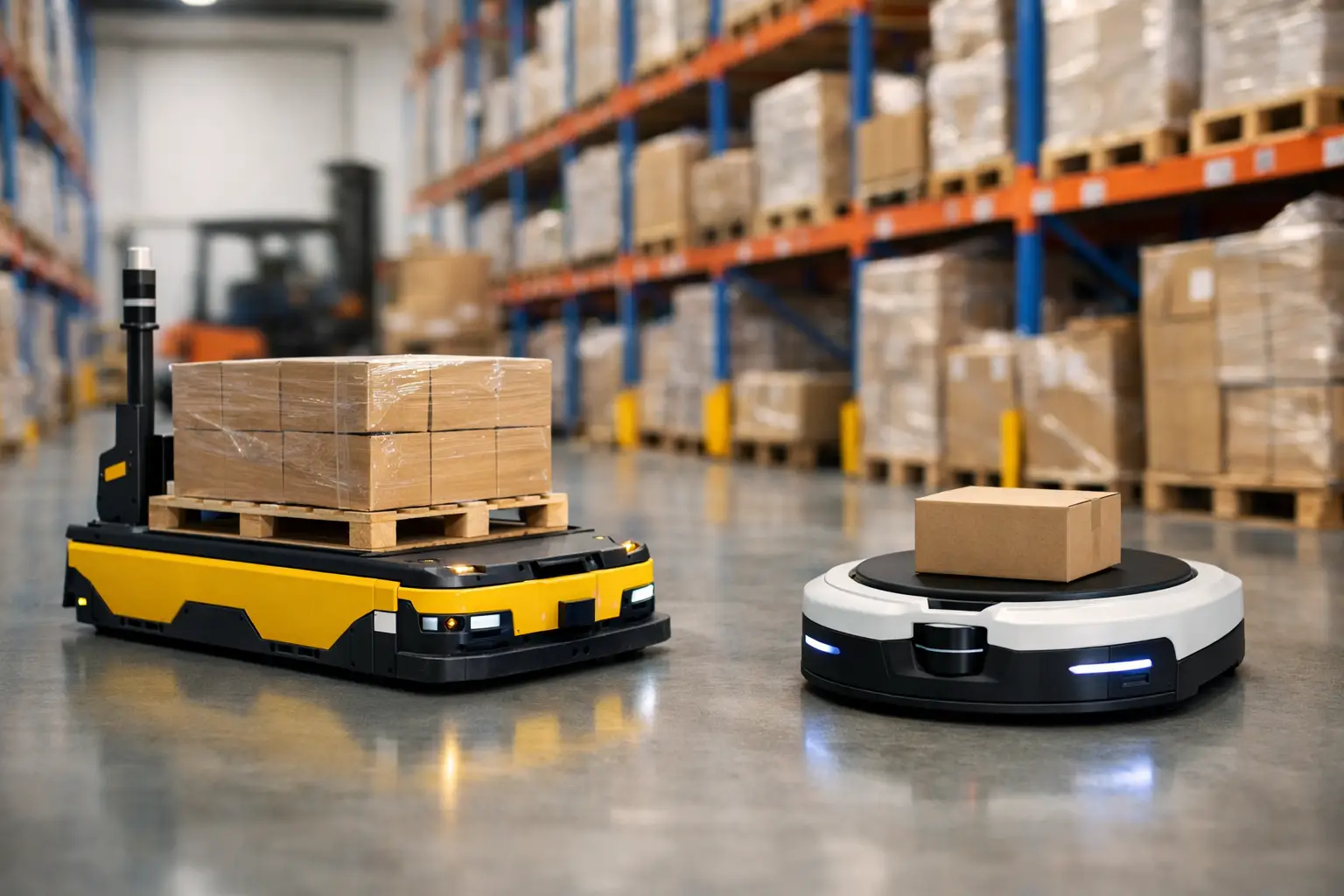
A warehouse automation decision can look straightforward until the equipment has to operate around production changes, seasonal volume swings, pedestrian traffic, and an active installation schedule. The question of agvs versus amrs is not simply which vehicle is more advanced. It is which operating model can move material reliably within the constraints of your facility, process, labor plan, and capital program.
AGVs and AMRs both reduce manual travel, support more consistent material movement, and help operations scale without adding the same level of labor to every incremental increase in throughput. Their differences are meaningful, however, particularly when an operation is retrofitting an occupied building or integrating vehicles with conveyors, racking, workstations, and warehouse management systems.
AGVs Versus AMRs: The Core Difference
Automated guided vehicles, or AGVs, follow defined travel paths. Those paths may be established through floor-mounted wire, magnetic tape, QR codes, reflectors, lasers, or other guidance methods. The vehicle is programmed to travel within that controlled route network, making AGVs well suited for repeatable point-to-point movement.
Autonomous mobile robots, or AMRs, use onboard sensors, mapping, and software to navigate their environment. Rather than relying exclusively on a fixed guide path, an AMR can calculate a route to its destination and reroute around many temporary obstructions. It still operates within defined rules, safety zones, and traffic management parameters, but it has more flexibility in how it reaches a task location.
That distinction affects more than the vehicle itself. It changes how aisles are designed, how traffic is managed, how future process changes are handled, and what is required to commission the system safely.
Where AGVs Make Operational Sense
AGVs are often the right fit when material movement is stable, highly repetitive, and predictable. A manufacturing plant moving pallets from a production line to a stretch wrapper, finished-goods staging area, or warehouse location may have clear pickup and drop-off points that do not change often. In that setting, a defined route can be an advantage rather than a limitation.
Their structured movement also makes AGVs appropriate for processes that require tight control. Operations may use them to transport heavy loads, feed assembly lines, move carts through designated production areas, or connect fixed equipment such as conveyors and palletizers. Since the routes are known in advance, operators can design guardrails, crossings, charging areas, and pedestrian separation around the vehicle flow.
AGVs can offer a lower-complexity solution when the facility and workflow already support dedicated travel lanes. They are not automatically less expensive than AMRs, especially where extensive guide-path infrastructure or building modifications are required. But for a stable process with high utilization, their predictable performance can support a strong return on investment.
The trade-off is change management. Moving a station, adding a new destination, or altering a route may require modifications to the guidance system, controls, and safety review. For facilities where layouts change frequently, that work can become a recurring cost and operational disruption.
Where AMRs Provide an Advantage
AMRs are designed for environments where conditions change more often. Distribution centers with variable pick paths, replenishment moves, order consolidation, returns processing, or dynamic staging can benefit from a vehicle that adjusts its route without requiring a physical guide path for every change.
An AMR can detect many obstacles and select an alternate route, reducing the impact of a blocked aisle or temporary work area. This flexibility is valuable in facilities shared by lift trucks, pedestrians, pallet jacks, and other mobile equipment. It does not mean AMRs can operate without disciplined traffic planning. Their performance depends on clear operating rules, well-defined handoff points, reliable wireless coverage, and a layout that gives the robot room to navigate safely.
AMRs are particularly attractive in retrofit projects because they may reduce the need to install wire, tape, or other permanent route infrastructure. A facility can add routes or destinations through software configuration, subject to validation and safety requirements. That can shorten the path from concept to operational use when the building has a changing process or limited downtime window.
The trade-off is that AMRs require thoughtful systems integration. Mapping, fleet management, Wi-Fi design, charging strategy, and interface requirements all need to be addressed early. An AMR fleet that is introduced without adequate staging space or clear task logic can create congestion instead of relieving it.
Evaluate the Process Before Selecting the Vehicle
The vehicle should follow the process design, not the other way around. Before comparing specifications or reviewing vendor proposals, operations teams should document the movement that needs to be automated: load type, weight, dimensions, pickup method, destination, frequency, travel distance, and required cycle time.
A pallet-moving application may require a counterbalanced vehicle, reach capability, fork interface, or conveyor transfer. Cart transport may require a tugger, conveyor-top unit, or custom coupling. Case, tote, and each-pick workflows often call for a different class of AMR and a different interaction with picking stations or sortation equipment. The label AGV or AMR does not determine whether the equipment can complete the task.
Facility conditions are equally important. Floor flatness, joint condition, rack clearances, aisle width, dock activity, door thresholds, temperature, dust, lighting, and wireless coverage can all influence system performance. Cold storage, food and beverage, pharmaceutical, and automotive environments may also introduce sanitation, validation, battery, or material-handling requirements that narrow the available options.
Cost Is More Than Vehicle Price
A direct vehicle-price comparison rarely provides the full financial picture. A sound business case includes infrastructure, controls integration, charging equipment, fleet-management software, safety systems, installation, commissioning, training, spare parts, and ongoing support. It should also account for lost capacity or temporary operating constraints during implementation.
AGVs may require more fixed route infrastructure, while AMRs may require greater investment in network readiness, mapping, and software integration. Either system may require changes to racking, staging, conveyor elevation, doors, fire protection clearances, or pedestrian travel paths. These project elements are often where schedules and budgets are won or lost.
The labor model should be evaluated carefully as well. Mobile automation may reduce travel time and repetitive transport work, but it can shift labor toward exception handling, replenishment coordination, maintenance, and system supervision. The best result is not always the smallest headcount. It is a more productive operation with less non-value-added travel and a more predictable flow of work.
Safety and Traffic Design Cannot Be Added Later
Both AGVs and AMRs use safety-rated sensors and stop functions, but safety performance depends on the entire operating environment. A vehicle cannot compensate for poorly marked crossings, unmanaged lift truck traffic, blocked aisles, or workstations positioned inside travel zones.
A complete plan establishes right-of-way rules, pedestrian crossings, emergency access, speed zones, charging locations, manual recovery procedures, and maintenance access. It also defines how the mobile fleet will interact with fixed automation and facility systems. For example, a vehicle arriving at a conveyor transfer must communicate with the conveyor controls so the load handoff occurs correctly and does not create a downstream backup.
This is why mobile automation projects benefit from one coordinated scope that considers the building, storage system, equipment, controls, and installation sequence together. Changes to any one component can affect the others.
Implementation Strategy for an Operating Facility
Most warehouse leaders cannot pause operations for a full automation installation. The implementation plan should therefore separate design decisions from live cutover decisions. Early planning should verify the current layout, identify utility and network requirements, test vehicle travel in representative conditions, and establish a phased route or zone deployment.
A pilot can be useful when it answers a specific operational question, such as whether vehicles can sustain a required cycle time during peak activity or whether a proposed pickup interface works consistently. A pilot that is isolated from the real process may demonstrate that the vehicle moves, but it will not validate throughput, exception handling, or labor adoption.
Commissioning should include real-world scenarios: obstructed routes, missed pickups, low battery conditions, barcode failures, manual overrides, and system recovery after a network interruption. Supervisors and maintenance personnel need practical training before the fleet becomes part of the daily production plan.
Choosing the Right Path Forward
For stable, repeatable material movement in controlled lanes, AGVs can provide dependable automation with highly predictable travel behavior. For dynamic workflows, changing layouts, and variable travel paths, AMRs can offer greater adaptability. Many larger facilities may use both: AGVs for fixed, high-volume transport and AMRs for flexible movement between changing work areas.
The deciding factor is not the technology label. It is whether the full solution supports safe flow, required throughput, future expansion, and a workable installation plan. Start with the material movement that creates the greatest operational constraint, then design the facility, controls, and support model required to make that movement reliable every shift.